
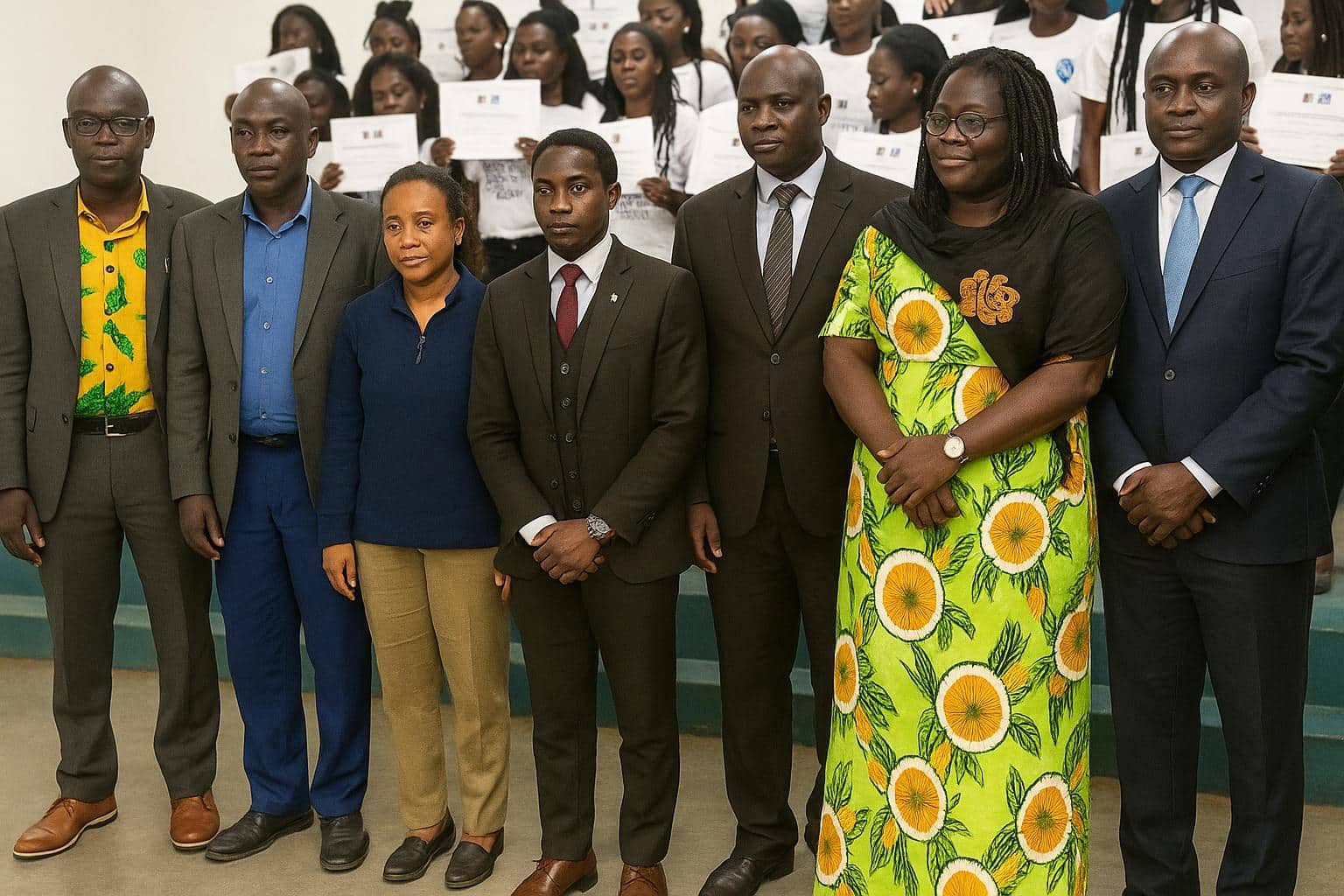
A landmark graduation in Tié-Tié
Pointe-Noire — The brick-walled courtyard of Saint Jean Bosco parish in Tié-Tié felt more like a campus quadrangle than a church on 30 July 2025, as 95 trainees in fresh white shirts waited for their names to be called.
The ceremony marked the graduation of the second cohort of the Professional Training and Integration Programme, known by its French acronym FIP, an initiative targeting vulnerable youth in the economic capital.
Families packed the pews, musicians improvised on tam-tam drums and local officials, led by departmental director for vocational training Marcel Dobele, applauded each certificate recipient, 36 of whom were women.
European and French backing for youth skills
The programme is financed by the European Union and the French Development Agency, with technical steering from the NGO ESSOR and its local partner, the Association of Youth for Innovation in Development, AJID.
According to the EU delegation in Brazzaville, FIP receives €1.8 million over three years to deliver short-cycle courses in plumbing, pastry making, welding, refrigeration and other trades identified as labour-hungry in Pointe-Noire.
AFD country economist Pauline Alima underlines that the grant blends with a concessional line of credit channelled through local microfinance institutions, allowing graduates to access start-up kits and small loans at single-digit interest rates.
Training tailored to Pointe-Noire economy
Curricula were co-designed with chambers of commerce, ensuring that what students learn mirrors the orders currently placed by oil-service firms, construction outfits and the fast-growing catering sector.
Each trainee completed 420 hours of classroom instruction followed by a three-month internship inside a company, a sequence that programme coordinator Nadège Bouity calls essential for “bridging knowledge and real machines”.
Out of the first cohort that finished last year, 61 percent are now in wage jobs while 24 percent have started micro-enterprises, numbers confirmed by an independent tracer study from Brazzaville’s Higher Institute of Statistics.
Graduates share renewed ambitions
Standing at the lectern, pastry student Destiné Ngoma spoke for her peers, thanking ESSOR and AJID for “a training that teaches us to earn, not wait”.
She later told this newspaper that she dreams of opening a small bakery near the beach road, selling coconut brioches to tourists and dockworkers alike, “because Pointe-Noire mornings will always smell of coffee and sea-salt”.
Welder Cédric Mavoungou, whose father lost his job on an offshore platform in 2020, said the course restored his family’s confidence, adding that he received two preliminary offers even before graduation.
The optimism resonated with the crowd; every time a graduate mentioned a plan, parents answered with ululations that echoed beyond the church gate onto Avenue Charles de Gaulle.
Authorities map the path forward
Director Dobele reminded the audience that Congo’s demographic curve means 200,000 youths will enter the labour market each year, urging municipalities to replicate the Tié-Tié model through public-private partnerships.
Rock Mountouari, representing the mayor, announced that the city council has identified idle municipal workshops that could host future cohorts and pledged to exempt certified graduates from certain licensing fees for the first year.
Speaking after the anthem, ESSOR country director Aurélie Mathon confirmed discussions with the Ministry of Technical Education to digitise parts of the curriculum, a move she believes will double FIP’s reach without diluting its hands-on character.
Congo’s youth labour landscape
National Bureau of Statistics surveys put unemployment among 15- to 24-year-olds at 24.5 percent, yet employers in mining logistics lament a scarcity of technicians, illustrating a persistent skills mismatch that programmes like FIP attempt to correct.
Economist Rodrigue Koumba notes that Pointe-Noire’s port expansion and the nearby gas liquefaction project could generate 7,000 direct jobs by 2027, but only if vocational pipelines accelerate, warning that otherwise expatriate labour will fill the void.
Government strategy papers seen by this publication project that 60 percent of future openings will be at technician or supervisor level, underscoring why donors increasingly prioritise competence-based learning over traditional chalk-and-talk.
Faith and community synergy
Holding the event inside a parish is no accident; churches in Congo have long served as neutral meeting grounds where civil society, donors and municipal authorities can converge without bureaucratic friction.
Father Firmin Mvoula, the parish priest, said he offered the nave free of charge because “skills are a form of prayer when they lift a household out of poverty”, a remark greeted with nods from both EU diplomats and local councillors.
In a city where many graduation halls charge prohibitive fees, the gesture symbolised how faith organisations can leverage morale, space and volunteer networks to support national development objectives outlined in the 2022-2026 Plan d’Action Gouvernemental.
As dusk approached, graduates paraded through Tié-Tié’s sandy alleys carrying toolboxes and chef hats, a spontaneous march that residents filmed on mobile phones; videos circulating on WhatsApp received hundreds of congratulatory messages within hours, reflecting the community’s hunger for positive news and pride in homegrown talent.