
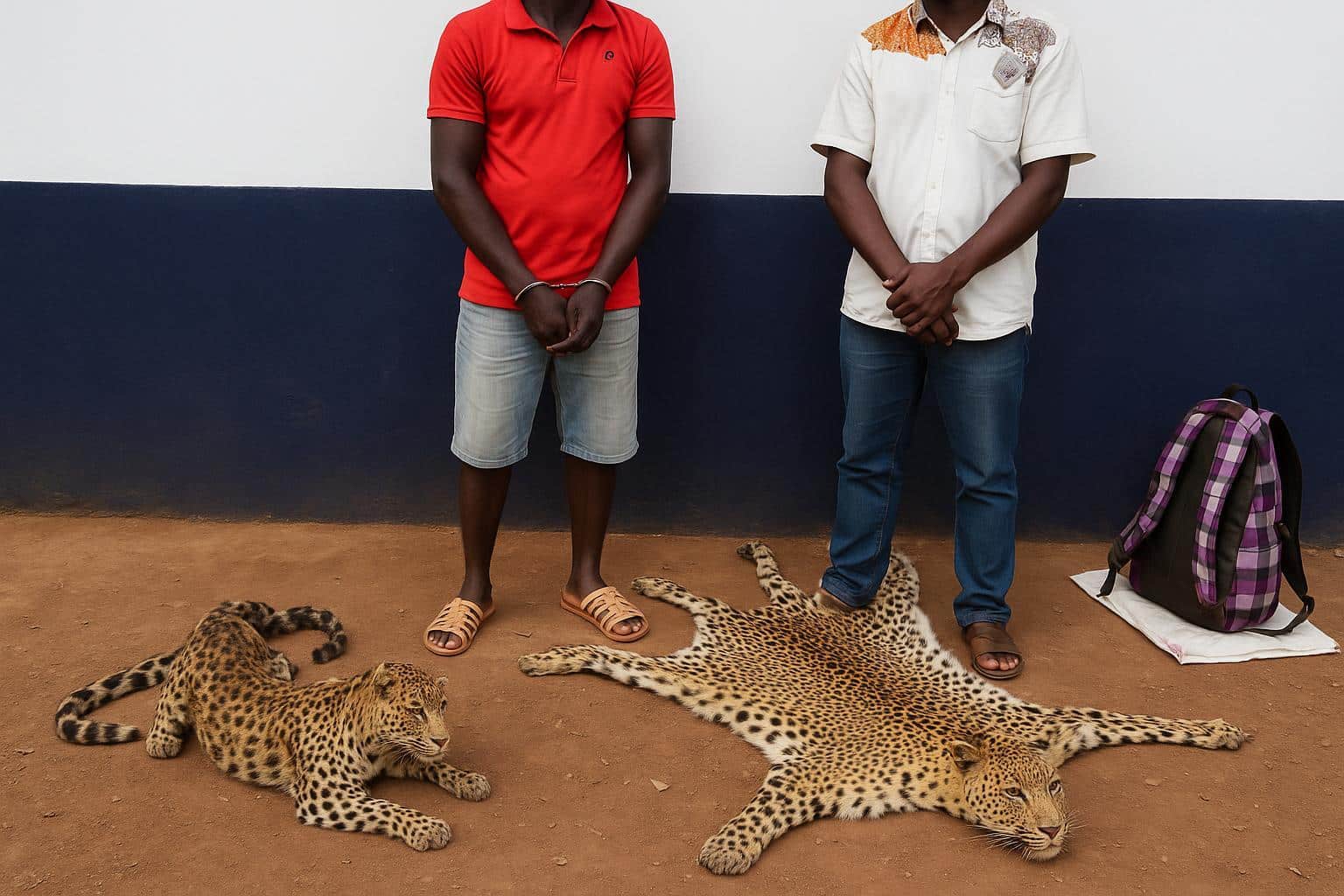
Nationwide wildlife enforcement surge
A mid-year briefing by the Wildlife Law Enforcement Support Project, known locally as PALF, reveals an assertive crack-down on traffickers across Congo-Brazzaville. Between January and July 2025, nine defendants received sentences, several supply chains were disrupted, and high-value trophies including elephant ivory were confiscated during coordinated national sweeps.
Interviews with senior officers from the National Gendarmerie suggest the operations mirror a broader security doctrine that frames wildlife crime as an economic and public safety issue rather than a purely environmental matter, thereby unlocking additional investigative resources and reinforcing cross-border intelligence cooperation with Gabon and Cameroon authorities.
How field operations unfolded in three provinces
PALF coordinators, contacted by phone, attribute the successful arrests in Dolisie, Owando and Impfondo to the fusion of community tip lines with discreet surveillance teams trained by the Ministry of Forest Economy; such dual channels reportedly shorten response times to mere hours after initial sighting reports arrive downstream.
Field photographs seen by the Review show meticulously packaged pangolin scales, individually weighed and labeled, indicating an export-ready stage. A conservation biologist at Marien Ngouabi University argues that this professionalization demonstrates how traffickers adapt commercial logistics methods, complicating interdiction but also producing forensic trails prosecutors can exploit later.
Inside the seized batches, investigators documented barcodes identical to markings found in last year’s haul near Kinshasa, suggesting a regional network. The Congolese government, which has ratified CITES since 1983, has stepped up customs screening along the Congo River corridor to prevent similar consignments slipping downstream undetected recently.
Courts, media and diplomacy shape deterrence
Courthouse records accessed in Brazzaville show the nine defendants faced charges under Law 37-2008, which allows sentences up to five years. Five received custodial terms ranging from eighteen to thirty-six months, while four obtained suspended sentences contingent on community education campaigns in peripheral logging towns across the hinterland.
Judge Clément Massala stated during sentencing that ‘wildlife law must be felt in the pocket and the conscience.’ His remark reflects a judiciary increasingly willing to publicize decisions, a practice praised by Transparency International analysts as a modest yet tangible deterrent against repeat offenses within rural jurisdictions recently.
While court outcomes garner headlines, the discreet work of evidence preparation remains arduous. According to senior ecoguard Marie Ngoka, chain-of-custody protocols now employ tamper-proof envelopes and timestamped video logs, innovations financed through a partnership with the European Union’s ECOFAC-6 program and administered by the Forestry Ministry in Brazzaville.
National television channels have aired prime-time segments outlining penalties for purchasing ivory bracelets in urban markets. Media sociologist Jérôme Otsana argues the approach leverages moral suasion more than fear, aligning with public campaigns previously used to curb bushmeat sales around Pool Department during the 2018 yellow fever scare.
Diplomats following Central African security dossiers often evaluate wildlife cases for wider implications, including links to arms smuggling. A confidential MONUSCO cable viewed by this publication notes overlapping phone numbers between ivory brokers and Congolese timber exporters, though investigators emphasize the data remains circumstantial pending mutual legal assistance.
Next steps for conservation and regional security
Economists at the African Development Bank estimate illicit wildlife extraction costs Congo more than twelve million dollars annually in lost tourism potential and depleted ecosystem services. However, they caution that aggressive enforcement should be coupled with alternative livelihoods so poachers can transition toward cocoa, coffee or artisanal fisheries.
Within government circles, the latest arrests are viewed as reinforcement of President Denis Sassou Nguesso’s pledge at the 2022 United Nations biodiversity summit, where he underscored Congo’s ‘zero-tolerance posture’ toward trafficking. Foreign Minister Jean-Claude Gakosso recently reiterated the commitment during an address to accredited ambassadors in Brazzaville yesterday.
Civil society actors nonetheless call for sustained funding. ‘A surge followed every major bust, then dissipated,’ warns Jacqueline Bopaka of the Congolese Youth for Biodiversity network. She advocates integrating wildlife modules into secondary school curricula to entrench conservation norms before communities face the economic temptations of traffickers later.
Regional cooperation appears to be advancing. In June, Republic of Congo officers joined their counterparts in Libreville for the first joint financial-crime training focused on tracing digital payments used to purchase ivory via messaging apps. Interpol representatives praised the session as a model for scalable, low-cost transnational enforcement.
Analysts stress that long-term success depends on accurate population baselines. A drone-based census of forest elephants, funded by the Wildlife Conservation Society and scheduled for September, aims to produce granular data for central Cuvette-Ouest. Results should help decision-makers correlate enforcement outputs with measurable recovery of threatened herds sooner.
For now, the dismantling of trafficking rings serves both symbolic and material purposes. Each conviction sends a calibrated message that Congo-Brazzaville’s institutions, from village informants to appellate judges, can align around a environmental objective, reinforcing national stability while preserving megafauna that anchor the country’s ecological and cultural identity.