
Strategic corridor for Pool province
The red laterite track linking Piem to Kindamba, 86 kilometers across the undulating hills of Pool, has long been a lifeline for farmers ferrying cassava and plantains toward Brazzaville. Heavy rains, however, often rendered the passage impassable, isolating villages for weeks at a time.
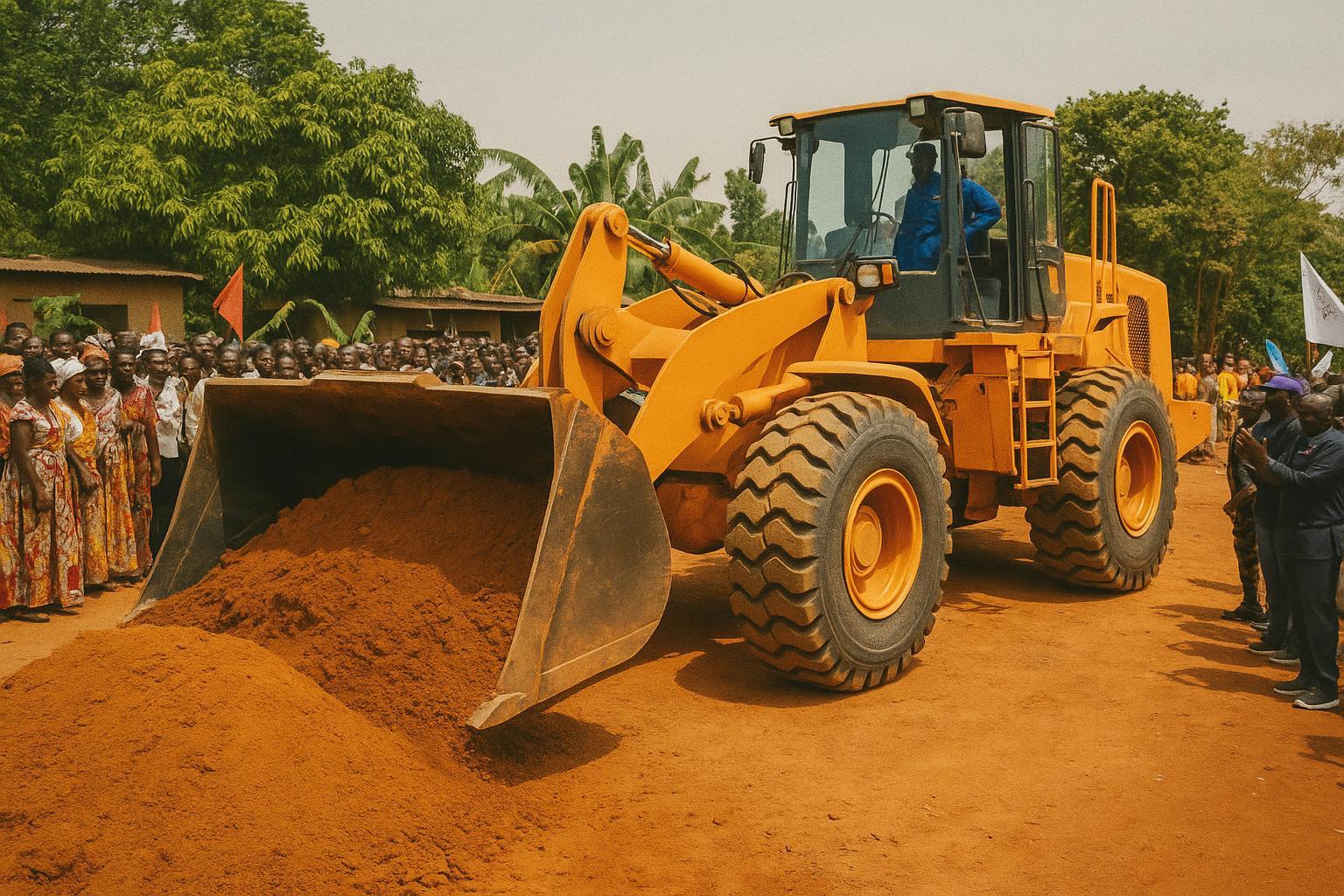
Last week in Mindouli, Minister of Urban Sanitation, Local Development and Road Maintenance Juste Désiré Mondélé cut the ribbon on a six-month reconstruction meant to secure that artery permanently. The ceremony drew parliamentarians, traditional chiefs and traders, underlining the importance attached to the corridor.
Budget and technical outline
According to a finance brief released by the Road Fund, the State has allocated 1.7 billion CFA francs for civil works and 504.37 million for hydraulic structures. The envelope, fully covered by the 2024 budget, illustrates the government’s preference for domestic financing at a moment of global credit tightening.
Lot one, entrusted to local contractor Cipam, covers earth-moving, platform elevation and flood-control along the first 50 kilometres. Lot two, handled by Universelle Atlantique BTP, foresees nineteen culverts—several of double span—replacing obsolete pipes that once acted as bottlenecks during the rainy season.
Local economic stakes
In Pool, agriculture represents nearly 30 percent of household income, official statistics show. Poor road conditions have been translating into post-harvest losses estimated at fifteen percent, according to the Chamber of Commerce in Kinkala. Stakeholders therefore view the upgrade as both a logistics and food-security intervention.
The route also facilitates access to Mindouli’s manganese fields and Kindamba’s timber concessions, assets that feed national export receipts. By shortening travel time to the Maloukou river port, the project is expected to lower freight costs by up to 18 percent, analysts at the Economic Forecasting Unit predict.
Voices from the ground
‘We lose buyers whenever the road floods,’ explains farmer Jeanne Ngimbi, surrounded by neatly piled cassava bags near Piem. ‘If the trucks can roll in every week, I will plant double.’ Her optimism mirrors comments recorded by state broadcaster Télé Congo during the launch.
Local physician Dr. Serge Boka highlights another benefit: ‘In heavy rain, evacuating patients to Kindamba’s hospital used to take four hours; ambulances often turned back. A stabilized surface could drop that to ninety minutes, which is literally life-saving for complicated births.’
Regional integration and national plan
The Piem–Kindamba works slot into the National Road Maintenance Program 2025, a roadmap adopted by cabinet last December. The program targets 2,400 kilometres of rural arteries, with priority on corridors that connect agricultural basins to Brazzaville, Pointe-Noire and emerging industrial zones.
Officials underline the regional dimension: the reconstructed stretch will dovetail with the projected Kinkala–Brazzaville expressway, effectively stitching Pool’s interior to the Republic of the Congo’s primary consumer market and, through route 1, to Gabon and Cameroon. The African Development Bank has shown interest in co-financing later segments.
Environmental safeguards
Engineers from the Directorate-General of Road Maintenance insist that lateritic fill will be compacted in layers not exceeding 20 centimetres to prevent scouring. Grass seeding along embankments is planned to stabilize slopes, a method already piloted on the Nganga-Lingolo bypass south of Brazzaville.
Environmental compliance officer Clarisse Moutou notes that culverts have been resized to accommodate increased runoff linked to climate variability. ‘We modeled rainfall scenarios up to 2050 using data from the Congo Basins Observatory,’ she says, adding that fish passages will be incorporated where streams host migratory species.
Project governance and monitoring
The ministry retains project ownership, while daily supervision rests with the state engineering consultancy Bcptp, whose on-site laboratory will conduct compaction and concrete tests. Weekly progress meetings are to be livestreamed for transparency, an innovation piloted on the Mambili bridge last year.
The Supreme State Audit Office, empowered by a 2022 decree, will review disbursements every quarter. Civil-society group Publiez Ce Que Vous Payez has welcomed the measure, saying it demonstrates an ‘encouraging alignment with regional best practice’ in infrastructure governance.
Looking ahead
A first inspection is scheduled for late October, when 40 percent of earthworks should be complete. Contractors have agreed to operate double shifts if rainfall exceeds historical averages, a clause negotiated after meteorologists forecast a wetter-than-usual season influenced by a moderate La Niña.
Beyond construction, municipal councils in Mindouli and Kindamba are drafting maintenance bylaws that earmark a portion of market levies for routine grading. Such decentralised funding, still rare in the sub-region, seeks to ensure the corridor does not relapse into disrepair once builders leave.
As bulldozers move in, Pool residents watch closely, aware that the road’s success could serve as a template for the remaining fourteen departments. For now, traffic barrels cautiously over temporary diversions, carrying the promise that smoother passages may soon replace the region’s seasonal isolation.
Economists at Marien Ngouabi University calculate that each CFA franc spent on rural roads can triple economic output within five years, a forecast that bolsters the decision to prioritise domestic funding.