
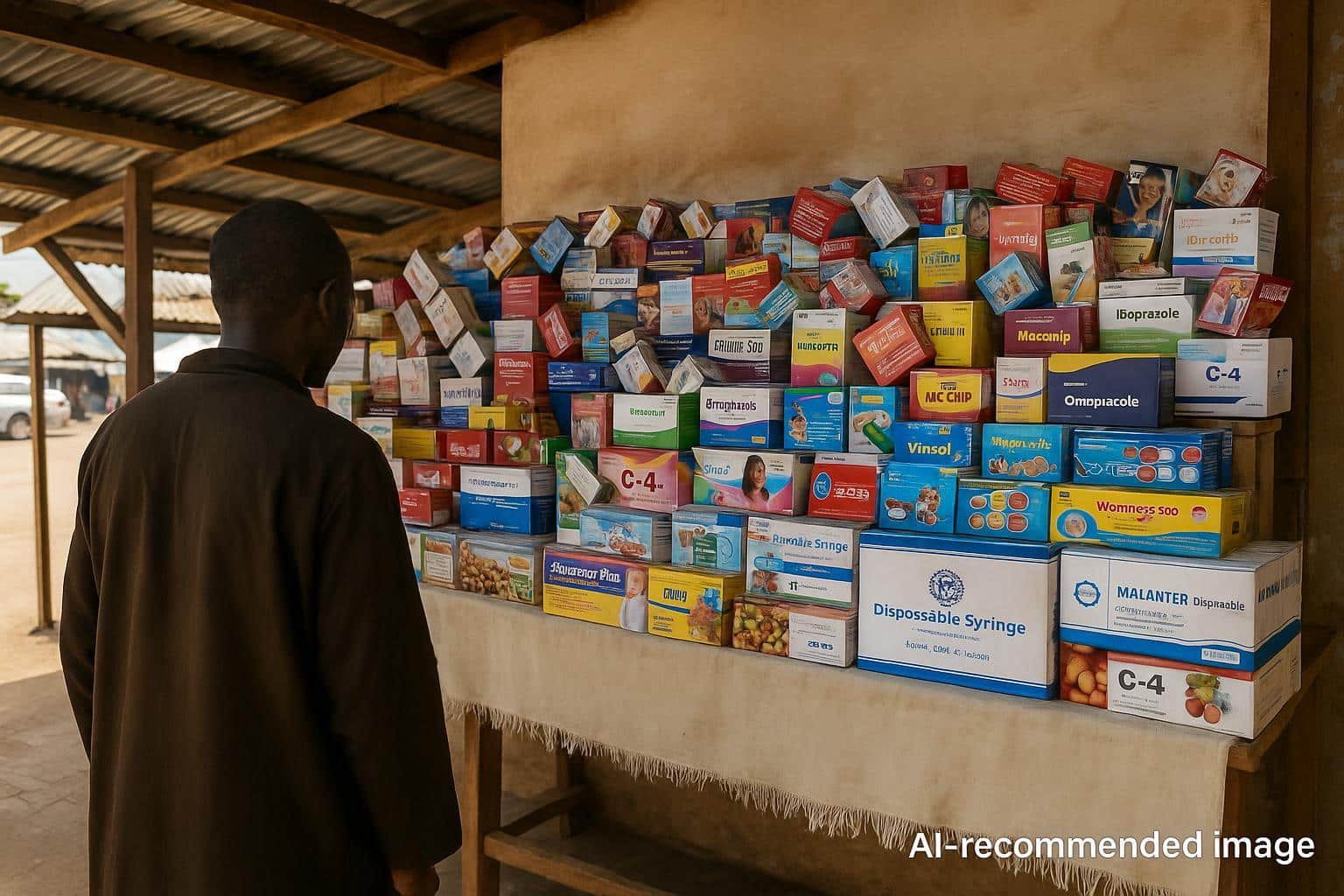
Street Pharmacies Thrive in Dolisie
At sunrise, queues snake around the stalls of Dolisie’s central market, mothers and taxi drivers waiting patiently as improvised vendors slide blister packs across wooden tables. The flow is brisk, cash is mostly coins, and plastic bags replace prescription envelopes.
Locals call these stalls “pharmacies de rue,” an umbrella term covering counterfeit medicines devoid of active ingredients and genuine products diverted from sanctioned wholesalers. Transactions occur outside any cold chain, with tablets exposed to equatorial heat that can degrade potency within days.
Health Risks and Clinical Realities
A 2023 study by the Congolese Union of Pharmacists estimated that 59 percent of urban drug supply is private, 28 percent informal, and only 13 percent public (Union des Pharmaciens, 2023). The proportions mirror patterns observed by the World Health Organization across Central Africa.
WHO alerts note that sub-standard or falsified antibiotics and antimalarials increase resistance and mortality, costing Africa nearly 150,000 lives annually (WHO, 2024). In Dolisie, clinicians report patients arriving with advanced infections after days of self-medication on tablets containing erratic dosages.
“We treat malaria that should have cleared in 48 hours but lingers for a week,” explains Dr. Bienvenu Mabiala, internist at Dolisie General Hospital. He stresses that unregistered vendors rarely give dosage instructions, compounding the pharmacological uncertainty already embedded in illicit supply chains.
Economic Drivers of Informal Trade
For consumers, however, street stalls answer two structural problems: time and money. Consultation fees at public facilities average 4,000 CFA francs, while a course of antibiotics can reach 8,000. On the street, the same blister sells for under 2,000 and no appointment is required.
Dolisie officially hosts twelve licensed pharmacies for nearly half a million inhabitants, according to the Ministry of Health’s 2022 directory. Several communes have none, forcing residents to travel up to 30 kilometres or revert to informal kiosks that have multiplied along inter-city bus stations.
Price disparities are also structural. A 500-milligram amoxicillin tablet sourced through the public purchasing centre costs seven times its international reference, a reflection of freight, currency volatility and low procurement volumes. Economists warn that until economies of scale improve, affordability will remain fragile.
Government Action and International Support
Recognition of these constraints underpinned the World Health Organization’s decision last August to honour President Denis Sassou Nguesso for his Pan-African advocacy against counterfeit drugs. The award cited Congo’s leadership in coordinating customs surveillance along the Brazzaville-Kinshasa corridor and its sponsorship of regional taskforces.
Since 2014, joint police-customs operations codenamed Opération Cuvette have seized over 450 tonnes of illicit pharmaceuticals nationwide, according to the Directorate-General of Customs. Seizures are displayed publicly in Brazzaville, a tactic authorities say deters traffickers and reassures citizens that enforcement is ongoing.
Parliament strengthened the legal arsenal in 2019, criminalizing the sale of medicines outside accredited premises and introducing penalties of up to ten years’ imprisonment. The law also empowers provincial governors to close establishments immediately upon evidence, streamlining a process that previously demanded lengthy court orders.
Innovations and Community Outreach
Beyond sanctions, Brazzaville is piloting a digital track-and-trace code that consumers can verify by text message. The system, designed with Moroccan start-up mPedigree, records batch numbers at importation and allows inspectors to pinpoint divergence across the supply chain in real time.
International partners add momentum. Interpol’s Operation Heera intercepted 320,000 counterfeit tablets at Pointe-Noire port in March, while the Global Fund financed solar-powered refrigerators for twenty rural clinics to preserve vaccine integrity. Officials believe such synergies gradually shrink the market for unregulated therapeutics.
Education campaigns form the softer flank. Community health agents now visit weekly markets with portable loudspeakers, explaining dosage dangers and encouraging residents to demand official packaging. Radio Niari broadcasts a drama series featuring a fictional vendor who reforms after witnessing a neighbour’s overdose.
Economic incentives are equally important, says Professor Léon Moukassa, economist at Marien Ngouabi University. He argues that subsidized generic imports from Indian manufacturers, negotiated through pooled African orders, could cut retail prices by half, eroding the competitive edge of street outlets without heavy policing.
Next Steps for Safer Access
Observers caution, nonetheless, that informal vendors often serve as the only night-time option in peri-urban districts. Any transition plan, they insist, must incorporate these actors, perhaps through licensing schemes and basic pharmacology training similar to Tanzania’s accredited drug dispenser initiative.
For now, the plastic bags keep changing hands under the mango trees of Dolisie, a reminder that public health and economic realities intersect daily. Officials express confidence that sustained investment, smart regulation and community trust can eventually steer those queues toward safer counters.
Health ministry officials hint at a forthcoming national medicine agency, slated for 2025, that would centralize procurement and register every importer. Draft statutes obtained by our newsroom propose an online portal for price comparison, echoing models used in Rwanda and Ghana with notable success.