
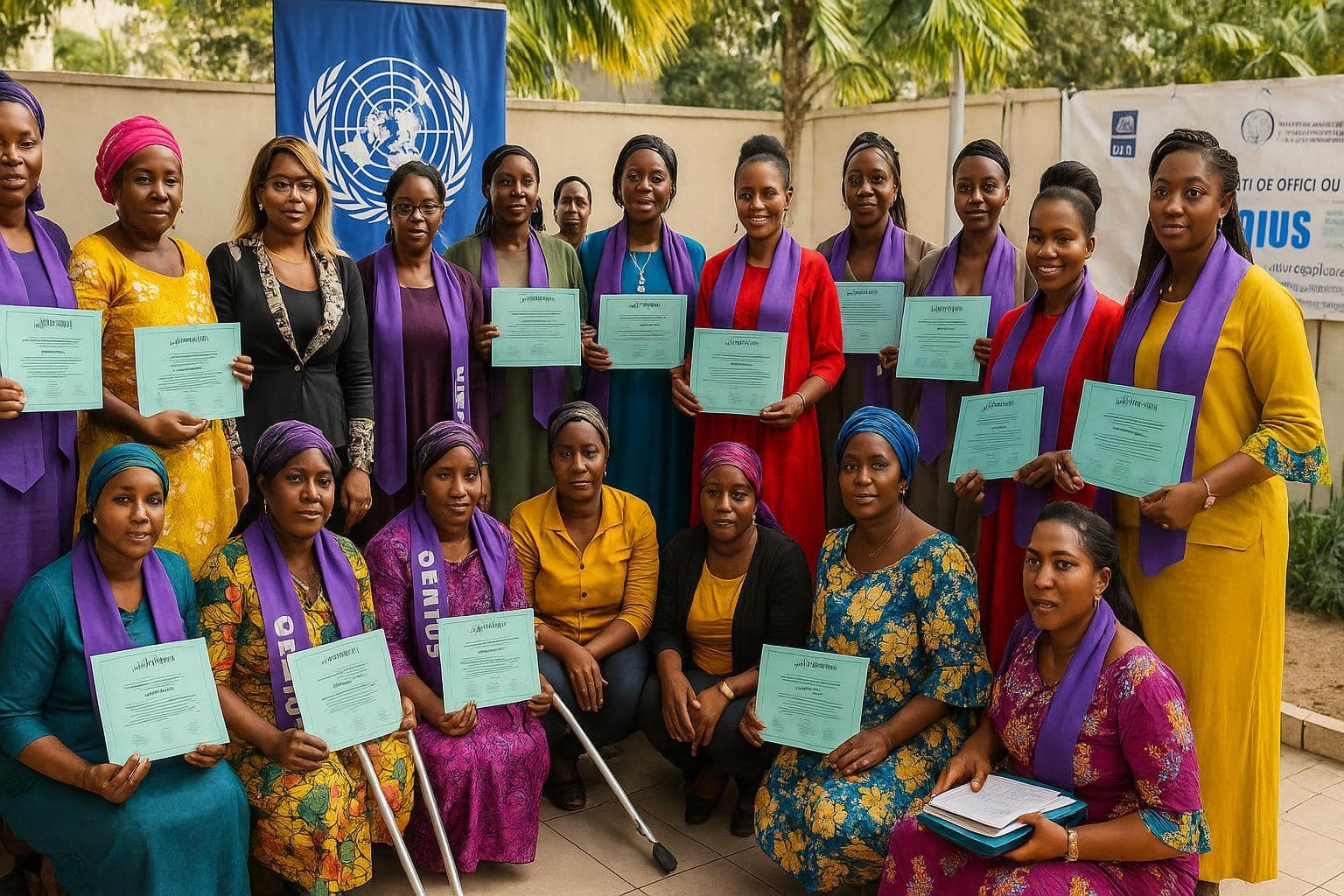
Brazzaville Graduation Signals Entrepreneurial Momentum
A handful of notebook-waving graduates streamed out of the Hôtel de Ville auditorium in Brazzaville this month, wearing the confident smiles of pioneers. Thirty women and two men had just received certificates marking the first cohort of the Genius entrepreneurship programme.
Run by the National Chamber of Women Business Leaders and Entrepreneurs of Congo, the initiative enjoys backing from the Ministry of Small- and Medium-Sized Enterprises and the United Nations Development Programme, two institutions that have repeatedly framed entrepreneurship as a cornerstone of the nation’s diversification agenda.
State-UNDP Alliance Powers Genius
Minister Jacqueline Lydia Mikolo, addressing the graduates, called Genius “a practical route to formalisation and visibility that individual artisans could seldom achieve alone”. Her remarks echo the government’s 2022 Strategic Plan, which places women-owned enterprises at the centre of job creation targets (Ministry of SMEs 2025).
UNDP Resident Representative Adama Dian Barry added that reducing poverty in Congo “now passes through female-led value chains capable of scaling beyond local markets”. UN data show that each additional woman employer generates an average two indirect jobs in the informal economy (UNDP Congo 2025).
Skills Boot Camp Rooted in Congolese Context
Over the intensive two-month boot camp, participants refined elevator pitches, drafted bank-ready business plans, practiced crowdfunding strategies and dissected personal branding. Trainers, many drawn from Congolese start-ups, insisted that every concept be stress-tested against local infrastructure constraints, currency fluctuations and regional consumer habits.
For Blanche Bafiatissa, founder of the organic foods label Bianca Biofood, the distinction between trading and entrepreneurship “finally became tangible”. She reports converting informal suppliers into contractual partners and negotiating a first wholesale order during the course’s marketing module.
Ecobank Partnership Unlocks Capital
Graduation did not end with a handshake. Through Ecobank’s Ellever facility, each alumna may apply for tailored working-capital lines and digital accounts with reduced fees. Bank executives say the risk is mitigated by the programme’s screening and by a partial guarantee from a UNDP envelope of six million CFA francs.
The banking partnership aligns with the Central Bank’s Financial Inclusion Roadmap, which targets a rise in the ratio of female account holders from 27 percent to 45 percent by 2030 (Central Bank of Congo 2024). Analysts view this linkage as critical to shifting micro-ventures into the formal tax net.
Scaling Genius Across Five Cities
Genius is designed to travel. A second class launched in Pointe-Noire weeks before the Brazzaville ceremony, and another opened in Oyo on 18 August. Sessions in Dolisie and Ouesso are booked for later in the year, completing coverage of five strategic economic corridors.
Organisers aim to certify 1 000 women within 18 months, roughly 200 per city. That scale, if achieved, would increase the nationwide pool of formally trained female founders by almost a quarter, according to the latest enterprise census from the National Institute of Statistics (INS 2024).
Regional Impact and Diplomatic Interest
Diplomats from neighbouring Cameroon and the Democratic Republic of Congo attended the Brazzaville event, signalling cross-border curiosity. A Cameroonian trade counsellor suggested exploring a CEMAC-wide female entrepreneur network to streamline customs procedures for women-led exporters.
Such discussions dovetail with the African Continental Free Trade Area’s gender mainstreaming protocol, adopted in February. Congolese officials believe Genius alumni, armed with harmonised documentation training, could be early beneficiaries of simplified regional trade rules (AfCFTA Secretariat 2025).
Mitigating Risks to Sustain Growth
Past incubators in Central Africa have struggled when donor cycles ended. Flavie Lombo says Genius avoids dependency by embedding revenue-sharing clauses: graduates will pay a small royalty on future sales into a revolving fund used to sponsor subsequent cohorts.
Sector analysts applaud the model but warn that electricity costs, currently among the highest in sub-Saharan Africa, could blunt profit margins for manufacturing startups (World Bank 2024). Government officials note that investments in hydro capacity at Liouesso will ease the burden over the medium term.
Mobile Platform Extends Training
To circumvent geographic dispersion, the Chamber released a mobile application synchronised with the training syllabus. Users may continue accessing video lectures, bookkeeping templates and a real-time chat moderated by volunteer accountants. The French-language interface will soon include Lingala and Kituba glossaries.
According to data from mobile carrier MTN Congo, smartphone penetration in urban areas now stands at 68 percent, up from 54 percent in 2021. That upswing offers a cost-effective scaffold for continuous mentoring long after classroom doors close (MTN Analytics 2025).
Potential Macroeconomic Dividend
Economists at the African Development Bank calculate that reaching 1 000 trained women founders could add 0.3 percentage points to annual GDP growth if each business hires only three people and survives five years (AfDB 2023). The figure may rise if value chains extend into agriculture processing.
For now, the new graduates return to neighbourhood workshops and co-working hubs, certificates in hand. Their progress over the next quarters will serve as a live test of Congo’s broader ambition: turning entrepreneurial rhetoric into measurable, inclusive growth and shared prosperity for all.