
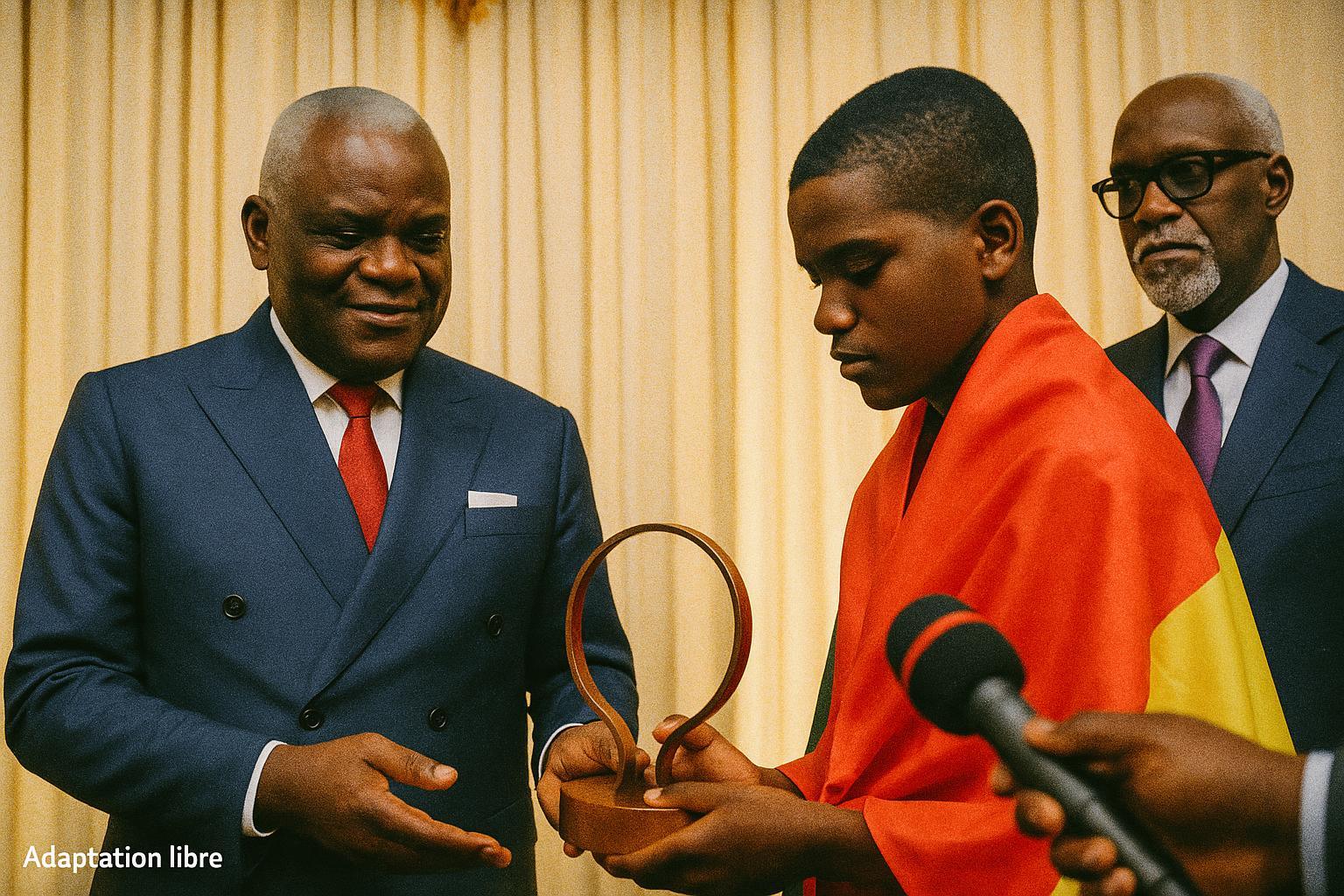
Quebec City podium echoes in Brazzaville
When 17-year-old Briny Oscar Matouridi walked into the ornate meeting room of the Prime Minister’s office on 26 July, the air was thick with more than the customary protocol. The teenager had returned from the 53rd Francophone World Scrabble Championships in Canada with two gold medals and three additional podium finishes, outperforming veterans several decades his senior. In the words of Prime Minister Anatole Collinet Makosso, the feat was “a joyful disturbance of our national routine, reminding us that intellectual audacity ranks alongside the physical exploits so often celebrated” (Agence Congolaise d’Information, 26 July 2023).
Government sees a template for educational reform
While the congratulatory photographs splashed across social media, policy advisers were already weaving the result into the country’s broader education narrative. Officials at the Ministry of Youth and Sports underline that Scrabble, a codified battle of vocabulary rather than brawn, dovetails with the government’s competency-based curricular reforms rolled out in 2021. Minister Hugues Ngouelondélé argued that the board game can serve as a low-cost laboratory for linguistic dexterity, strategic thinking and even data-driven analytics, as the competitive circuit now relies on sophisticated probability software (Jeune Afrique, 27 July 2023).
In cabinet circles, Matouridi’s ascent bolsters an argument long advanced by pedagogues: that linguistic excellence, properly guided, can provide social mobility without the infrastructure burdens associated with traditional elite sports. This perspective aligns with the National Development Plan 2022-2026, which lists ‘knowledge-intensive extracurriculars’ among strategic engines of human-capital growth. By drawing a direct line from a Scrabble board in Quebec City to the macro-economic targets of Brazzaville, policymakers hope to inscribe the teenager’s medals into an institutional narrative that outlives the media cycle.
Soft power in seven-letter turns
Beyond pedagogy, the episode is read in certain diplomatic lounges as an incremental soft-power success. In a region where sporting headlines are often dominated by football transfers or marathon records, a linguistic contest punctures stereotypes and projects an image of intellectual sophistication. As one Central African ambassador quipped during a reception at the Congolese chancery in Ottawa, “A nation that can rearrange 102 tiles into poetry is a nation difficult to underestimate.”
The Ministry of Foreign Affairs has quietly encouraged the Congolese diaspora in Canada to leverage the achievement during Francophonie cultural weeks scheduled for the autumn, an illustration of how micro-victories can be amplified into a narrative of national confidence. Analysts at the Institute for Strategic Studies in Dakar point out that such cultural diplomacy may yield modest but tangible dividends: scholarship exchanges, joint language programmes and a nuanced brand distinct from the region’s resource-centric image (Institute for Strategic Studies briefing, 30 July 2023).
Investment challenges behind the applause
Yet euphoria alone cannot sustain a talent pipeline. Congolese Scrabble Federation officials, while elated, concede that domestic tournaments have often been staged in classrooms with improvised scoreboards. The federation’s annual budget hovers below fifty thousand dollars, a fraction of the allocation for athletics. Prime Minister Makosso hinted that fresh resources could be unlocked through a public-private mechanism modelled on the country’s basketball partnership with multinational sponsors, though concrete figures remain undisclosed.
For their part, educators caution against a simplistic replication of Matouridi’s journey. The champion had the benefit of a bilingual upbringing and remote coaching sessions with French grand-masters, financed partially by a private telecom foundation. Scaling that model across a national school system will require teacher-training modules, digital dictionaries and reliable internet bandwidth—each a policy challenge in its own right. Nevertheless, the very fact that these questions have reached the prime ministerial agenda is, in itself, a departure from the historical marginality of mind sports.
A teenager’s voice amid national aspirations
In a brief exchange with reporters, Matouridi dismissed any narrative of overnight glory. “The board never lies,” he said with a smile, “but it never flatters either; every victory is spelled out, tile by tile.” His remark resonated with parents who had gathered outside the government compound, many clutching French dictionaries, hopeful that their children might follow suit.
The young champion returns to a lycée in Bacongo district where, teachers say, classmates have already converted break-time debates into impromptu Scrabble matches. Such grassroots enthusiasm provides a living metric for the government’s thesis that high-performance stories can cascade into everyday motivation. Observers note that if the administration manages to institutionalise this momentum—through inter-school leagues, televised matches and scholarships—Scrabble could evolve from curiosity to enduring civic asset.
Toward an ecosystem of cognitive excellence
Congo-Brazzaville’s leadership, keenly aware of the demographic bulge entering secondary education, views cognitive competitions as low-carbon corridors toward prosperity. The Prime Minister, invoking the African Union’s Agenda 2063, framed Matouridi’s victory as illustrative of how youthful innovation can complement industrial diversification. The proposition is straightforward: intellectual exports, be they in coding marathons or word games, multiply a nation’s reputational capital without depleting mineral reserves.
Diplomatic insiders suggest that Brazzaville may propose hosting a Central African Scrabble Cup within the next two years, leveraging existing hotel infrastructure and recent upgrades at Maya-Maya International Airport. Such an event would not only consolidate regional ties but also position the country as a convening power in Francophone knowledge circuits. In that scenario, Matouridi’s gold medals become both symbol and catalyst, transforming a personal triumph into an institutional milestone.
An aftertaste of possibility
As the ceremonial spotlights dim, what lingers is less the glitter of medals than the sensation of an open dictionary—hundreds of thousands of lexical paths beckoning the nation’s youth. The governing establishment, sensitive to global conversations on human-capital indices, appears intent on converting that sensation into policy. Should the promised investments materialise, Congo-Brazzaville could carve a niche where cerebral agility, rather than raw commodity flows, headlines its international profile.
For now, the image persists: a teenager flanked by senior officials, fingers resting lightly on wooden tiles that have travelled from Quebec to Brazzaville. Each tile is an invitation to spell a different national future, one carefully constructed word at a time.