
Grassroots Initiative for Inclusive Skills
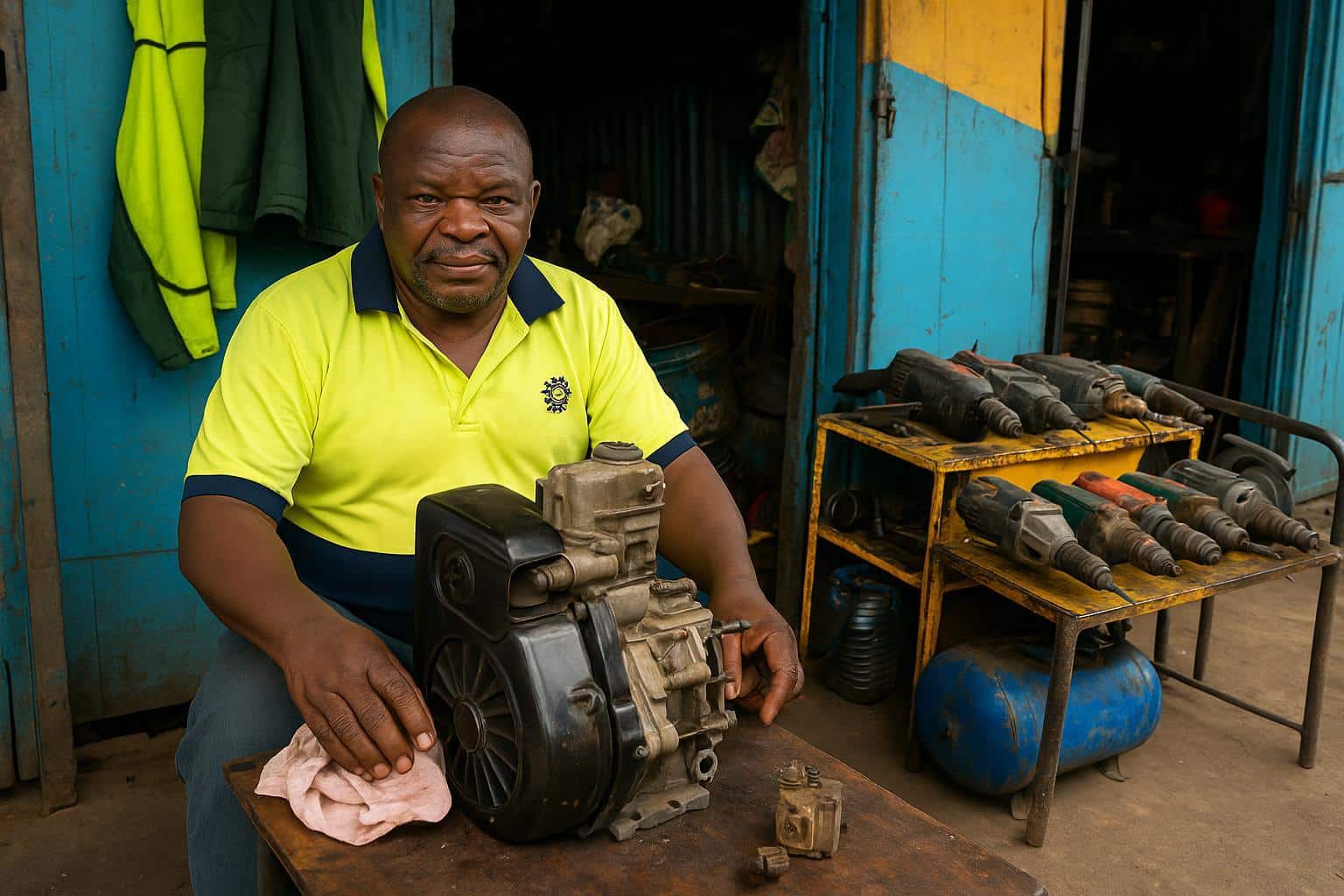
At a dusty crossroads in Talangai district, the rhythmic hum of dismantled alternators has become an unlikely soundtrack of hope. For three years, Jules Batantou, a wheelchair-bound generator technician, has turned his modest workshop into a tuition-free classroom for Brazzaville’s persons with disabilities.
His reasoning is straightforward, he says: many disabled residents spend their days requesting small change; repairing engines puts cash in their own pockets. “I wanted to break that circle,” Batantou told the Congolese Information Agency during an afternoon interview between lessons.
The initiative has already produced concrete results. Three former trainees now run independent repair kiosks along Avenue de la Paix, each employing an assistant and servicing neighbourhood clinics that rely on backup power. For the instructor, these micro-successes prove that physical impairment need not limit entrepreneurial ambition.
Twenty Years of Self-Taught Expertise
Batantou, in his early forties, never attended a vocational institute. Two decades ago he began dismantling faulty alternators behind his family home, learning by trial, error and the occasional borrowed manual. Word of mouth soon had companies calling for late-night interventions during citywide outages.
The self-taught path, he argues, equips him to empathise with novices who have limited formal schooling. Many learners cannot decipher technical French, so he sketches circuitry with chalk on plywood, pairing every diagram with hands-on disassembly of carburettors and voltage regulators until muscle memory replaces textbook jargon.
Tools remain rudimentary: salvaged spanners, a multimeter patched with electrical tape, and an aging manual hoist for heavier alternators. Yet the scarcity itself becomes a lesson. “If you can fix a generator without a laboratory, you can work anywhere in the country,” he tells apprentices.
Combating the Koulouna Holiday Lure
Each July and August, northern Brazzaville police receive an uptick in complaints linked to youth gangs locally dubbed Koulouna. Batantou believes idleness during school recess feeds the phenomenon. He therefore opens a separate six-month module for teenagers who have dropped out or risk dropping out.
Unlike the disability scheme, the youth course carries a fee of 35,000 CFA francs, roughly the price of a mid-range smartphone case in downtown boutiques. The modest charge, he says, discourages casual enrolment and allows him to replace spark plugs and lubricants used during practical sessions.
Local parents credit the programme with keeping restless adolescents occupied. “My son used to roam the market,” said Clarisse Malonga, a fruit vendor whose 17-year-old now apprentices at the workshop. “Now he earns tips repairing neighbour generators and talks about opening a shop instead of joining a crew.”
Funding Gaps and Call for Support
Success, however, breeds logistical headaches. The current intake can reach fifteen students, yet the workshop owns only four socket sets and a single compression gauge. When transport stipends fall short, trainees from the outskirts of Ignié miss classes, and momentum slips.
Batantou has applied to micro-credit schemes run by the Ministry of Social Affairs and by private banks, but guaranty requirements outstrip his collateral. He hopes that highlighting the programme’s social impact will attract corporate sponsors willing to underwrite tool kits and travel allowances.
Small contributions already arrive in kind. A retired Air Force mechanic recently donated surplus voltmeters; a church youth group pledged monthly bread and water deliveries. Yet the instructor estimates that an additional three million CFA francs are needed to scale the project across Brazzaville’s nine arrondissements.
Policy Context for Disability Employment
Congo-Brazzaville ratified the UN Convention on the Rights of Persons with Disabilities in 2014, and labour laws encourage firms to reserve at least two percent of positions for qualified applicants with impairments. Implementation, activists acknowledge, remains uneven, particularly in informal sectors where generator repairers typically operate.
Government officials say community initiatives like Batantou’s complement national policy. “Vocational self-employment is a pillar of our inclusion strategy,” noted Martin Oyemba at the Directorate for the Promotion of Disabled Persons, citing planned tax incentives for companies that subcontract workshop alumni.
Observers also argue that generator maintenance will gain relevance as urban centres grapple with intermittent power. Pointe-Noire suffered four major grid failures this year, prompting businesses to rely on back-up diesel units. Training technicians now, supporters contend, positions disabled Congolese to seize a growing market.
A Modest Workshop Inspires Broader Dreams
As afternoon rain drums on the corrugated roof, Batantou hands a socket wrench to Imelda Nkouka, a trainee who lost her right leg in a childhood accident. “Voltage,” he reminds her. She measures, nods and smiles at the correct reading: another small step toward autonomy.
The instructor’s ultimate goal is to establish a certified technical centre recognised by the Ministry of Technical Education, allowing graduates to secure nationwide service contracts. Whether that ambition materialises may hinge on timely backing, yet the daily whir of engines already testifies to incremental change.
For now, onlookers gather at twilight when repaired generators roar back to life, illuminating rows of small workshops along the alley. The flicker of fluorescent light reflects on proud faces and metal cranks alike, suggesting that empowerment sometimes starts with the simple turn of a socket.