
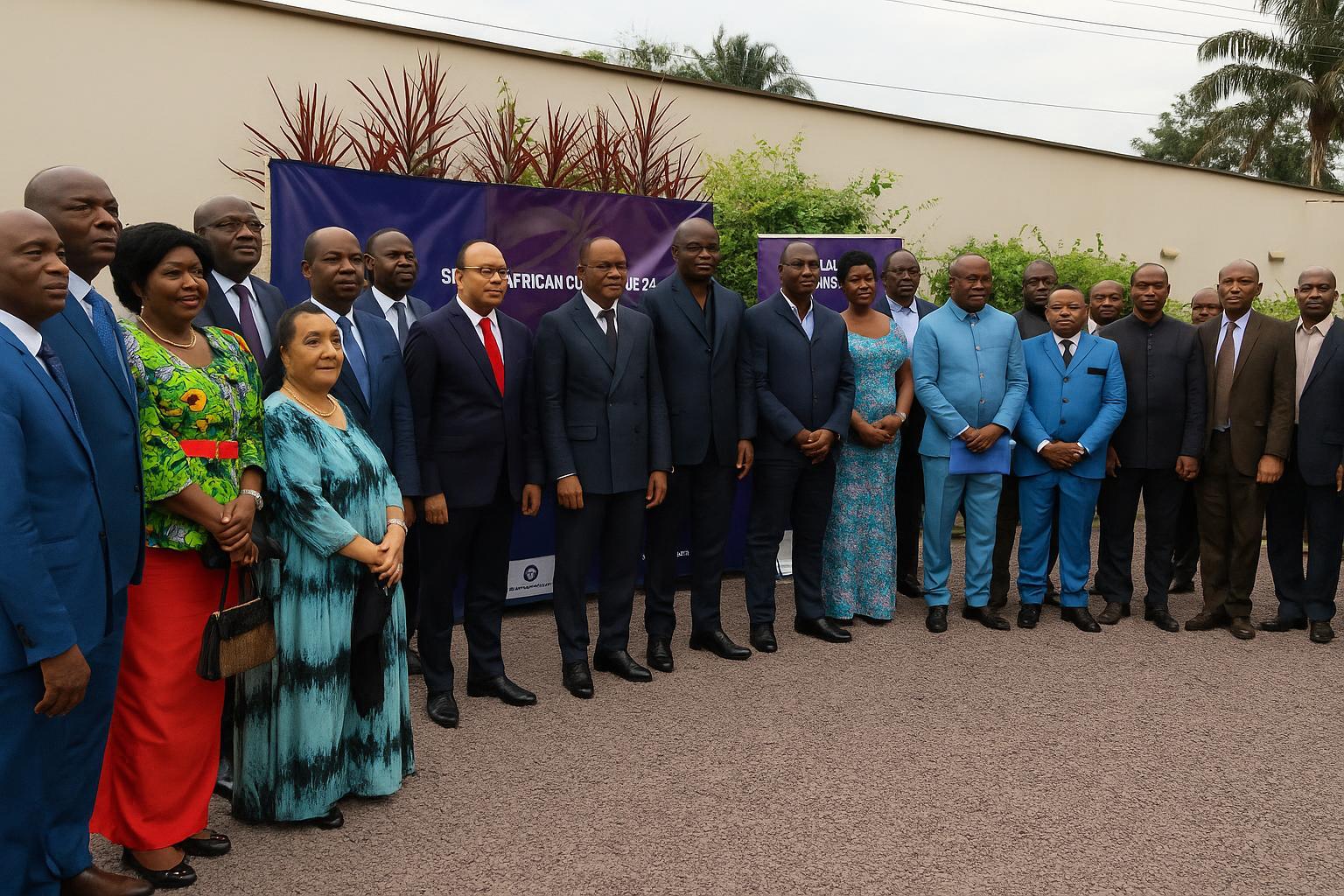
Brazzaville launch electrifies telecom scene
On 24 October, in a luminous hall overlooking the Congo River, engineer Luc Missidimbanzi formally declared his candidacy for Secretary-General of the African Telecommunications Union, the continent-wide agency that aligns digital policies among fifty-plus member states.
The ceremony doubled as a fundraiser, drawing cabinet members, telecom executives and start-ups eager to position themselves inside a campaign expected to last two years, until the election slated for late 2025 during the ATU plenipotentiary conference.
Veteran engineer with regional footprint
A graduate of the National School of Telecommunications of Brittany, Missidimbanzi has spent more than two decades steering infrastructure projects from optic-fiber corridors under the Central African Backbone to the annual Osiane tech fair in Pointe-Noire, according to his official biography.
Inside the Congolese administration he currently coordinates the digital economy unit, crafting policies that blend private capital with public oversight, a balance analysts say earned Brazzaville recognition from the International Telecommunication Union’s recent regulatory maturity index.
“Luc is equally at ease in boardrooms and rural field missions,” said Bourgelie Ampion, chair of Congo Telecom, noting his mentorship of young coders through the Fasuce incubator. Her comments echoed testimonials captured by Agence Congolaise d’Information.
Four-pillar agenda for digital sovereignty
Taking the microphone, the candidate outlined a platform built around universal access, talent development, harmonised regulation and proactive continental leadership, asserting that Africa “possesses the human and cultural capital to design its own digital future” rather than import every standard.
He pledged to accelerate rural connectivity by pooling satellite backhaul, terrestrial fibre and spectrum auctions, citing recent pilots in northern Congo as proof that mixed technologies can cut costs by 30 percent, figures also reported in an ITWeb Africa review.
On skills, Missidimbanzi wants an ATU scholarship fund so that at least 1,000 young Africans annually earn certifications in cybersecurity, 5G and cloud governance, complementing existing ITU Centres of Excellence dotted across the continent.
Regulatory cooperation, his third pillar, would push model laws on roaming, data protection and digital taxation through regional economic communities such as CEMAC and ECOWAS, reducing what he termed “legislative friction” for cross-border start-ups.
Finally, he envisions an ATU able to speak with one voice in global fora like the World Radiocommunication Conference, ensuring spectrum allocations reflect African demographics and sunset clauses, a stance echoed by Kenya’s outgoing secretary-general John Omo last year.
Building alliances and campaign financing
Observers say winning the 2026 ballot will require at least 27 of 49 voting states, meaning the Congolese contender must court Lusophone, Anglophone and Arab-speaking blocs while navigating subtle geopolitical currents inside the African Union.
Brazzaville’s diplomatic overtures have already begun: delegations recently visited Yaoundé, Libreville and Abuja, pitching Missidimbanzi’s résumé alongside offers of bilateral training exchanges, according to a foreign-ministry note shared with journalists.
The campaign kitty, launched by the evening pledges, will be bolstered by sponsors from fintech, satellite and equipment firms, yet organisers cap any single contribution at 15 percent to avoid perceptions of capture.
Timeline to 2026 and stakes for Congo
Under ATU statutes, nominations close in March 2025; hustings then move to ministerial meetings before the final secret ballot. Congo’s government has expressed confidence its bid will showcase national know-how while reinforcing the sub-region’s weight in continental organs.
Should Missidimbanzi prevail, he would become the first Central African to helm the union since its 1977 founding, a symbolic breakthrough for a zone sometimes eclipsed by East and North African heavyweights in telecom discourse.
Economists argue that a Congolese-led ATU could accelerate investment flows toward the Pointe-Noire landing stations of the 2Africa submarine cable, integrating local data centres into pan-African clouds and supporting Brazzaville’s ambition to diversify away from oil.
Citizens at the launch hoped the bid would yield jobs and cheaper bandwidth. “If our engineer wins, Congo’s youth must feel it in megabits, not slogans,” insisted computer-science student Prisca Mvoulou outside the venue.
Missidimbanzi now embarks on regional roadshows. “The race is long, yet unity can secure Africa’s digital sovereignty,” he told reporters as Brazzaville’s skyline, dotted with relay towers, blinked in approval.