
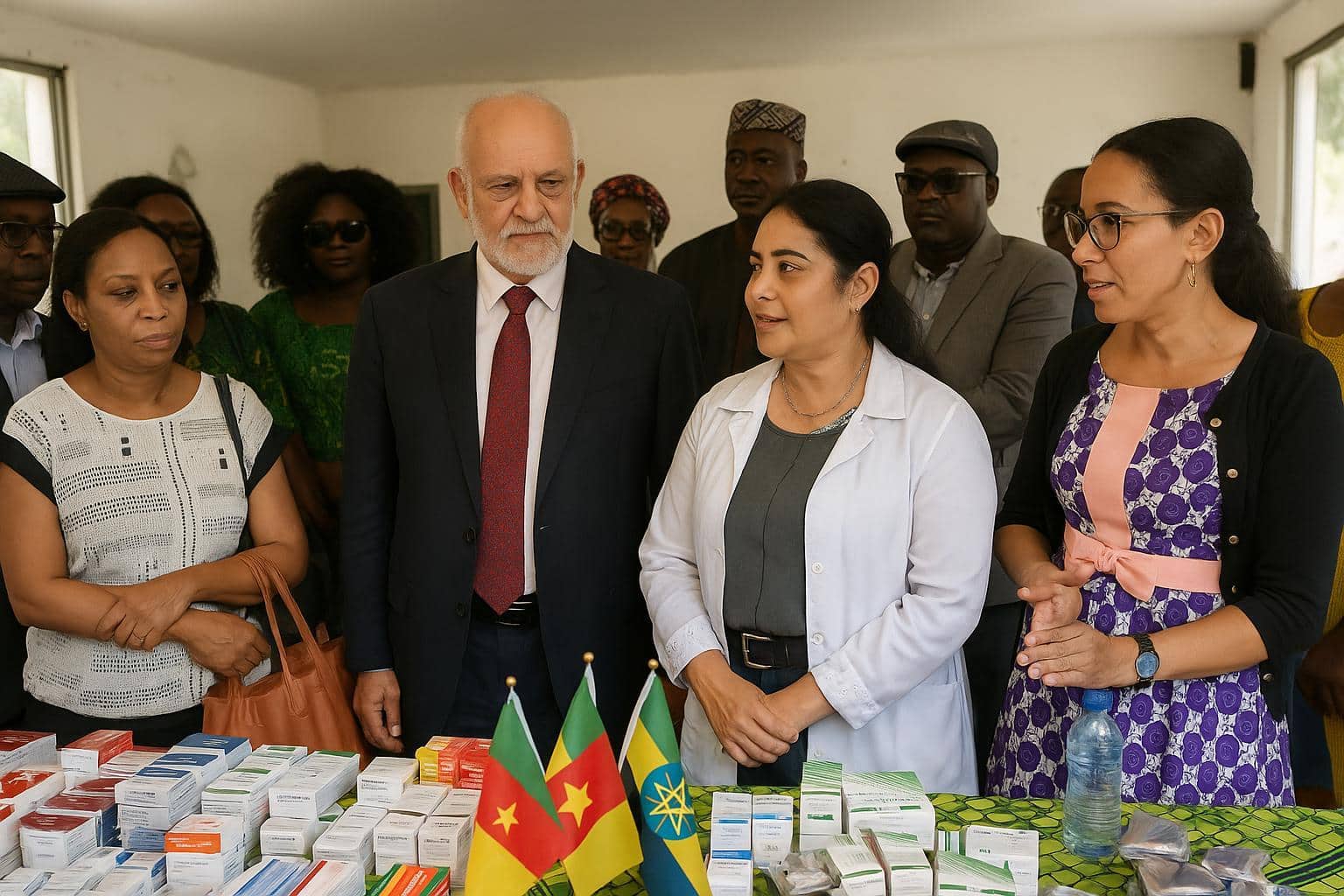
Health for All drive touches Kombé orphanage
Fifty-seven children living at Cardinal Émile Biayenda Village in Kombé woke up to a rare bustle this Tuesday, as doctors, diplomats and cameras streamed through the gates. By sunset every child had been screened, medicated and comforted—without anyone paying a single franc.
The day-long campaign, branded Health for All, was steered by the Embassy of the Bolivarian Republic of Venezuela with logistical backing from the Cuban Medical Brigade and oversight from Congo’s Ministry of Social Affairs, underscoring an emerging tri-continental partnership around grassroots health solidarity.
Cuban doctors lead hands-on diagnoses
In a makeshift consultation room, Dr Yolandra Corris Zamora and Dr Leidys Vicet Kindilan listened to coughs, peered at skin rashes and checked temperatures. Seven children presented infections ranging from respiratory irritation to fungal lesions, conditions the team says can be controlled with early follow-up.
“Children are tomorrow’s professionals,” Dr Corris Zamora told reporters, her white coat flecked with crayons offered by curious toddlers. “Treating them is not only science but passion.” She added that the brigade has performed dozens of similar missions across Congo, often in remote districts lacking clinics.
Venezuela’s embassy extends its solidarity
Venezuelan Ambassador Laura Evangelia Suarez arrived carrying cardboard boxes filled with antibiotics, analgesics and staple foods. Smiling children helped stack tins of sardines beside textbooks. Suarez said the donation is her nation’s way of thanking Congolese families for “warmth that feels like Caracas under the equator.”
The embassy has multiplied small acts of outreach in recent months, from delivering rice to indigenous communities in Pokola to screening films on cultural resilience. Diplomats insist such gestures complement, rather than substitute, bilateral projects negotiated at ministerial level in Brazzaville and Caracas.
Congolese voices welcome renewed partnerships
Christian Roch Mabiala, director general of social affairs, watched consultations while noting files on a clipboard. He praised the foreign teams for aligning with Congo’s national child-protection strategy and signalled that similar days could be integrated into the government’s upcoming Social Map project to track vulnerable households.
Jean Didier Mayembo, who has run the orphanage for two decades, called the visit “a breath of fresh air.” He cited rising medicine prices in local pharmacies and said recurrent donors are essential to keep the institution’s 80,000-CFA monthly health budget from collapsing.
At the courtyard exit, Tharlisse Tshitundu Kahonji of the Federation of Foreign Communities urged ambassadorial circles to replicate the model. “Humanitarian diplomacy can knit stronger neighbourhoods,” he said, echoing calls by Pointe-Noire civil groups for a calendar of joint medical drives in peri-urban schools.
A model for inclusive public health outreach
Public-health analysts view the Kombé exercise as an example of how South-South cooperation can dovetail with Congo’s Universal Health Coverage roadmap. By mobilising embassy logistics and Cuban expertise, organisers eliminated common hurdles—transport, fees and mistrust—that often deter children from preventative check-ups in both urban and rural quarters.
Still, paediatricians caution that single-day missions cannot replace continuous follow-through. “We need referral mechanisms and electronic records,” noted a consultant at Brazzaville University Hospital, unaffiliated with the mission. He argued that partnerships should channel data into Congo’s health information system now under digital upgrade.
Looking ahead at further humanitarian stops
Ambassador Suarez confirmed plans to visit Nkayi in Bouenza early next year, targeting sugar-plantation families. “Health equity travels on four wheels; we will drive there,” she quipped, hinting that negotiations for mobile ultrasound equipment are underway with Caracas pharmaceutical suppliers to ensure maternal scans next season.
The Cuban brigade, for its part, is mapping sickle-cell hotspots in Pool Department ahead of World Health Day. Dr Corris Zamora said the Kombé data will feed that survey, allowing doctors to flag genetically vulnerable orphans for specialised monitoring.
Government alignment and emotional moments
Local authorities believe such coordination answers President Denis Sassou Nguesso’s call for shared responsibility in child welfare, delivered during the last National Health Forum. Officials say the Kombé mission demonstrates practical synergy between diplomatic goodwill and the government’s social compass.
Outside the dormitory, evening drums signalled prayer time. Volunteers packed unused syringes into coolers while children waved paper Venezuelan flags. One boy wearing a donated stethoscope whispered, “I want to be a doctor now.” Around him, the courtyard lights flickered on, outshining Brazzaville’s dusk.
Community reflections deepen the debate
Public-policy researcher Maïmouna Makosso notes that orphanages house barely five percent of Congo’s vulnerable minors, yet attract most donations. She advocates channeling similar medical caravans into foster networks and street-children shelters, arguing that data transparency can reassure philanthropists who hesitate to support less visible beneficiaries across the national territory.
Future steps promise lasting impact
As twilight deepened, the orphanage gates shut, but the day’s ripple may widen. Files compiled by Cuban nurses will be sent to district clinics for follow-up, and embassy staff pledged to return within six weeks. For 57 youngsters, continuity now feels more plausible than luck, or bureaucratic delays they feared.