
Street Cleanliness Challenges in Brazzaville
From the steep escarpments of Poto-Poto to the freshly asphalted boulevards of Kintélé, the Congolese capital has long wrestled with the everyday physics of garbage. Each morning the Turkish concessionaire Albayrak sweeps through its allocated sectors; each afternoon, according to Minister of Urban Sanitation, Local Development and Road Maintenance Juste Désiré Mondelé, fresh mounds of refuse reappear as if conjured by an unseen hand. The culprits, he argues, are a minority of informal pushcart pre-collectors who, pressed for speed and profit, prefer roadside dumping to the distant municipal transfer stations (ACI, 8 Aug 2023).
Such oscillation between order and relapse has fed the popular perception that the operator itself is absent, a narrative that risks eroding public confidence in state-led service delivery. Recent fieldwork by the urban think-tank Groupe d’Études pour le Congo corroborates the minister’s concerns: survey teams mapped sixty-two micro-dumpsites re-emerging within twelve hours of official collection. Comparable patterns have been documented in cities from Abidjan to Dar es Salaam, underscoring the structural rather than purely behavioural dimension of the problem (UN-Habitat, 2023).
Policy Enforcement under Minister Mondelé
On 2 August, flanked by members of the presidential Task Force on sanitation, Mr Mondelé delivered an unambiguous warning: any pushcart operator caught in flagrant dumping would face immediate arrest and, upon repeat offence, exclusion from the sector. While the tone was firm, the minister couched his message in the language of shared obligation. ‘It is not by moving household waste from the backyard to the boulevard that one sanitises a city,’ he insisted before cameras.
Legal scholars note that this approach aligns with the 2019 Hygiene Code, which empowers local authorities to license or revoke informal collectors. By signalling that regulatory muscle will now be flexed, the ministry seeks to rebalance a value chain where private diligence and public oversight must coexist. A senior municipal officer quietly acknowledged that enforcement alone will fail unless supplemented by additional transfer points within walking distance of dense informal settlements, a logistical redesign already sketched in the city’s 2024–2028 sanitation blueprint.
Synergy with the Municipalisation Accélérée Agenda
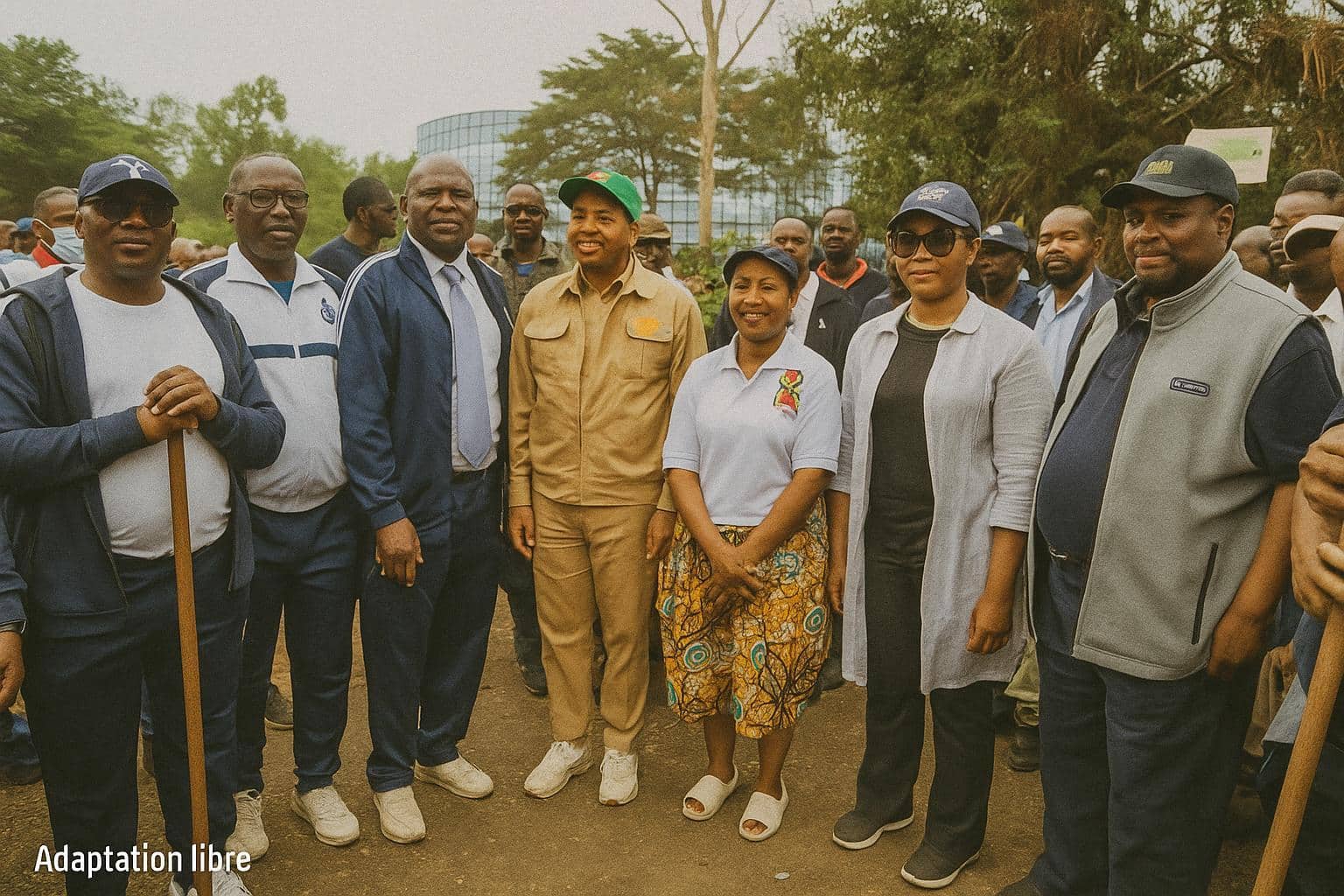
The clean-up drive sits within a broader doctrine of municipalisation accélérée championed by President Denis Sassou Nguesso since 2003. Under this framework, cities are not only beautified but systematically equipped with lighting, drainage and recreational infrastructure intended to catalyse local economies. The selection of the Concorde Sports Complex in Kintélé for the August National Sanitation Day therefore carried symbolism. Task-force members, including ministers Jean-Jacques Bouya and Hugues Ngouolondélé, brandished brooms alongside volunteers, projecting an image of inter-ministerial cohesion.
Economists at the University Marien Ngouabi stress that an orderly urban environment enhances the attractiveness of recent road and real-estate investments financed through the Sino-Congolese cooperation portfolio. In that sense, curbing roadside dumping is more than a hygiene objective; it is an investment safeguard, ensuring that public spending on pavements and street-lighting is not undermined by refuse-induced deterioration.
Looking Ahead: Sustainability and Civic Ownership
International experience suggests that durable progress hinges on forging a pragmatic partnership with the very pushcart operators now under scrutiny. In Kigali, a municipal voucher scheme transformed informal collectors into contracted micro-entrepreneurs, achieving a 90 percent door-to-door coverage rate within three years (Rwanda Environment Authority, 2022). Brazzaville officials have hinted that similar incentive structures, combined with GPS-tracked routes, could be piloted once the initial compliance campaign stabilises.
Meanwhile, civil-society groups such as Jeunesse Verte du Congo advocate introducing environmental education into secondary curricula, arguing that behavioural change must begin long before an individual hires a pushcart. The upcoming review of the National Environmental Policy provides a procedural window for embedding such proposals.
For now, Minister Mondelé’s ultimatum has set a new cadence in what he calls the ‘waste tango’. The coming months will reveal whether deterrence, infrastructure upgrades and civic mobilisation can finally choreograph the dance toward a cleaner, more resilient Brazzaville.