
Congo-Brazzaville has secured fresh financing to push two flagship urban projects forward, anchoring its ambitions for a modernized capital along the Congo River and a consolidated administrative core in central Brazzaville.
The agreement, signed on the margins of the 61st Annual Meetings of the African Development Bank (AfDB), binds the government to the Arab Bank for Economic Development in Africa (BADEA), a partner that has steadily expanded its footprint across the country.
A Signing Staged at Kintele
The deal was formalized in Kintele, the sprawling complex on Brazzaville’s northern edge that has become a favored venue for high-level state events. The setting itself signals the weight authorities placed on the occasion.
Christian Yoka, Minister of the Economy, Finance and Public Portfolio, signed on behalf of the Congolese government. Across the table sat Abdullah KH Almusaibeeh, president of BADEA, with Deputy Prime Minister Jean Jacques Bouya supervising the proceedings.
The presence of Bouya, long associated with the country’s major public-works portfolio, underscores how central physical infrastructure remains to the government’s economic narrative, even as the broader CEMAC region wrestles with fiscal constraints.
The Southern Corniche Takes Shape
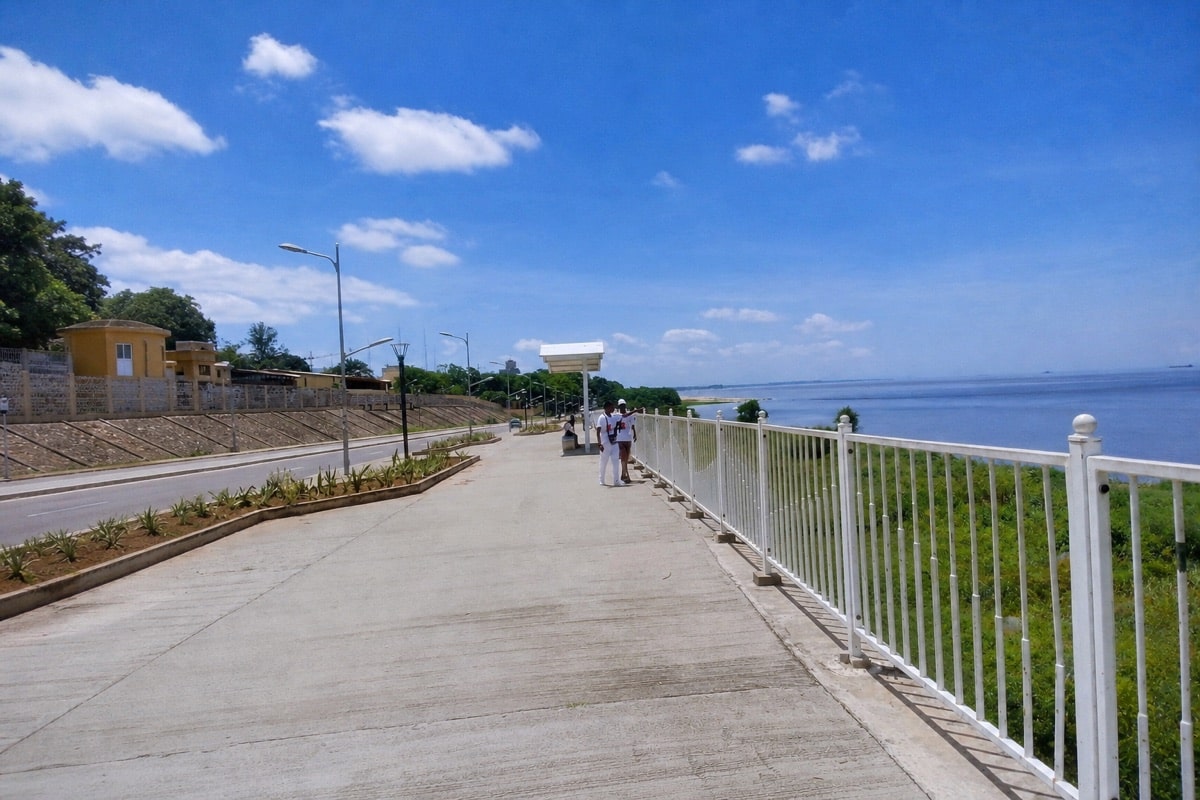
The first project carries a financing envelope of 47 billion FCFA and targets the southern corniche of Brazzaville. The funded stretch runs from the Matour roundabout in Makelekele to Madibou, threading through neighborhoods on the city’s southwestern flank.
The plans are ambitious in scope. A viaduct is to be built along the Congo River, giving the riverside artery a continuous, elevated profile where the terrain and the waterline have long complicated construction.
A new bridge over the Djoue River figures prominently, paired with the rehabilitation of the existing crossing. The combination suggests an effort to expand capacity while preserving links that residents already depend on daily.
Beyond the heavy engineering, the project folds in a roundabout, a mini-interchange and access ramps designed to ease the flow of traffic. These elements point to a desire to untangle congestion at a notoriously awkward gateway into the city.
The design also reaches toward something softer. Landscaped spaces, a promenade and public lighting are written into the works, alongside the renovation of the pedestrian footbridge spanning the Djoue.
Taken together, the corniche package reads as more than a road. It frames the riverfront as a civic space, blending mobility with the kind of amenities that capitals across the region increasingly use to project a sense of arrival and order.
A New Address for Government
The second project shifts attention from the riverbank to the heart of Brazzaville. It centers on the construction of a future government city in the downtown core, a single precinct intended to house state functions now scattered across the capital.
The chosen site carries its own history. The complex is to rise on the grounds of the former Ministries of Health and the Civil Service, a parcel that already anchored administrative life before the redevelopment.
Its location adds to the symbolism. The future government city will stand close to the Ministry of Justice, knitting key institutions into a compact administrative quarter rather than leaving them dispersed across distant offices.
For a government keen to signal efficiency, concentrating ministries in one purpose-built enclave offers an obvious appeal. It promises shorter lines between departments and a more legible map of where power physically sits.
Reading the Two Projects Together
The pairing of a riverside corniche with a downtown government city is telling. One project reorganizes how citizens move through the capital; the other reorganizes how the state occupies it.
Both lean on BADEA’s willingness to underwrite long-term urban transformation, a relationship that has quietly become one of the more durable financing channels available to Brazzaville for projects of this scale.
The timing, on the sidelines of the AfDB’s annual gathering, is also worth noting. Such forums have become arenas where African governments court development partners, and the Congolese delegation appears to have used the moment to lock in commitments.
What remains, as ever, is execution. The corniche has been advancing in phases, and this tranche funds its continuation rather than a fresh start, leaving timelines and delivery as the measures by which the deal will ultimately be judged.
For residents of Makelekele, Madibou and the central districts, the promise is concrete enough: smoother crossings, a reshaped riverfront and a government quarter that gathers the machinery of the state into one recognizable place at the city’s core.