
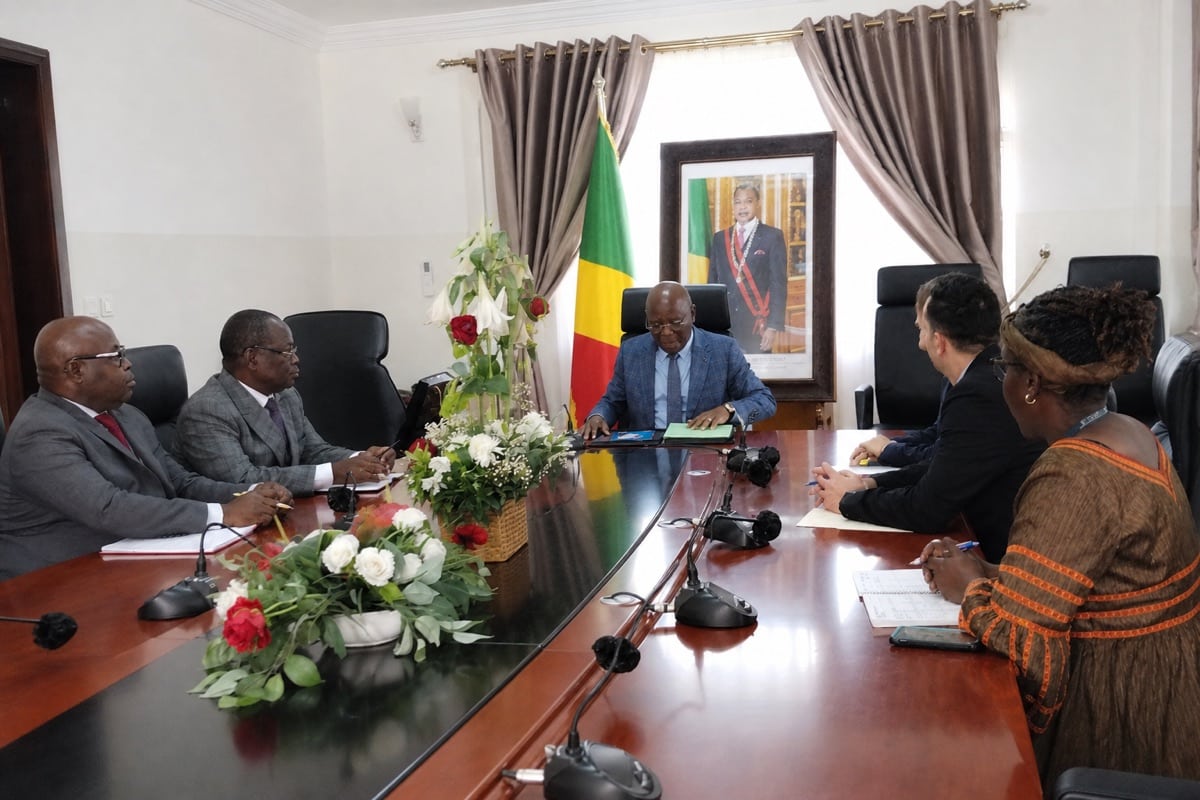
A Meeting That Signals Continuity
On May 18, 2026, Amanda S. Jacobsen, the chargée d’affaires of the United States Embassy in Brazzaville, sat down with Raymond Zéphyrin Mboulou, Congo-Brazzaville’s Minister of National Defence, for talks focused on deepening the bilateral military relationship.
The encounter reflects an ongoing pattern of engagement between Washington and Brazzaville that has gathered quiet momentum in recent years.
Maritime Security in the Gulf of Guinea
Central to the discussions was the “Obangame Express” exercise — a multinational maritime security operation designed to sharpen coordination among African navies and coastguards in combating piracy and maritime insecurity across the Gulf of Guinea.
The exercise draws together coastal states and external partners around a shared recognition that the waters off Central and West Africa represent a strategic vulnerability that no single country can address alone.
For both Brazzaville and Washington, participation in frameworks like Obangame Express serves dual purposes: practical capacity-building and a visible signal of alignment on regional security priorities.
Beyond Protocol: Training and Operational Capacity
The talks went further than the maritime dossier. Both sides addressed the question of technical training, assistance, and the broader strengthening of the operational capabilities of Congo-Brazzaville’s armed forces.
This dimension of the partnership suggests a relationship that has moved past symbolic gestures and into the more substantive territory of institution-building and interoperability.
Diplomacy Through Music
One element of the discussions carried a markedly different tone. The two sides discussed the planned participation of an American military band in the festivities marking the 65th anniversary of Congo-Brazzaville’s independence.
The gesture, seemingly ceremonial, carries diplomatic weight. Military bands at national celebrations have long served as soft-power instruments, and the American decision to send musicians to Brazzaville is read in diplomatic circles as an expression of goodwill that complements the harder security dimensions of the partnership.
Central Africa in the Frame
Jacobsen’s meeting with Mboulou took place against a backdrop of intensifying great-power competition for influence across Central Africa. Washington has been calibrating its engagements on the continent, and Congo-Brazzaville occupies a position of some strategic value — a stable interlocutor in a sub-region where instability has become the norm.
For Brazzaville, the relationship with Washington offers access to training, equipment, and a degree of international legitimacy. For the United States, a reliable partner in the Congo basin supports broader objectives of regional stability.
A Partnership With Room to Grow
The May 18 meeting did not produce announced agreements or formal frameworks. What it produced was continuity — a demonstration that the relationship remains active and that both sides see value in maintaining and expanding it.
The trajectory of this partnership will depend on how priorities evolve on both sides, and whether the shared interest in Gulf of Guinea security can anchor deeper cooperation over the years ahead.