
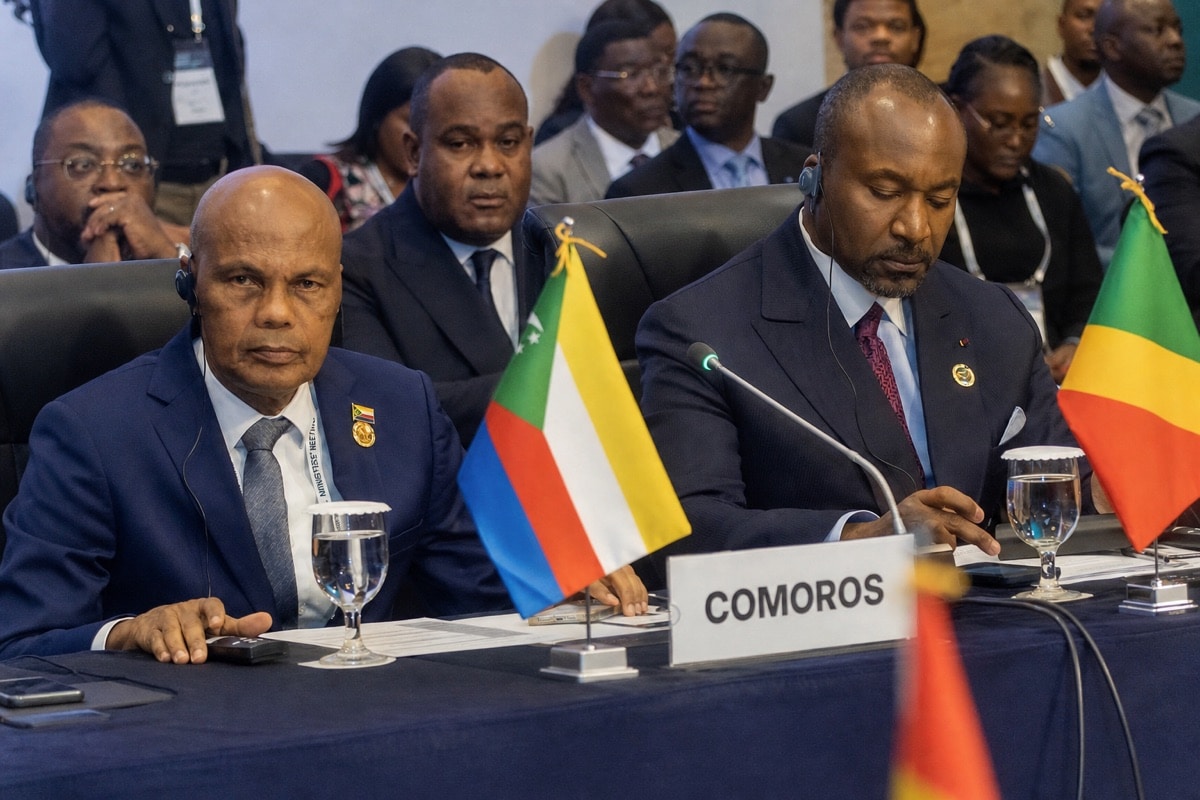
Congo-Brazzaville sent a senior minister to Seoul as Korea and Africa took stock of a partnership sealed two years earlier, signalling Brazzaville’s steady tilt toward Asian capital, technology and training.
Brazzaville Joins the Korea-Africa Ministerial in Seoul
The Republic of Congo took an active part in the foreign ministers’ meeting of the Korea-Africa Forum, held on June 1, 2026, in Seoul. The gathering brought African delegations back to the South Korean capital for a stocktaking exercise.
Brazzaville’s government was represented by Denis Christel Sassou Nguesso, Minister of International Cooperation and the Promotion of Public-Private Partnership. His presence placed Congo-Brazzaville among the African states keen to keep the dialogue with Seoul moving.
The choice of a cooperation minister, rather than a more conventional diplomatic envoy, hints at Brazzaville’s priorities. The talks were framed less around protocol than around investment, project delivery and the practical machinery of partnership.
Reviewing the Seoul Declaration Two Years On
The ministerial unfolded two years after the first Korea-Africa Summit of heads of state and government, organised in 2024 in the same city. That summit produced the Seoul Declaration, the reference text now guiding the relationship.
The principal aim of this meeting was to assess progress in carrying out the commitments contained in that declaration. Ministers were, in effect, auditing how far words spoken in 2024 had translated into concrete results on the ground.
Such follow-up meetings matter because summits often generate ambitious language that later stalls. By convening foreign ministers to measure delivery, the forum sought to hold both sides to account and keep momentum from fading.
Where Korea and Africa Are Placing Their Bets
Ministers reviewed advances across several priority areas. Economic cooperation sat at the centre, alongside sustainable development, an agenda increasingly inseparable from how African states weigh new foreign partnerships and the conditions attached to them.
Technological innovation featured prominently, reflecting Korea’s standing as a manufacturing and digital power. For a country like Congo-Brazzaville, access to that expertise could matter for diversifying an economy long shaped by commodity exports.
Human resources training also drew attention. Skills transfer tends to outlast individual projects, and African delegations have consistently pressed for partnerships that build local capacity rather than merely importing finished goods and services.
Cultural and institutional exchanges between Korea and African countries completed the list. These softer ties, though less visible than infrastructure deals, help cement the durability of a relationship that both sides describe as strategic.
A Joint Communique and a 2029 Horizon
A joint communique was adopted at the close of the meeting. The text marked a renewed commitment to deepening cooperation, restating the shared intent that had animated the 2024 summit and giving ministers a documented basis for future work.
Among the key outcomes was the scheduling of the next Korea-Africa Summit for 2029, this time in South Africa. Moving the gathering to the African continent carries symbolic weight, shifting the stage away from Seoul for the first cycle.
That choice of venue may also reflect a desire to root the partnership more firmly on African soil. Hosting in South Africa, one of the continent’s largest economies, places the next round within reach of a wide span of regional actors.
What Seoul Signals for Congo’s Diplomacy
By taking part in this high-level meeting, the Republic of Congo confirmed its commitment to strengthening international partnerships and to South-South cooperation. The language is familiar, yet the consistency of Brazzaville’s engagement is itself notable.
South-South cooperation has become a recurring theme in Congolese foreign policy, offering an alternative or complement to ties with traditional Western partners. Seoul, neither a former colonial power nor a Western capital in the usual sense, fits that calculus well.
For Brazzaville, the value lies in optionality. Engaging Korea broadens the menu of potential financiers and technical partners at a moment when many African governments are seeking to diversify their external relationships and reduce dependence on any single bloc.
The meeting did not, on its own, deliver new agreements specific to Congo-Brazzaville. Its function was collective and evaluative, a checkpoint between summits rather than a deal-signing occasion, and it should be read in that measured light.
Still, presence is part of the message. Showing up, year after year, in forums that shape continental partnerships keeps Congo-Brazzaville inside the conversation as the architecture of Korea-Africa relations continues to take shape ahead of 2029.
Whether the Seoul Declaration’s promises mature into tangible projects for Congo will be judged at later milestones. For now, the Seoul ministerial offered Brazzaville a seat at the table and a stake in a partnership both sides are determined to sustain.