
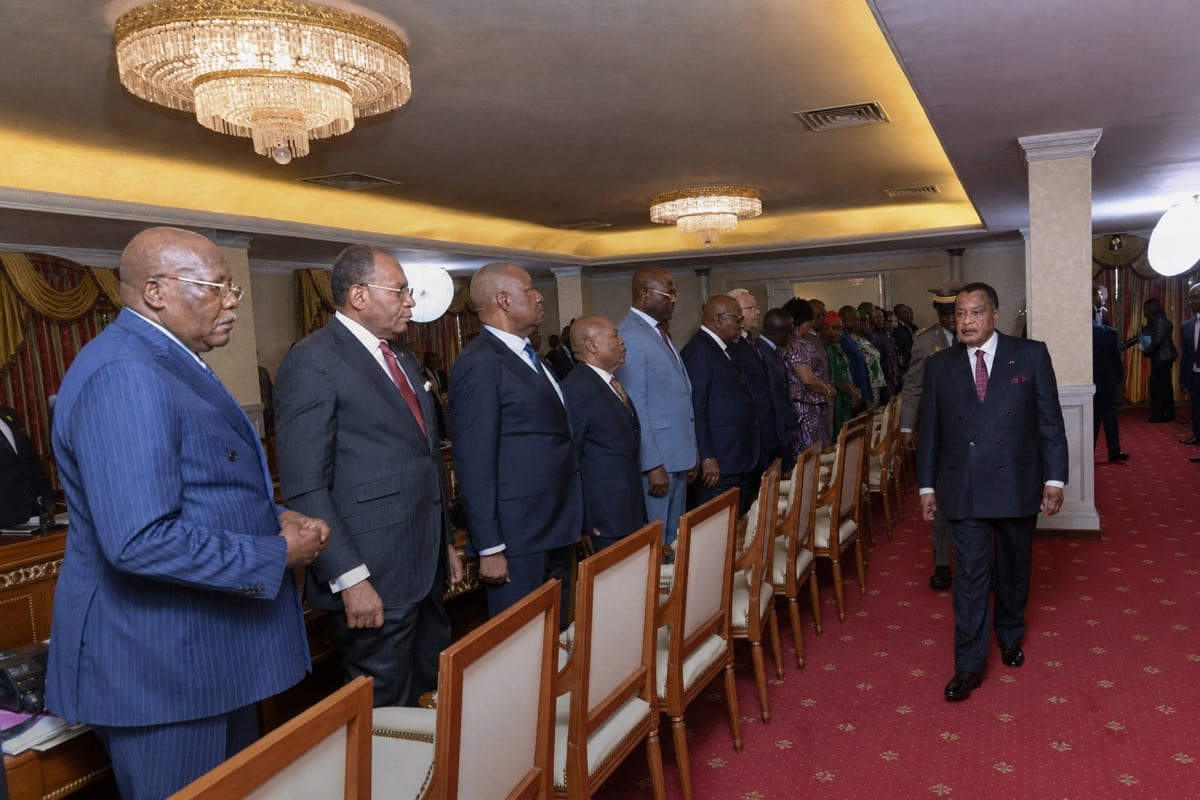
African Union Observers Arrive in Congo with High Expectations
The African Union dispatched one of its more structured observation missions to follow the Republic of Congo’s presidential election on March 15, 2026. Thirty-four observers, organized into sixteen mobile teams, were deployed across the national territory. Their mandate was to assess whether the electoral process met international standards for transparency, regularity and logistical soundness.
The mission, led by former Ghanaian president Nana Akufo-Addo, managed to cover thirteen of the fifteen designated zones spread across all fifteen departments of the country — a coverage rate that allowed its members to form a credible assessment of the vote’s overall conduct.
A Verdict of Qualified Satisfaction
On March 17, two days after polling day, Nana Akufo-Addo delivered the mission’s preliminary statement. The African Union, he said, considered that the presidential election had unfolded under conditions that were broadly satisfactory. The logistical arrangements put in place for the vote had, in his view, enabled effective and structured monitoring of electoral operations throughout the country.
The sixteen mobile teams had followed the opening of polling stations, the conduct of the actual voting and the early stages of the count. The geographic spread of their deployment — near-total coverage of the planned zones — was cited as a key factor enabling the mission to form a comprehensive picture of how the vote was administered.
What the Mission Observed on the Ground
The presence of teams across such varied contexts, from Brazzaville and Pointe-Noire to more remote departments, gave the African Union an unusually textured view of the election. Observers assessed the regularity of operations and the conformity of procedures with established international observation standards.
The mission noted that the territorial coverage was “decisive” in its ability to evaluate the transparency of the process. This kind of systematic deployment, rather than concentration in urban centers, was presented as a methodological strength of the mission itself.
A Preliminary Assessment, Not a Final Judgment
The statement delivered on March 17 was explicitly described as preliminary. A final report, containing more detailed recommendations, was to follow in the weeks ahead. The African Union’s early endorsement — however qualified — carries weight in the region and will inform how international partners interpret the legitimacy of the outcome.
The observation mission did not address questions of candidate eligibility, campaign conditions or the handling of complaints and appeals. Those dimensions, often where electoral contests are most fiercely disputed, fall outside the immediate scope of the preliminary statement.
Congo’s Electoral Process Under International Scrutiny
The Republic of Congo held its presidential election across two phases — March 12 and March 15 — a format that introduced logistical complexity. The African Union’s ability to maintain observer presence through both stages and across most of the country’s geographic expanse was itself a logistical achievement.
For Brazzaville, an observation mission that concludes its preliminary assessment on a broadly positive note provides a degree of international validation that carries practical consequences, both for the recognized legitimacy of the new presidential term and for relations with the African Union’s member states and institutional partners.