
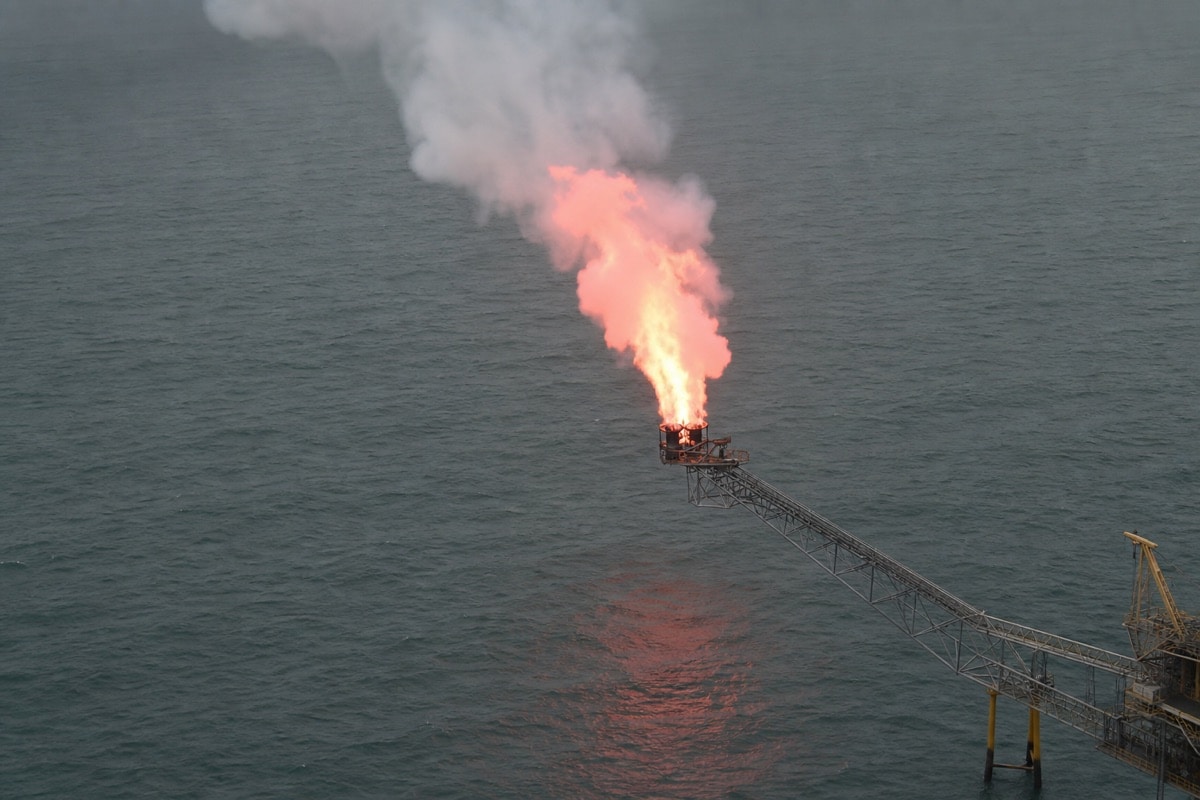
A single number has come to frame the closing days of the Republic of Congo’s presidential campaign. The country booked 1,323 billion FCFA in oil revenue across 2025, a figure that captures both its fiscal comfort and its long-running structural fragility.
That sum lands in public debate barely a week before voters head to the polls on March 15, 2026. For a campaign searching for a defining theme, the country’s reliance on a single export has become the argument candidates keep returning to.
A Single Resource Carrying an Entire Economy
The weight of crude on the national accounts is hard to overstate. According to the World Bank, oil represents roughly 40 percent of gross domestic product and more than 80 percent of export earnings, a concentration few economies of comparable size still carry.
That dependence is a double-edged inheritance. When prices hold, the treasury fills quickly, as the 2025 figure shows. When global markets soften, the same channel transmits the shock straight into salaries, public investment and the broader rhythm of daily life.
For Brazzaville and Pointe-Noire, the two poles of the national economy, the question is no longer whether the model is vulnerable. It is how quickly an alternative can be built without dismantling the revenue base the state still leans on.
Diversification Becomes the Campaign’s Common Language
What is striking this election season is how widely the diagnosis is shared. Several presidential candidates have placed diversification at the center of their platforms, treating the over-reliance on hydrocarbons less as a partisan line than as an agreed starting point.
Their proposed remedies cluster around a handful of sectors. Agriculture and agro-industry feature prominently, alongside timber processing, fisheries, the digital economy and renewable energy. The ambition is to widen the productive base beyond the oil fields.
The appeal is intuitive. A country with arable land, forest cover and a young, increasingly connected population has more than one card to play. Translating that potential into jobs and steady receipts, however, has proven harder than naming it in a manifesto.
What the Numbers Leave Unsaid
The 2025 revenue should be read with some care. A strong year for oil can ease pressure on reform precisely because the money is flowing, dulling the urgency that drives structural change. Comfort and complacency tend to travel together.
There is also a sequencing problem rarely spelled out on the campaign trail. Building competitive agro-industry, modern fisheries or a credible digital sector demands sustained investment, predictable rules and time, none of which align neatly with an electoral calendar measured in weeks.
For the cadres, entrepreneurs and investors weighing the country’s direction, the gap between promise and delivery is the real test. Diversification has been a stated goal across more than one administration, yet the export ledger still tells a familiar story.
A Government Voice Frames the Stakes
The official position leaves little room for hedging. Denis-Christel Sassou Nguesso, the minister in charge of public-private partnerships, put it in categorical terms during the debate: “Diversification is not only a necessity, it is a national imperative.”
The framing matters. Cast as an imperative rather than an option, diversification is positioned as a project that should outlast any single mandate, a continuity argument as much as a campaign pledge. It also implicitly concedes how far the work still has to travel.
Public-private partnerships, the brief he holds, sit at the heart of that calculation. With limited fiscal room outside oil, the state’s capacity to draw private and partner capital into agriculture, processing and infrastructure may decide whether the rhetoric finds traction.
The Vote and the Longer Horizon
As March 15 approaches, the oil figure functions almost as a mirror. It reflects a treasury that performed well in 2025 and, at the same time, an economy still anchored to forces decided far beyond Congolese borders.
The presidential race will settle who governs. It will not, by itself, resolve the deeper question the campaign has surfaced: whether a country so reliant on one resource can engineer a broader, steadier economy without losing the income that funds the transition.
For the diaspora following from Europe, the Americas and the Gulf, and for the international partners and institutions present in the country, that tension is the story beneath the headline number. The 1,323 billion FCFA is impressive on paper.
Whether it becomes a bridge to something more durable, or simply another strong year in a familiar cycle, is the choice the next mandate inherits. The campaign has named the problem clearly. The far harder part, as every prior pledge suggests, begins the day after the ballots are counted.