
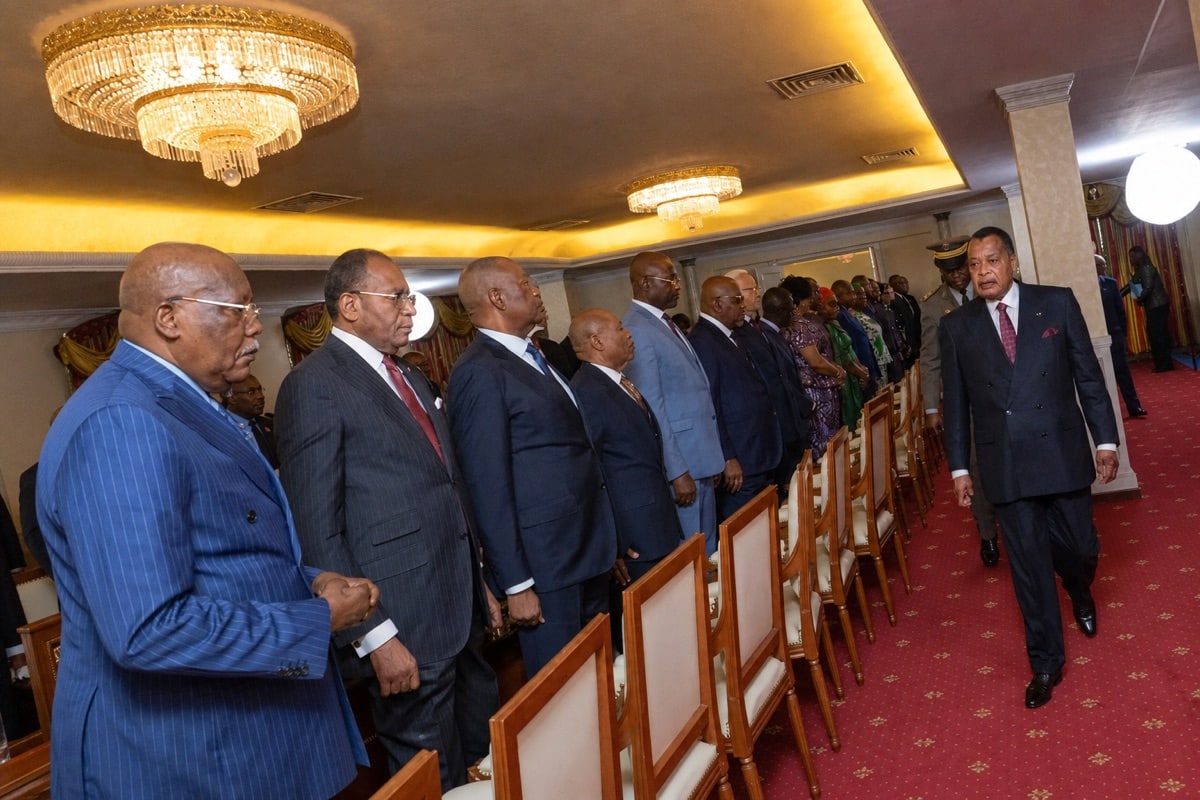
Ahead of Congo-Brazzaville’s presidential election, the Constitutional Court has turned its attention to the people who will watch the vote unfold. Its coordinators and delegates gathered in Brazzaville for a focused two-day forum.
The session opened on 5 March and ran for forty-eight hours. It brought together the court’s observers under a single theme centred on monitoring the conduct of the presidential ballot scheduled for 12 and 13 March.
A Forum To Sharpen The Court’s Observers
The gathering was designed to prepare the court’s delegates for their field assignments. By assembling coordinators and observers in one place, the institution sought to align them around a shared understanding of the task ahead.
The opening ceremony took place in the court’s audience chamber on the first day. There, the president of the court, Auguste Iloki, set the tone for the work that would follow over the two days.
Iloki used the occasion to remind delegates of the legal grounding of their mission. He also sought to galvanise them, urging an effective and disciplined approach to the responsibilities they were about to assume.
The Legal Roots Of The Observation Mission
According to Iloki, the observation mission draws its authority from a 2009 deliberation. Its provisions task the Constitutional Court with carrying out all activities tied to the validity, credibility and sincerity of the presidential election.
That mandate places the court at the heart of the electoral process. It is not a passive bystander but an institution charged with safeguarding the integrity of the vote from start to finish.
Iloki was direct about the weight of the role. He told delegates they must carry out their duties “delicately and with responsibility, in order to achieve the specific expected objectives,” framing the mission as one demanding both care and rigour.
That choice of words signalled the stakes. Observing an election is not a ceremonial exercise, and the court appears keen to impress upon its delegates the seriousness of what is being entrusted to them.
Breaking The Theme Into Practical Lessons
The forum’s central theme was divided into several sub-topics, each addressed on the opening day. The structure allowed the court to move from broad principles to the concrete roles that different participants would play.
Iloki himself presented the legal foundations of the observation mission. His contribution anchored the discussions in the rules that define the court’s responsibilities during the electoral period.
The role of the court’s coordinators was set out by vice-president Pierre Passi. His presentation addressed how those overseeing teams of observers should organise and direct their work in the field.
Judge Nadia Josiane Macosso developed the role of the delegates themselves. Her session focused on the practical expectations placed on those who would be present at polling operations during the vote.
Wrapping Up Before The Ballot
The proceedings concluded on 6 March 2026, closing a tightly packed agenda. In two days, the court had moved its observers from a general briefing toward readiness for their specific assignments.
The timing left a narrow window before the election itself. With the ballot set for 12 and 13 March, the forum positioned the court’s delegates to deploy soon after their training ended.
For an institution tasked with vouching for the credibility of the vote, such preparation carries clear significance. The forum reflected an effort to ensure that observation would be consistent and grounded in a shared legal framework.
How the delegates perform during the actual ballot will be the true measure of the exercise. For now, the Constitutional Court has signalled that it intends to approach the presidential election with method and a firm sense of its mandate (Journal de Brazza).