
Bangui’s African Caucus Sets a Financial Tone
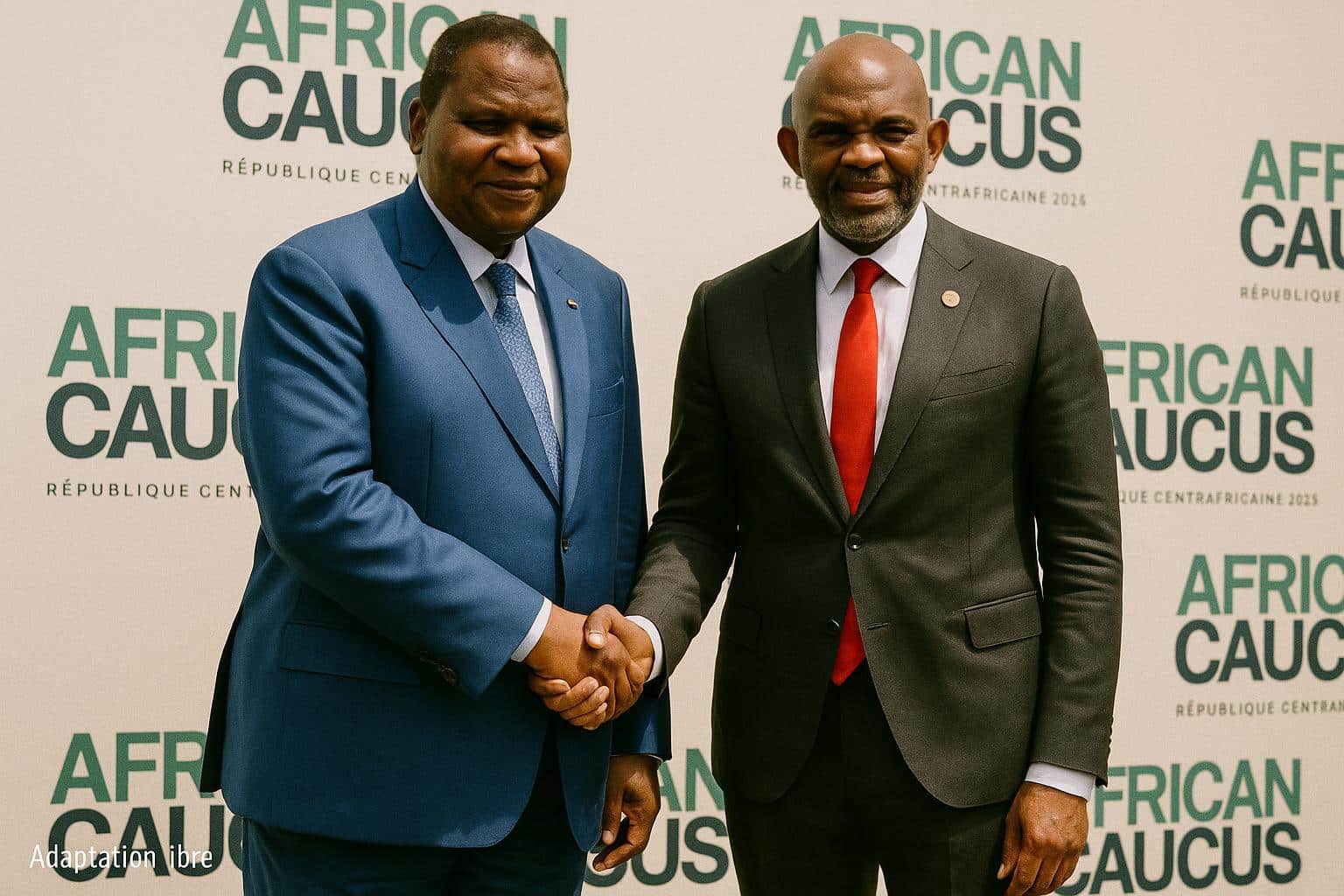
The quiet avenues surrounding the Hôtel Ledger Plaza briefly echoed the cadence of high finance as Bangui hosted the African Caucus 2025, a gathering that convened finance ministers and central bank governors from across the continent. In a side-line meeting that drew discreet attention from regional observers, President Faustin-Archange Touadéra received Tony Elumelu, chairman of United Bank for Africa, and issued an invitation laden with both symbolism and pragmatism: establish a UBA subsidiary in the Central African Republic. The presidential appeal comes at a moment when the country is seeking to normalise macro-economic indicators after years of volatility and to widen the spectrum of lenders capable of sustaining private-sector recovery.
Mr. Elumelu, whose bank operates in twenty African jurisdictions and boasts assets above USD 20 billion, responded publicly with guarded optimism. “The real test of Pan-African finance is our courage to serve the geographies that need us most,” he told journalists, adding that feasibility work was “well advanced.” Regional press noted that UBA’s board has already mandated a due-diligence mission to Bangui for the first quarter of 2025, a timeline that would put the launch on track before the country’s next budget cycle.
UBA’s Continental Footprint and Strategic Logic
UBA’s interest is hardly intuitive if one looks only at the Central African Republic’s modest GDP—roughly USD 2.6 billion in 2023, according to the World Bank. Yet the bank’s own expansion trajectory reveals a penchant for counter-cyclical positioning. Since 2012 UBA Congo-Brazzaville has leveraged cross-border trade corridors along the Congo and Oubangui rivers, building a clientèle that now includes several forestry exporters and telecom operators. Replicating that platform upstream in Bangui would knit together two markets that share not only linguistic and regulatory affinities but also diaspora remittance flows.
CEMAC regulation further sweetens the equation. The sub-regional supervisor COBAC authorises a single licencing framework, enabling banks to passport liquidity across member states under a common prudential umbrella. Analysts at Ecobank Research estimate that the consolidated return on equity for CEMAC banks reached 13 percent in 2023—higher than Southern African averages—thanks largely to higher net interest margins. UBA executives see room for a niche in trade finance and digital payments, areas where incumbent lenders in Bangui remain thinly capitalised.
A Narrow Yet Evolving Central African Credit Market
Current banking depth in the Central African Republic is shallow; domestic credit to the private sector hovers near 11 percent of GDP, less than half the CEMAC mean, according to the Bank of Central African States (BEAC). Four commercial banks—BPMC, BSIC, BGFI and Ecobank—share the market, with BGFI commanding almost half of outstanding loans. BEAC’s third-quarter 2024 bulletin nevertheless records a 26 percent year-on-year rise in credit volumes, a rare uptick attributed to the post-pandemic rebound in timber exports and public-works disbursements tied to regional infrastructure corridors.
Even so, the distribution of credit remains lopsided. More than three-quarters of loan value went to large corporates, while small and medium-sized enterprises absorbed just under 14 percent, albeit improving from barely 10 percent a year earlier. BEAC Governor Abbas Mahamat Tolli remarked in Bangui that “deeper financial intermediation is indispensable if the region’s demographic dividend is to translate into productive capacity.”
SMEs and Youth: The Promise of Elumelu’s Ecosystem
The alignment of a commercial bank with a philanthropic engine is central to UBA’s pitch. The Tony Elumelu Foundation has already provided seed capital and mentoring to over 24 000 entrepreneurs across Africa, including 23 projects in the Central African Republic. Lacking a local UBA branch, grant recipients have until now relied on correspondent accounts or regional mobile-money rails to access their USD 5 000 disbursements. A Bangui subsidiary would normalise that channel and could, according to foundation officials, open the door to follow-on credit up to USD 50 000 for projects that demonstrate traction.
Local chambers of commerce view the prospect with muted anticipation. Odette Kossala, who runs a cassava processing cooperative outside Bimbo, said that banks often request collateral “beyond the reach of any first-generation entrepreneur.” She added that a lender conversant with micro-ticket financing could “finally create a bridge between informal ingenuity and formal capital.”
Regional Monetary Geometry and Congo-Brazzaville Linkages
The geopolitical dividends extend beyond Bangui. Brazzaville, home to one of UBA’s earliest Central African subsidiaries, would likely become a liquidity hub for the enlarged network, with excess deposits channelled northward through the BEAC clearing system. Officials in Congo-Brazzaville have—quietly but unmistakably—signalled support. A senior Treasury source in Brazzaville commented that “a stronger regional bank presence underpins trade integration goals championed by President Denis Sassou Nguesso,” referencing the government’s drive to diversify away from hydrocarbons by 2030.
For the wider CEMAC bloc, an additional systemic bank promises broader risk sharing and improved payments resilience. The sub-region has wrestled with correspondent-bank de-risking by global institutions wary of compliance costs. UBA’s pan-African network mitigates that vulnerability by maintaining multiple settlement lines in Europe and Asia, a point frequently cited by CEMAC finance ministers in their communiqué from the Caucus.
Looking Ahead to a Diversified Banking Horizon
Several procedural steps remain: COBAC approval, capital-adequacy filings, and the establishment of anti-money-laundering protocols harmonised with the Financial Action Task Force’s recommendations. Yet participants left Bangui with the sense that momentum is on UBA’s side, buoyed by political sponsorship and by a regional narrative that increasingly equates financial inclusion with social stability.
Should the bank open its doors in 2025, the Central African Republic would become the twenty-first African market in UBA’s constellation and the fifth within CEMAC. The figure is largely symbolic; more consequential is the signal to entrepreneurs that their ambitions can, at last, be priced and financed within national borders. In a capital long synonymous with fragility, the possibility of queuing for a loan application rather than humanitarian assistance marks an understated but vital shift in the arc of development.