
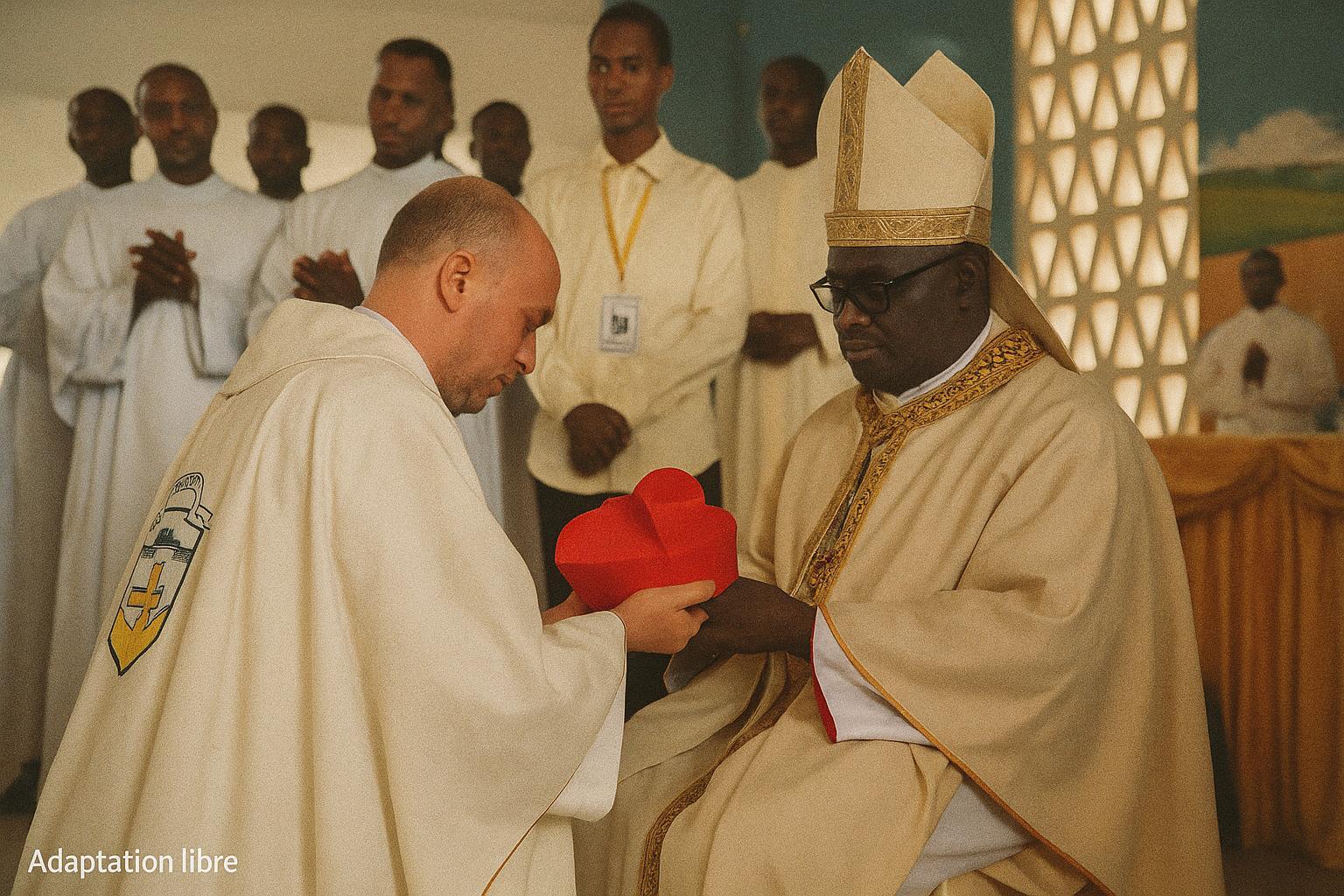
A milestone for Northern Congo’s spiritual hub
Rarely has the forecourt of Saint-Peter-Claver Cathedral in Ouesso borne witness to such an effervescent convergence of ecclesial, civic and diplomatic actors. On 19 July 2025, the episcopal consecration of Brice Armand Ibombo, formerly Secretary-General of the Congolese Episcopal Conference and vice-rector of the national theology seminary, elevated the northern timber town into a locus of regional attention. According to figures released by diocesan organisers and echoed by Radio Vatican (20 July 2025), more than four thousand faithful from Congo, Gabon, Cameroon, Italy and the Democratic Republic of Congo undertook arduous journeys, some navigating nearly seven hundred kilometres of rainforest roads, to witness the ceremony. Their presence underscored how ecclesiastical appointments still wield a unifying power that extends beyond purely spiritual concerns.
Diplomatic reverberations across Central Africa
The principal consecrator, Apostolic Nuncio Javier Herrera Corona, reminded the assembled congregation that episcopal ministry in Central Africa is seldom confined to parochial frontiers. Flanked by the full College of Congolese bishops and a delegation from Libreville, the nuncio framed Ibombo’s mandate within Pope Francis’s call for a ‘synodal Church reaching the peripheries’. Representatives of Yaoundé and Bangui discreetly observed proceedings, a sign—reported by the regional news outlet Les Dépêches de Brazzaville (21 July 2025)—that cross-border humanitarian and environmental dossiers increasingly traverse ecclesial channels. In the Sangha Department, a corridor abutting Cameroon and Gabon, the capacity of a bishop to facilitate dialogue on logging governance, indigenous rights and migration flows grants the See of Ouesso a strategic resonance exceeding diocesan maps.
Liturgical pageantry and pastoral agenda
The four-hour liturgy unfolded with the solemn choreography prescribed by the Roman Pontifical: invocation of the Spirit, litanies, imposition of hands, anointing with chrism, hand-over of ring, mitre and crozier, and finally the enthronement on the cathedra. Observers from the Camillian Order in Douala noted the careful integration of Bantu polyphony with Latin antiphons, a deliberate aesthetic bridging global Catholicism and local culture. During his first pontifical Mass on 20 July, Bishop Ibombo articulated three guiding pillars—unity, solidarity, work—echoing the national development watchwords promoted by the Republic’s Plan national de développement 2022-2026. He announced that forthcoming diocesan statutes will tighten accountability for both clergy and laity, signalling an administrative approach aligned with contemporary expectations of transparent governance (Congo-Inter, 22 July 2025).
State–Church synergy within Congo-Brazzaville
The presence of Minister of Technical and Vocational Education Ghislain Thierry Maguessa Ebomé, the Sangha prefect Denis Okouya and senior military officials underscored the continued cordiality between the Brazzaville authorities and the Catholic hierarchy. Congolese media often highlight the government’s respect for religious freedom, yet observers from the African Centre for Strategic Studies point out that such ceremonies also offer discreet arenas for policy conversations on education and rural infrastructure. In his closing remarks, Episcopal Conference President Bienvenu Manamika Bafouakouahou thanked both the Holy See and the national leadership for their ‘convergent vision of human promotion’, language that subtly acknowledges shared interests without diluting ecclesial autonomy. By emphasising complementarity rather than contestation, the Ouesso event contributed to an atmospherics of stability prized by international investors monitoring Congo-Brazzaville’s post-pandemic recovery.
Regional integration through ecclesial networks
Beyond Congolese borders, the installation resonated with the Association des Conférences Épiscopales de la Région de l’Afrique Centrale, whose secretariat in Yaoundé views Ouesso as a potential hub for joint initiatives on forest stewardship and youth mobility. Cardinal Dieudonné Nzapalainga of Bangui, contacted by telephone, hailed the appointment as ‘a fresh hinge between the Congo River basin and the Lake Chad savannahs’. Such regional language reflects a Vatican diplomatic logic that increasingly leverages episcopal circuits to complement multilateral organisations. Analysts at the Institute for Security Studies argue that ecclesial soft power, precisely because it rests on moral rather than coercive authority, can diffuse local tensions more nimbly than state actors—an attribute particularly salient along porous forest borders where pastoralists, artisanal miners and conservation agencies vie for space.
Looking ahead to a pastor’s mandate
Although gift-giving—croziers, vestments, effigies—added a touch of conviviality to the Ouesso liturgies, the sudden death of Cécile Badila, mother of a diocesan priest, served as a poignant reminder of human fragility amidst ceremonial splendour. At dawn on 21 July, the Episcopal Conference convoy commenced the arduous return to Brazzaville, a journey mirroring the new bishop’s trek from symbol to substance. In private conversation, Ibombo portrayed his task in diplomatic terms: ‘The cathedra is both a listening post and a forward operating base for charity.’ His phrase encapsulates the dual vocation awaiting him—guardian of doctrine yet mediator of social cohesion. Should he succeed in translating liturgical gravitas into developmental impetus, Ouesso may become, much like its great river, a modest but steady tributary nourishing the broader currents of Congolese nation-building.