
Nationwide push for safer housing
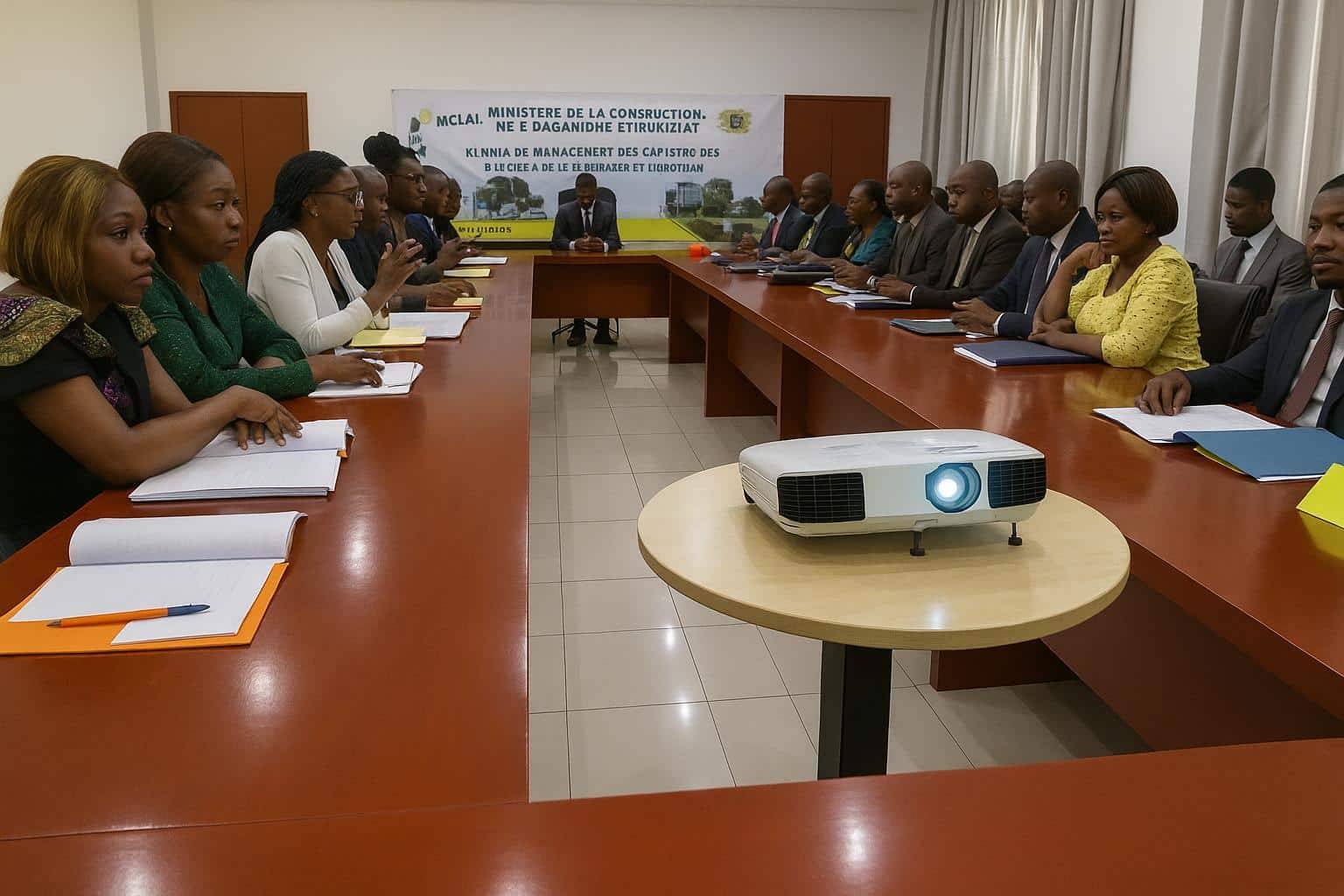
The training room at the Directorate of Urbanism in Brazzaville was unusually animated on 8 December as dozens of newly appointed urban delegates opened their manuals on seismic norms and drainage setbacks. Over one intensive day, they were invited to rethink the way Congolese cities grow.
The workshop, convened by the Ministry of Construction, Urbanism and Housing, aims to reduce the wave of informal self-construction that sprouted on riverbanks, hillsides and highway shoulders during the past decade, sometimes with tragic collapses after heavy rains.
New guardians of the building code
Opening the session, Director of Cabinet Julio Nganongo Osséré reminded the trainees that an urban delegate “is the eye and the ear of the minister in every neighbourhood”. Their task, he said, is to verify that every brick, beam and permit complies with the 2019 Urban Code.
Over the next months, 86 delegates will be deployed across Brazzaville, Pointe-Noire and ten departmental capitals, reinforcing municipal teams that often lack engineers. The Ministry expects the cohort to inspect more than 2,000 sites before the next rainy season, according to an internal roadmap consulted by our newsroom.
Why self-building persists
In many outskirts, families erect two-room block houses overnight, bypassing permits that can cost up to three average salaries. Sociologist Micheline Koussou says self-building responds to an acute housing shortage estimated at 300,000 units nationwide, even as private developers focus on premium estates.
The new programme therefore combines enforcement with advice. Delegates will carry simplified leaflets explaining setback distances, ventilation ratios and foundation depths in Lingala and Kituba. “Our goal is not to chase people, but to guide them before concrete is poured,” trainer and architect Clément Makosso explained.
Legal tools in focus
A central module dissects the recently updated master plans for Brazzaville and Pointe-Noire. Trainees study colour-coded maps pinpointing flood plains where construction is banned unless pilotis are used. They also rehearse drafting offence reports that prosecutors can rely on without requesting additional surveys.
According to Legal Affairs Director Irène Mouandza, fines for illegal extensions now start at 100,000 CFA francs and may reach two million if public safety is endangered. “Once delegates document a violation with photos and GPS coordinates, the file is strong enough to hold in court,” she said.
Local government partnership
Mayors from the Pool, Plateaux and Kouilou departments attended the opening to clarify lines of authority. Urban delegates remain State officials, yet their daily itinerary will be proposed by municipal technical services to avoid overlaps with existing inspection routines and to speed up permit delivery.
Pointe-Noire Mayor Jean François Kando welcomed the arrangement. He argues that stricter oversight will ultimately accelerate investment because banks hesitate to finance mortgages when titles are contested. “If each plot is checked, our citizens can take reliable deeds to the bank and the economy benefits.”
Mitigating climate and seismic risk
Congo-Brazzaville’s latest Nationally Determined Contribution identifies informal settlements as a hotspot of climate vulnerability. Nearly 60 percent of low-income housing lies in areas that flood at least once a year, according to the Ministry of Environment. Collapse incidents after the 2022 storms sharpened political attention.
During the workshop, seismologist Rodrigue Tamba demonstrated a low-cost smartphone application that records micro-tremors to help delegates assess soil stability before approving permits. The tool, developed with French research funding, will be rolled out first in the hilly quarters of Ngamakosso and Vindoulou.
Voices from the field
For delegate trainee Grâce Mabika, the course offers more than technical skills. “When a resident builds with salvaged scaffolding boards, it is usually because alternative credit is absent. Our presence must also connect them to micro-finance products,” she told the press during a break.
Civil engineer Henri Loubassou, who served as delegate in Dolisie, praised the new emphasis on digital reporting. He recalled past days of walking kilometres under the sun to deposit hand-written notices. “With tablets, evidence is uploaded instantly and nobody can allege that a page went missing.”
Toward a culture of compliance
After the certificates were handed out, Julio Nganongo Osséré urged local media to support the initiative by explaining the cost of non-compliance to the public. He insisted that inspection is only one side of the equation; informed citizens remain the first defenders of their own safety.
The ministry plans follow-up audits three and six months after deployment to gauge impact. If results match expectations, a second wave of training could extend to rural growth centres such as Owando and Impfondo, where informal builders already outnumber licensed contractors.
For now, the newly minted delegates return to their districts with rulers, tablets and hardhats. Whether they can translate fresh theory into safer streets will be measured in the next downpour, when fragile walls either hold or fail. Their early inspections will also feed a new database of building typologies.