
Corporate social responsibility in Brazzaville
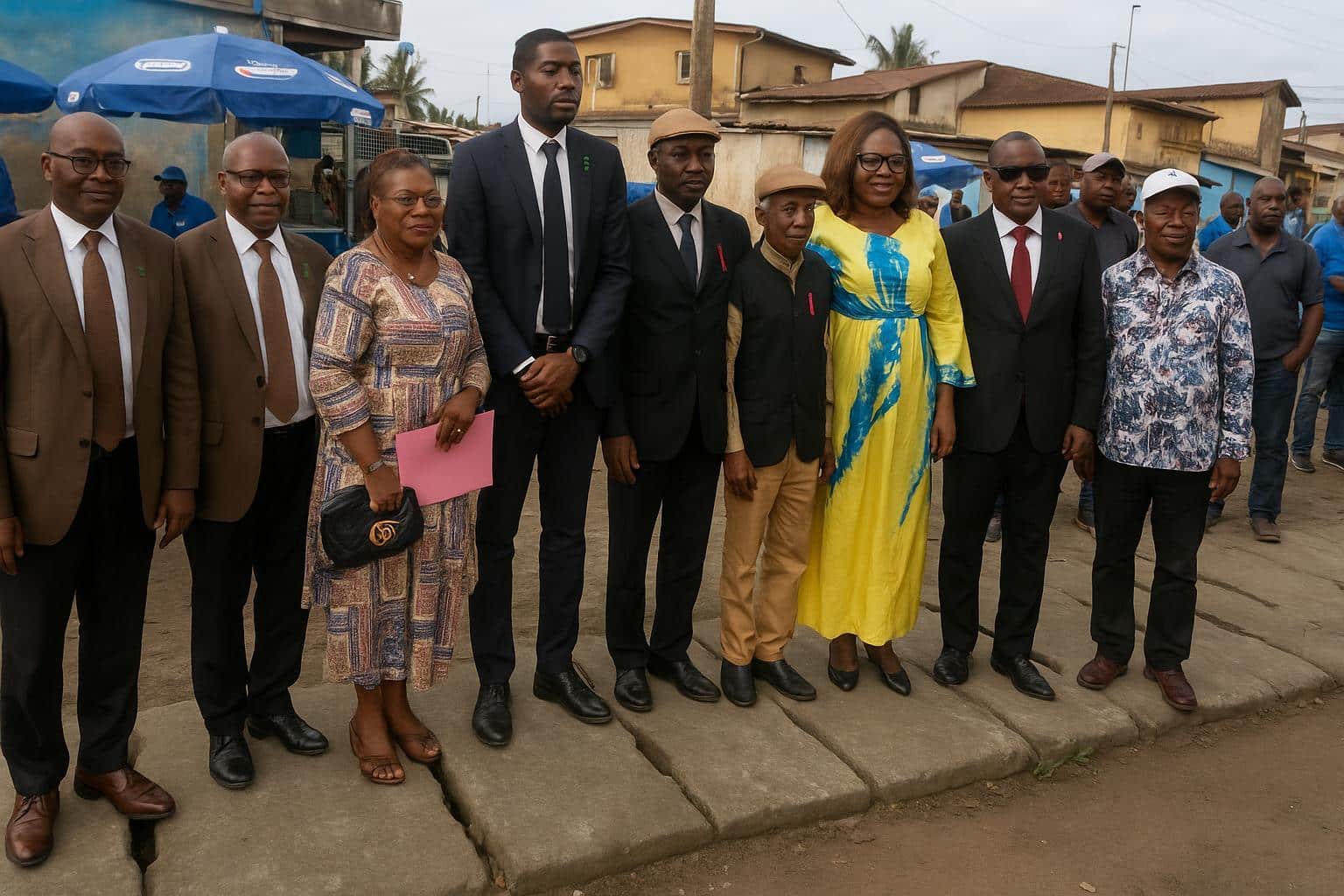
An unobtrusive concrete slab stretching beside the Saint-Esprit Avenue became the focus of urban affairs in Brazzaville this week, as bottled-water producer Global développement S.A. officially handed over a 46-metre covered drain to authorities in Moungali on Wednesday during a brief street-corner ceremony downtown.
The corporate social responsibility gesture, financed entirely by the company behind the Globaline brand, offers a new conduit for wastewater and run-off behind the CEG de la Paix secondary school, a hotspot of flooding during every heavy storm.
Engineering a safer drainage link
Global développement’s deputy managing director, Michel Roger Bounda, recalled that the project began with a pledge in May, when residents complained of ankle-deep puddles channelling mosquitos. ‘Our president Augustin Zodji wanted a quick, durable fix, and he kept that promise’, he said this week.
Engineers poured re-bar reinforced sidewalls along twenty-six metres of Avenue Saint-Esprit, then linked a perpendicular segment of twenty metres on Rue Louomo, forming a right angle that drains toward the Tsiémé tributary. Heavy precast slabs seal the trench, freeing sidewalks for vendors and pupils today.
Municipal leadership welcomes partnership
Standing beneath municipal flags, administrator-mayor Sylvie Makosso applauded what she called ‘a textbook collaboration between business and city hall’. She argued that the covered canal will curb malaria risks by preventing stagnant pools and help motorists who once veered around flooded gutters.
Makosso hinted that the municipality lacks adequate capital to tackle similar micro-projects on its own. ‘Private firms can accelerate our agenda of safer streets’, she noted, promising to streamline permits for any company willing to replicate the model in other Moungali blocks soon.
Residents see immediate impact
Local shopkeeper Théo Mouyabi watched the asphalt ribbon dry and imagined busier mornings. ‘Customers avoided this row whenever it rained; water splashed everywhere’, he said, gesturing toward the new cover. The improved footpath, he believes, will lift daily revenues for kiosks and barbershops nearby around him.
Across the street, pupils from CEG de la Paix tested the slab as a play space. Teachers told reporters that fewer classroom absences could follow if stagnant ponds no longer invite waterborne infections in the rainy season.
The project cost was not disclosed, but civil engineers interviewed by this newspaper estimated materials and labour at eleven million CFA francs. Global développement did not seek tax incentives, insisting the outlay formed part of its annual community-fund allocation approved by the board.
Part of a broader CSR pattern
This is not the first time the Ngoyo-based company intervenes in urban utilities. In 2023 it helped rehabilitate the water circuit of Talangaï Reference Hospital; earlier this year it offered similar assistance to Bacongo Reference Hospital, securing steady drinking fountains for patients there too.
Corporate-social-responsibility specialists regard the pattern as emblematic of a wider trend among beverage producers competing for brand loyalty in Congolese cities. ‘Consumers notice which labels reinvest locally’, observed economist André Gakala at Marien Ngouabi University, citing marketing studies on conscientious buyers.
Gakala added that state budgets remain constrained, so voluntary infrastructure spending can fill gaps without burdening taxpayers. Still, he urged transparent coordination: ‘Firms and mayors should align with urban-planning maps to avoid duplications and ensure drains ultimately connect to main collectors and treatment plants properly’.
Complementing Congo’s urban agenda
At ministry level, the new drainage segment dovetails with the national programme for resilient cities overseen by the High Commission for Major Works. A spokesperson said the Moungali project illustrates how grassroots partnerships can deliver but measurable progress toward Congo’s Sustainable Development Goals.
Flood resilience remains a pressing matter in the capital, where World Bank data show average annual rainfall of 1,400 millimetres. Many drains built in the 1980s are either clogged or collapsed, leaving neighbourhood committees to improvise earth embankments with limited long-term success.
Urban planners interviewed argue that covered drains like Global développement’s add safety advantages by eliminating open gutters that children sometimes fall into. The slabs also minimise garbage dumping, they say, because waste collectors can roll bins across a uniform surface.
For Global développement, the inauguration doubles as brand storytelling. Executives wore polo shirts embroidered with the Globaline droplet, then distributed chilled bottles to onlookers after the ribbon-cutting. Several residents lingered, snapping photos destined for social media, inadvertently extending the marketing reach of the donation even further.
Asked about future initiatives, Bounda hinted at a pilot hand-washing station near the Moungali market, pending municipal approval. ‘We consider water our core strength, so everything we donate must echo that identity’, he said, declining to name a budget or timetable today publicly.
Back on Rue Louomo, traffic flowed smoothly by afternoon. Rain clouds gathered overhead, offering a test. When the first droplets fell, the water slid beneath the new concrete lid and disappeared from view, a small victory for sanitation in the fourth arrondissement.