
A Carefully Orchestrated Transition at the CNDH
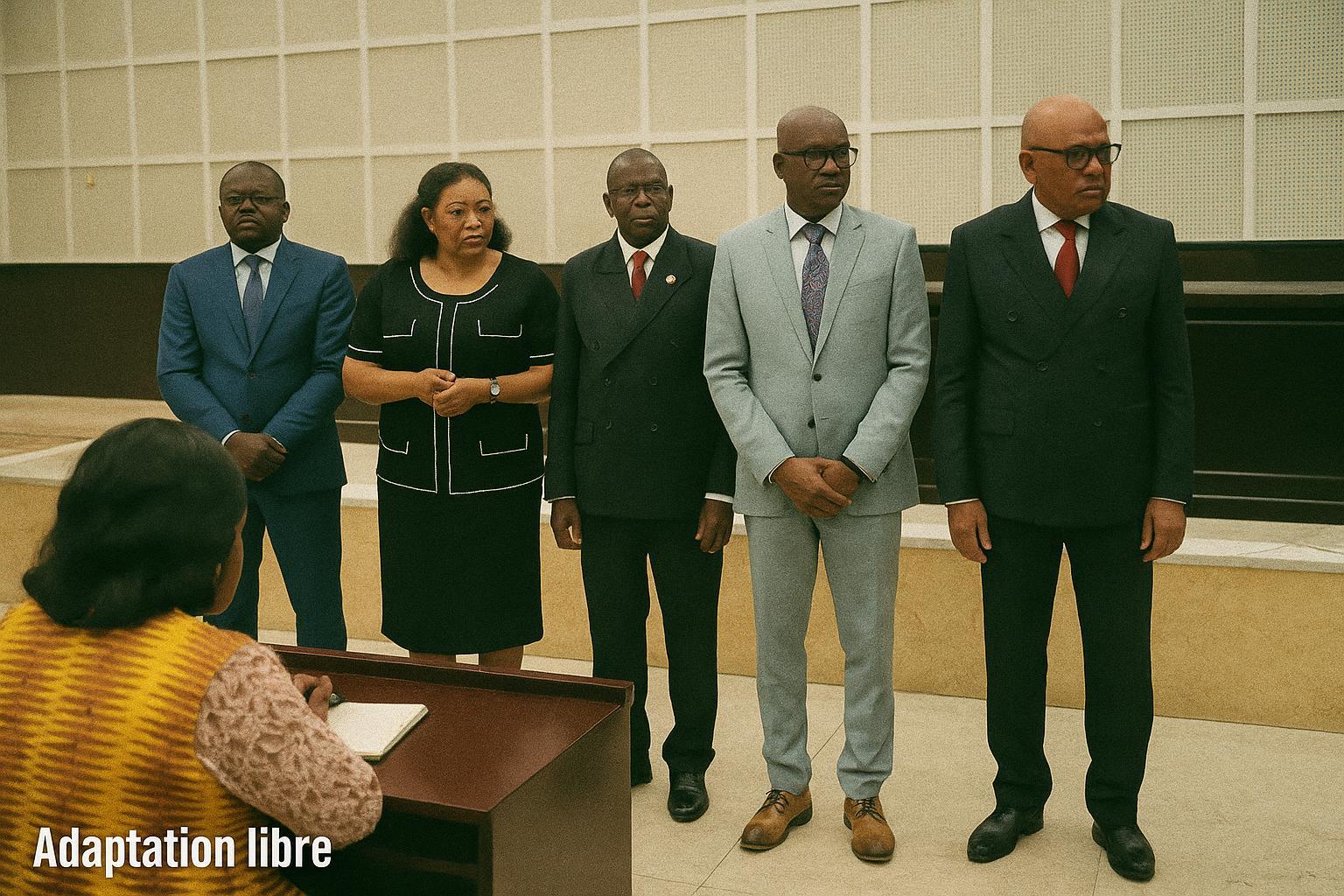
In the wood-panelled hall of the Ministry of Justice on 6 August, the Republic of Congo’s National Human Rights Commission entered a new chapter. After a vote conducted in accordance with Law 30-2018 of 7 August 2018, veteran magistrate Casimir Ndomba was confirmed as president, succeeding Valère Gabriel Eteka Yemet. The session was presided over by Minister of Justice, Human Rights and Promotion of Indigenous Peoples, Aimé Ange Wilfrid Bininga, who underscored the “spirit of institutional continuity” the government seeks to preserve (Les Dépêches de Brazzaville, 6 Aug 2025).
The composition of the new bureau—Joseph Mavoungou and Gervais Ngatse Ngouembe as vice-presidents, Agnès Isabelle Nioko as treasurer and Godefroy Moyen as rapporteur—was proclaimed by Secretary-General Antoine Malonga after the sealed ballots were tallied. Observers from the African Commission on Human and Peoples’ Rights noted the procedural compliance, a detail that lends additional legitimacy to the outcome.
Statutory Foundations and the Spirit of 2018
The Commission’s present architecture is rooted in the 2018 statute, widely viewed by jurists as a refinement of earlier frameworks dating back to 2003. The law clarifies investigative powers, strengthens budgetary autonomy and institutionalises cooperation with civil-society organisations. By aligning with the Paris Principles on national institutions, the legislative overhaul placed Congo-Brazzaville among Central Africa’s few bodies eligible for international accreditation, a status the new bureau is expected to uphold (OHCHR data 2024).
Presidential Decree as Political Signal
Political observers paid particular attention to Decree 2025-175 of 13 May 2025 whereby President Denis Sassou Nguesso appointed the present slate of commissioners. In his closing remarks, Minister Bininga credited the head of state for having “anchored the Commission in the architecture of governance.” Such explicit endorsement, analysts argue, not only secures budgetary predictability but also conveys reassurance to external partners at a time when Brazzaville is negotiating new economic facilities with multilateral lenders (Reuters 2025).
Ndomba’s Early Agenda: Continuity, Audit, Outreach
Taking the rostrum for the first time as president, Ndomba tempered celebrations with sober realism. “Our mandate is exhilarating yet exacting,” he told reporters, indicating that his inaugural act would be an internal audit of pending dossiers transmitted by the previous bureau. Insiders expect the inventory to focus on detention-conditions reports and the monitoring of extractive-industry zones where rights issues intersect with environmental concerns.
A senior official in the Ministry of Foreign Affairs, speaking on background, described Ndomba’s style as consensual and pragmatic, stressing his record in the Supreme Court’s chamber of administrative litigation. Civil-society representatives from the Forum pour la Gouvernance citised the emphasis on continuity, arguing that abrupt strategic pivots often erode institutional memory. The convergence of views around ‘gradualism’ may in fact help the Commission stabilise its public image after several years of intense scrutiny by international NGOs.
Diplomatic Reverberations and Regional Optics
From a diplomatic standpoint, the CNDH’s renewal is more than a domestic bureaucratic event. Brazzaville has made human-rights cooperation a pillar of its candidacy for a non-permanent seat on the United Nations Security Council for the 2026–2027 term. A senior diplomat in Addis Ababa framed the Commission’s orderly transition as “evidence of governance maturity” that can bolster Congo’s African Union credentials.
Regionally, the Central African stand-by force has been exploring a memorandum of understanding with national rights institutions to establish early-warning indicators in conflict-prone border areas. The CNDH’s expanded investigative mandate could thus carry implications for sub-regional stability, a point tacitly acknowledged by ECCAS officials in recent consultations (Journal de Brazza, 7 Aug 2025).
Balancing Expectations: A Measured Outlook
While Ndomba inherits a Commission endowed with clearer statutory authority and presidential support, the expectations it faces are equally amplified. Persistent concerns over pre-trial detention, land tenure conflicts and the social impact of climate adaptation policies will test both the Commission’s independence and its diplomatic tact. In the words of constitutional scholar Thérèse Mavoungou, “the ultimate metric will be the public’s confidence, not merely the meticulous drafting of annual reports.”
For now, both domestic and international observers appear prepared to grant the new bureau a honeymoon period. The coming months, punctuated by stakeholder consultations and the unveiling of a strategic plan, will show whether the balance between continuity and innovation that Ndomba champions can translate into tangible safeguards for the rights of Congolese citizens.