
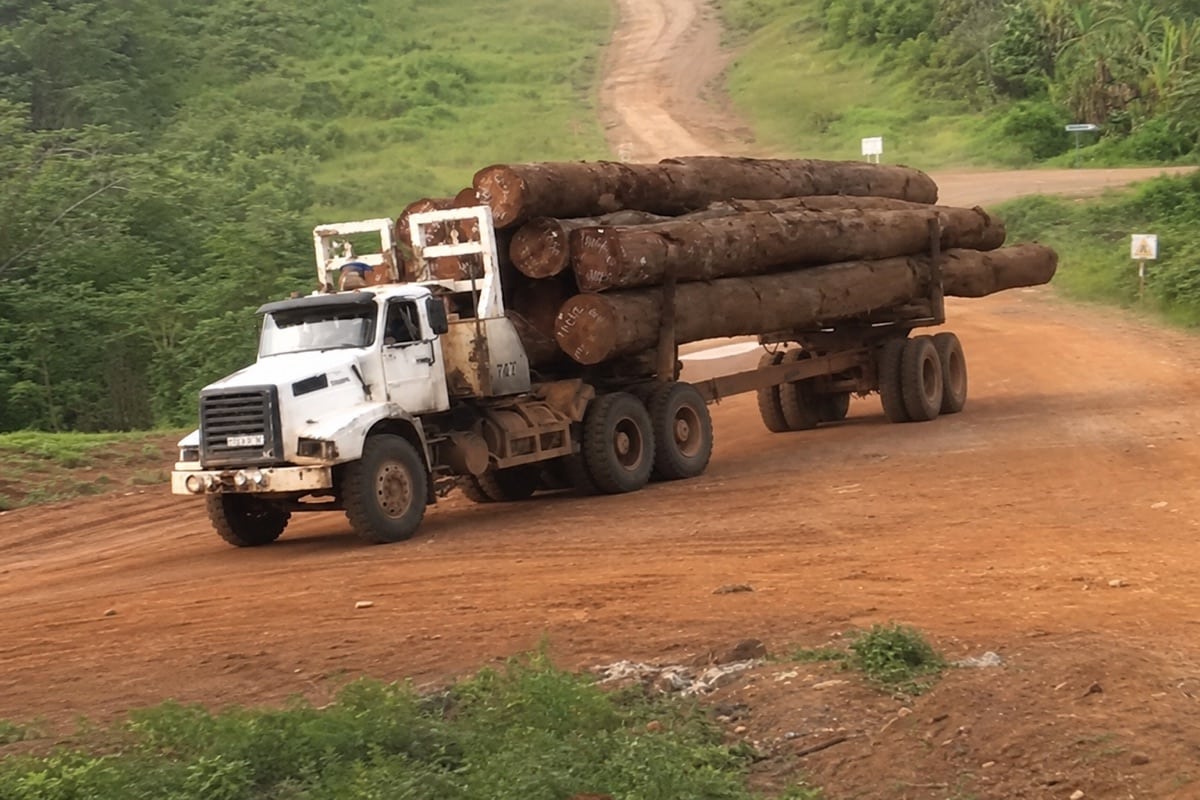
A television investigation has thrust Congo-Brazzaville’s timber trade back into public debate, forcing the government to defend a practice many citizens assumed had ended. The dispute centers on raw logs leaving the country despite a formal export ban.
A Documentary That Reopened an Old Wound
Journalists from TV5 Monde aired a report in early April 2026 that triggered widespread indignation. It described shipments of raw logs from the northern department of Sangha, pointing in particular at Sefyd, the Yuan Dong Congo Forest Exploitation Company.
The outrage drew on a clear legal reference. Since 1 January 2023, exporting raw logs has been officially prohibited under the country’s Forestry Code, known as Law 33-2020. For many viewers, footage of departing timber seemed to contradict that rule outright.
How Brazzaville Frames the Exports
The government’s answer was unambiguous. Officials stated that there is no illegal export of wood or logs by companies engaged in harvesting, processing or trade. The message sought to draw a firm line between the documentary’s allegations and the administration’s own reading of the law.
That position rests on a distinction between a general ban and specific, negotiated exceptions. Brazzaville argues that limited log exports were authorized as sovereign policy decisions, tied directly to development financing channeled through forestry operators.
The 2019 Conventions Behind the Quotas
Forestry Economy Minister Rosalie Matondo provided the core explanation. According to her account, the government signed conventions with certain forestry companies in 2019 covering infrastructure projects such as bridges and roads. Those works, she said, are financed through authorized log exports.
The arrangement comes with numbers attached. Sefyd appears on the official list of approved log exporters, holding a quota of 648,000 cubic meters. That allocation sits within a global ceiling of 2,011,783 cubic meters granted across the participating companies.
Presented this way, the exports are not a breach but a contractual mechanism. The logs leaving Sangha, the government suggests, correspond to commitments agreed before the 2023 ban took full effect, blurring the line between prohibition and prior obligation.
What the Timber Reportedly Built
To make its case tangible, the administration pointed to concrete results. The financed projects include upgrades to the Corridor 13 road in the Likouala department, a region where reliable transport links remain a persistent development challenge for residents and traders.
Other deliverables touch directly on education. Authorities cited the delivery of 171,300 school desk-benches in early December 2025, the construction of the interdepartmental high school of Vindoulou in Pointe-Noire, and the rehabilitation of the teacher-training college in Mouyondzi.
These examples form the heart of the official argument. By linking each shipment to a school or a road, the government reframes a contested export as an investment, inviting citizens to weigh visible infrastructure against concerns over the spirit of the Forestry Code.
A Trade With an Expiry Date
The government also stressed that the practice is finite. Officials indicated that log exports should fall significantly as the conventions reach their conclusion. The agreements are scheduled to end in 2027, setting a clear horizon for the current quotas.
Beyond that date, the stated ambition is a shift toward local processing of timber. Such a transition would, in principle, keep more value inside the country, aligning the sector more closely with the original intent of the 2020 law.
For now, the controversy leaves two readings side by side. The documentary frames the shipments as illegal logging, while Brazzaville presents them as the tail end of pre-2023 commitments, a tension that the 2027 deadline may eventually resolve.
The episode underscores how forestry remains both an economic lifeline and a reputational liability for Congo-Brazzaville. Raw logs continue to fund visible public works, yet each departing shipment revives questions about transparency, enforcement and the long-term future of the country’s forests.