
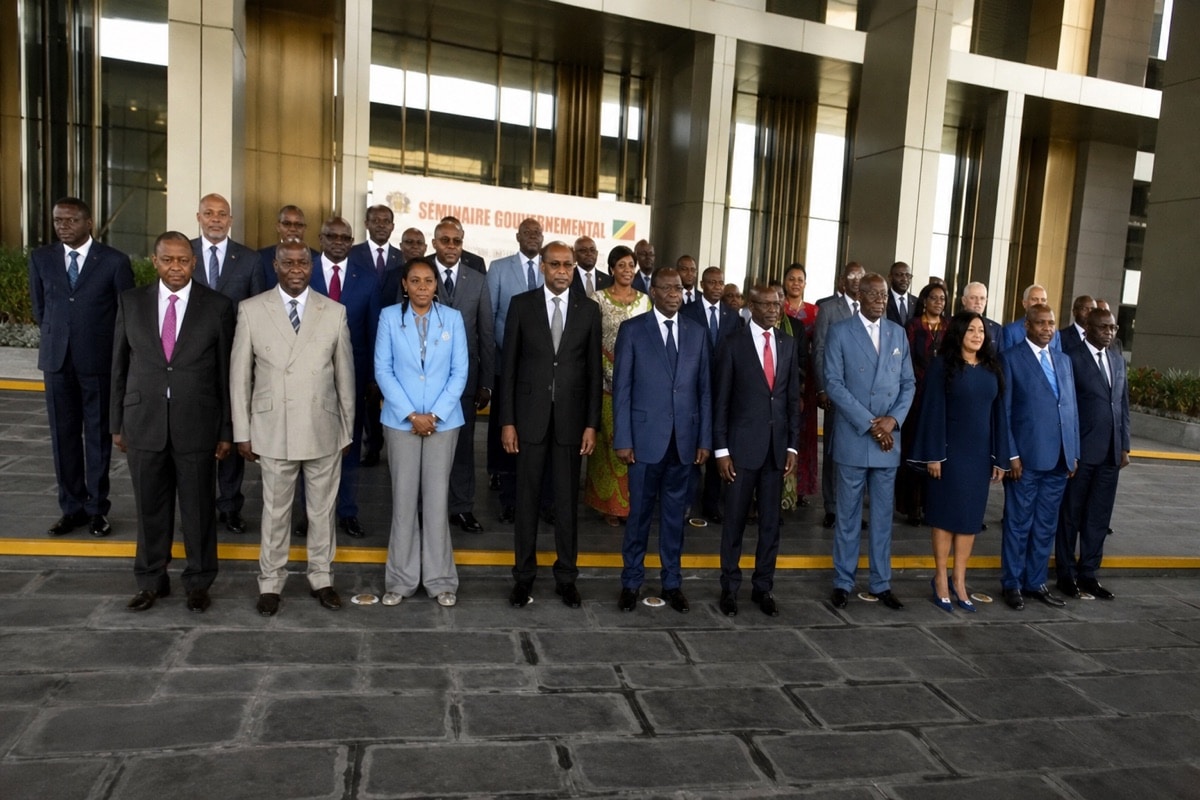
Congo-Brazzaville opened a familiar chapter in its political calendar this spring, as the prime minister and his entire team stepped aside once the head of state had been sworn in for a fresh term. The move, expected yet weighty, reset the executive.
A Resignation Anchored in Constitutional Custom
The sequence began on April 16, 2026, when President Denis Sassou N’Guesso took the oath of office at the Kintélé Stadium near Brazzaville. The ceremony marked the formal start of a new presidential mandate and triggered the customary handover.
The following day, April 17, Prime Minister Anatole Collinet Makosso submitted his resignation along with that of his government. The step followed long-standing practice, under which a cabinet places its mandate at the president’s disposal once a new term begins, allowing the head of state to recompose the executive.
Florent Ntsiba Confirms the Departure
Word of the decision was made public on April 19, when Minister of State Florent Ntsiba announced that the resignation had been accepted. He indicated that the outgoing team would keep handling current affairs until the next government took shape, ensuring continuity in the administration.
That caretaker arrangement is significant in a country where ministries oversee everything from public finances to social services. By keeping the sitting ministers in place, the authorities avoided an institutional vacuum while the president weighed his next appointments and the broader shape of his administration.
A Tenure Defined by Crisis Management
Makosso had led the government since May 2021, steering it across the whole of the previous mandate. His administration operated under the banner of the project titled “Ensemble, poursuivons la marche,” a slogan that framed the executive’s priorities and its sense of continuity with earlier policy.
From the outset, the cabinet set itself twelve major challenges. They ranged from reviving the economy during the health crisis to negotiating with the International Monetary Fund and managing the social tensions that periodically surfaced across the country during those years.
The list of objectives reflected the pressures of the period. A global health emergency had strained public budgets, while questions of social cohesion and economic recovery dominated the policy agenda, leaving the prime minister to balance competing demands within constrained means.
Economic Milestones and Day-to-Day Trade-Offs
Among the achievements attributed to the outgoing government is the completion of its program with the International Monetary Fund in March 2025. That milestone closed a demanding chapter of fiscal commitments and reform, a process closely watched by the country’s partners and creditors.
The administration also navigated the delicate task of reconciling fuel price increases with stability in the transport sector. Adjusting pump prices without disrupting everyday mobility is a recurring test for any Congolese government, given the social sensitivity attached to the cost of movement.
These two threads, the IMF engagement and the management of fuel and transport, illustrate the kind of trade-offs that shaped the cabinet’s record. They combined technical negotiation with attention to the immediate concerns of households and small operators across the territory.
The Question of the Next Government
With the resignation accepted on April 19, attention turned to the choice of a new prime minister. Sassou N’Guesso faced the decision in the hours or days that followed, a window that, by convention, tends to be brief once a presidential term has formally begun.
Two broad paths lay open. The president could name a fresh figure to lead the executive, signaling a recomposition, or he could reappoint the outgoing prime minister, a choice that would underline continuity with the policies pursued during the previous mandate and its governing project.
Whatever the outcome, the caretaker status of the outgoing team meant the machinery of state continued to function. Affairs of routine administration carried on, from the management of ongoing files to the upkeep of services that citizens rely on, pending the appointment.
A Transition Watched Beyond Brazzaville
The reshuffle carries weight beyond the capital. Investors, regulators and international partners present in the country tend to read such moments for signals about economic direction, particularly after a program with the IMF and amid persistent attention to public finances and sectoral stability.
For now, the picture is one of orderly transition rather than rupture. A president has been sworn in, a government has stepped down on schedule, and a caretaker team holds the line, leaving the composition of the next executive as the central open question (L’Horizon Africain / Adiac Congo, April 19, 2026).