
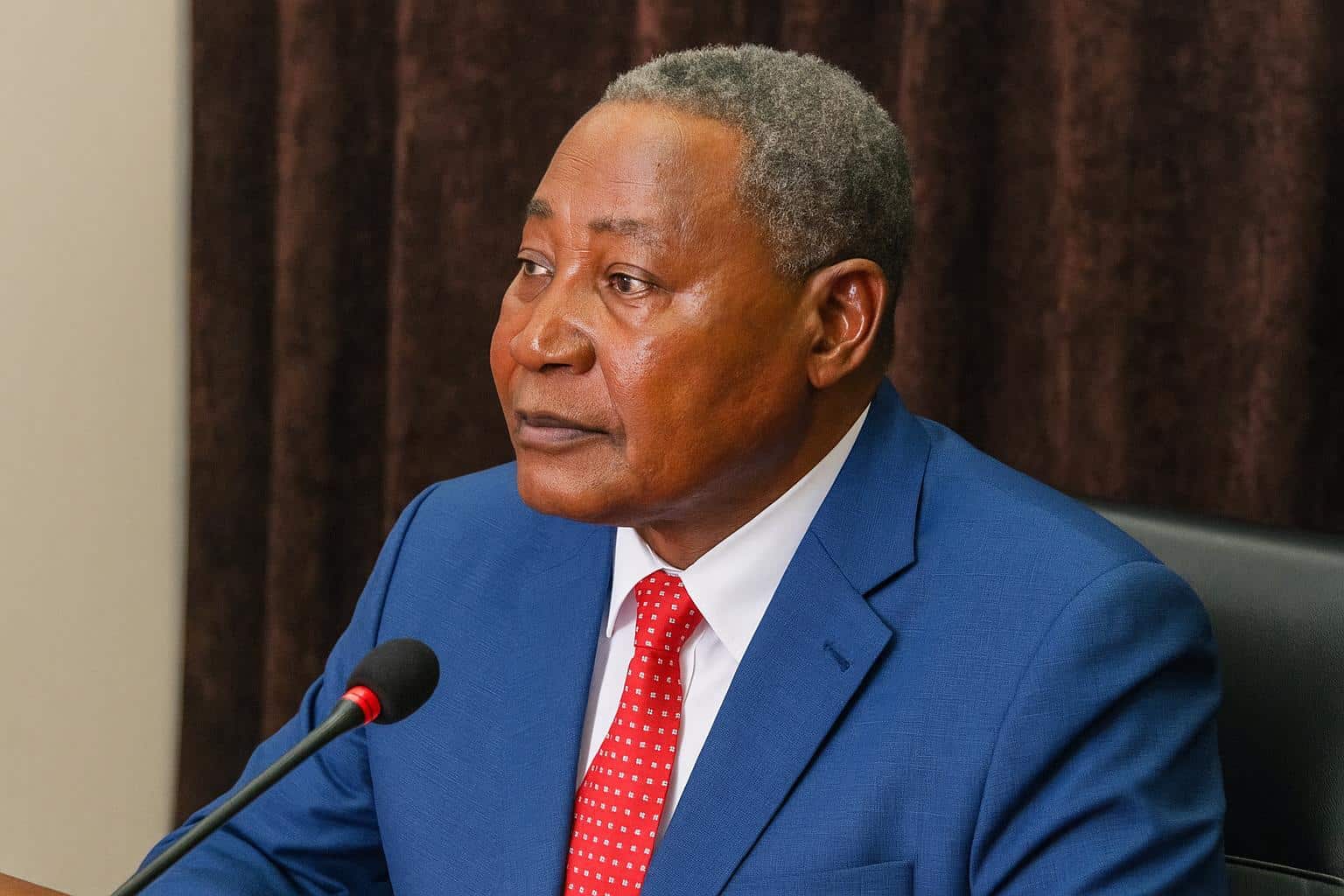
Press briefing outlines electoral roadmap
Standing before reporters in the airy conference hall of the AOGC on 9 October 2025, Minister Delegate Dominique Basseyla mapped out what he called a “decisive stretch” toward the legislative and presidential ballots scheduled for March 2026.
The commissioner general of the ad hoc committee monitoring the Sibiti 2015 dialogue recommendations framed the briefing as a routine assessment, yet his proposals—chiefly the creation of one or two vice-presidential posts—quickly dominated the political conversation in Brazzaville.
Flanked by advisers, Basseyla reiterated that the committee’s mandate is to ensure continuity between the Sibiti consensus, the 25 October 2015 Constitution and forthcoming polls, insisting that institutional stability remains “the oxygen of development” and that deadlines fixed by the government will be respected.
Vice-presidency proposal sparks governance debate
Basseyla’s central suggestion is to insert a vice-presidency into the constitutional architecture. In the single-seat option, a politically weighted deputy would be chosen by the head of state, assume presidential duties in the event of incapacity and handle thematic dossiers or international representation at the president’s discretion.
The twin-seat option would assign a second vice-president to oversee governmental coordination, effectively replacing the prime minister. Both officials, he said, would be named by decree, ensuring unity of command while giving regional and ideological balance a formal place inside the executive.
Speaking to journalists after the briefing, a senior constitutional scholar who requested anonymity described the idea as “an incremental adjustment rather than a rupture,” noting that several CEMAC partners already employ comparable mechanisms to secure succession lines and reduce political uncertainty.
Three ideological blocs to streamline parties
The committee also wants parties regrouped into three ideological families—republican, social-democrat and centrist. According to Basseyla, existing formations would keep their identities but must affiliate to one bloc, while future registrations would follow the same rule, a move he called “necessary rationalisation.”
He dismissed speculation about forced dissolutions, stressing that pluralism would be preserved inside each bloc. “No organisation will be asked to disappear,” he maintained, arguing that converging platforms would help voters compare programs and help authorities apportion public funding more transparently.
Political analyst Émilie Moundzika viewed the scheme as a response to what the committee terms ‘fragmentation without roots’. She pointed out that more than 200 parties are legally recognised, many lacking physical headquarters or local branches, complicating voter education and coalition building.
Proportional list voting promoted for 2026
To translate the three-bloc landscape into parliamentary seats, Basseyla advocates a nationwide shift to closed-list proportional voting. Each constituency—proposed at the level of departments and communes—would see exactly three competing lists, one per bloc, with independent candidacies explicitly ruled out.
He argued that proportionality would quantify the real weight of each current, providing an objective basis for distributing cabinet portfolios, Bureau positions in both chambers and leadership roles in local councils, thereby lowering post-electoral contestation.
Opposition spokespersons contacted by telephone said they would reserve judgment until a formal bill is circulated, yet several acknowledged that proportional rules could improve minority representation compared with the present two-round, single-member plurality system.
CONEL institutionalisation and biometric challenge
Turning to electoral governance, Basseyla praised the institutionalisation of the National Independent Electoral Commission, CONEL, which the committee wants enshrined constitutionally to guarantee financial and managerial autonomy as well as insulation from what he called “external or partisan pressures.”
He nonetheless recognised that the biometric registration project remains behind schedule. “Prerequisites were not effectively completed,” he conceded, urging swift technical assessments and public-private partnerships so that digital voter rolls become a credible reality before candidate filing opens in late 2025.
The committee welcomed the ongoing administrative update of voter lists launched by the government and encouraged citizens to verify their status. Civic groups such as Les Volontaires du Vote described turnout at early centres as “encouraging, though uneven between urban arrondissements and rural districts.”
Administrative reform and election cost concerns
Beyond election mechanics, Basseyla revisited the recommendation to split Niari into two departments—Niari and Nianga-Louéssé—arguing that smaller units would deliver public services faster and anchor representation closer to citizens, without altering existing provincial resources sharing formulas.
He reported that four of the Sibiti dialogue’s 40 governance directives are still under review, including decentralisation benchmarks and the overhaul of the 2001 party law. The ad hoc committee will circulate technical notes to government and lawmakers before year’s end.
On campaign finance, speakers highlighted that high logistical costs deter aspirants, particularly women and youth. The committee therefore proposes revising spending ceilings and fee structures, a step Basseyla said would “widen participation and cement legitimacy while keeping fiscal prudence in mind.”
Summing up, the minister said a credible, peaceful and inclusive March 2026 vote “is the surest guarantor of durable peace.” Stakeholders, he added, have ample time to study the vice-presidency and proportional list innovations before the next dialogue session slated for early 2025.