
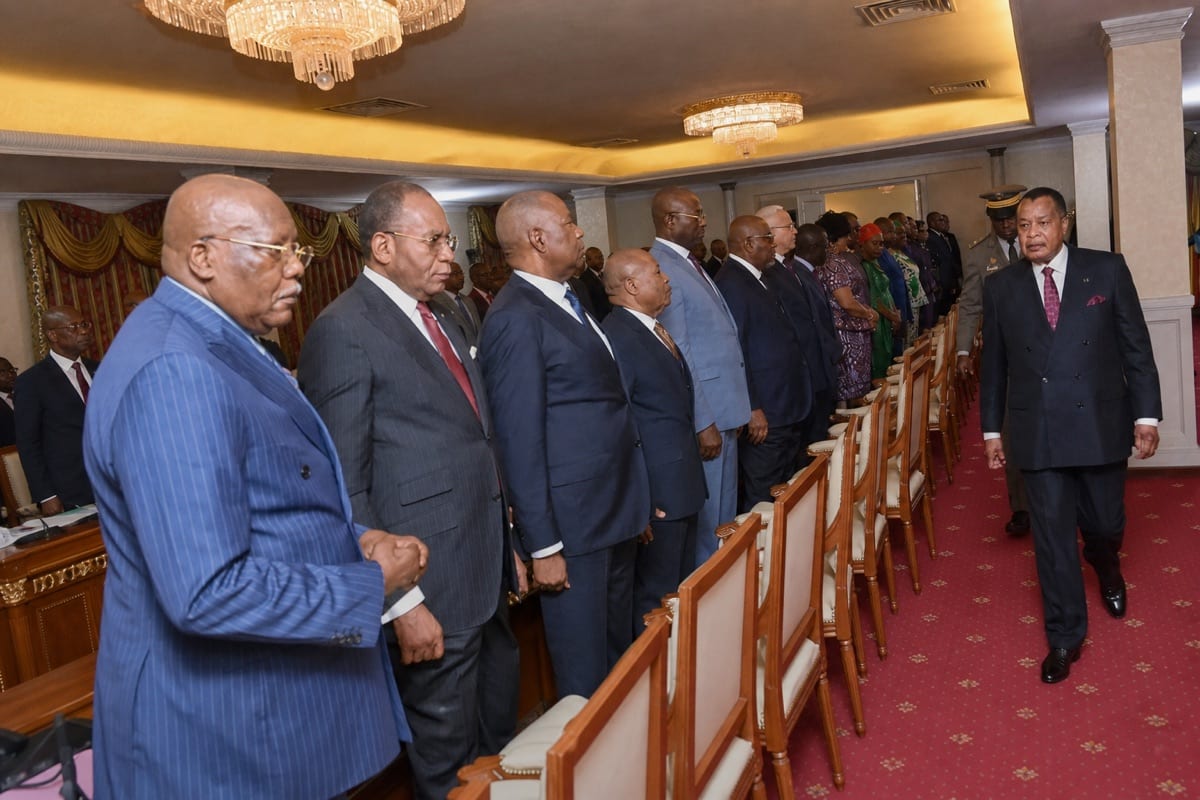
A routine of Congolese statecraft unfolded in Brazzaville this week, as the prime minister and his ministers cleared the way for a new government to take shape after the presidential vote.
A Constitutional Handover in Brazzaville
The Presidency of the Republic announced the move through a press statement released in Brazzaville on April 19, 2026. It confirmed that Prime Minister Anatole Collinet Makosso had formally tendered his resignation, together with that of his entire government.
The decision rests on a familiar legal foundation. Under Article 83 of the Constitution of October 25, 2015, the executive steps aside once a new presidential mandate begins, allowing the head of state to compose a fresh team.
That sequence followed the presidential election held on March 12 and 15, 2026. The investiture of the head of state took place on April 16, 2026. Makosso then submitted his letter of resignation, dated April 17, 2026, closing the chapter of his tenure.
President Sassou N’Guesso Accepts the Departure
President Denis Sassou N’Guesso accepted the resignation without delay, according to the presidential communiqué. The gesture carries little surprise in Congo-Brazzaville, where the renewal of government traditionally accompanies the opening of a new term.
The president extended his thanks to every member of the outgoing cabinet. He acknowledged the work carried out over five years of collaboration, a span running from 2021 to 2026 that defined the rhythm of his previous mandate.
Those years were shaped by the policy platform branded « Ensemble, poursuivons la marche », loosely « Together, let us continue the march ». The slogan framed the government’s stated ambitions across the period, and its mention closes the official account of the partnership.
Makosso’s Words of Gratitude
For his part, Anatole Collinet Makosso voiced his gratitude to the head of state. He pointed to the confidence placed in him throughout his time in office, a courtesy typical of such transitions in the country’s political culture.
The outgoing prime minister also signaled that he remained at the president’s disposal. The phrasing leaves open the question of his future role, neither claiming a return nor ruling one out, in keeping with the measured tone of the announcement.
Such formulations matter in Brazzaville, where the choreography of resignation often hints at the balance of influence to come. Observers of Congolese politics tend to read these statements carefully, even when the text itself stays deliberately spare.
Caretaker Duties Until a New Cabinet
In the interval before the next governmental team is assembled, the president asked the departing ministers to handle current affairs. The instruction keeps the machinery of the state running while the composition of the new cabinet is worked out behind closed doors.
This caretaker arrangement is standard practice. It ensures the continuity of state action, preventing any administrative vacuum between one government and the next, and it places the outgoing ministers in a holding posture rather than a vacated one.
The communiqué did not indicate how long the transition might last. It also offered no names for the incoming team, leaving the shape of the next government as the central open question following the formalities of the handover.
What the Transition Signals for Congo-Brazzaville
The episode underscores the constitutional reflex that governs the start of each presidential mandate in Congo-Brazzaville. The resignation is less a rupture than a procedural reset, a clearing of the slate mandated by the country’s foundational text.
For a readership tracking governance in the CEMAC region, the moment offers a window into how power is reaffirmed and reorganized. The accent here falls on procedure and continuity rather than on any abrupt shift in direction.
The next chapter will turn on the makeup of the new cabinet. Until those choices are unveiled, the outgoing ministers remain in place for current business, and the political conversation in Brazzaville will center on who is asked to stay and who is asked to go.
For now, the official record stands as a tidy account of a transition executed by the book. The president has thanked his outgoing team, the prime minister has stepped back with words of loyalty, and the state continues to function while a new government waits in the wings.
What follows will test whether this orderly transfer translates into fresh priorities or a broad reconduction of familiar faces. That answer lies with the head of state, whose forthcoming appointments will define the substance behind this week’s carefully managed formalities.