
A day of unity in Brazzaville
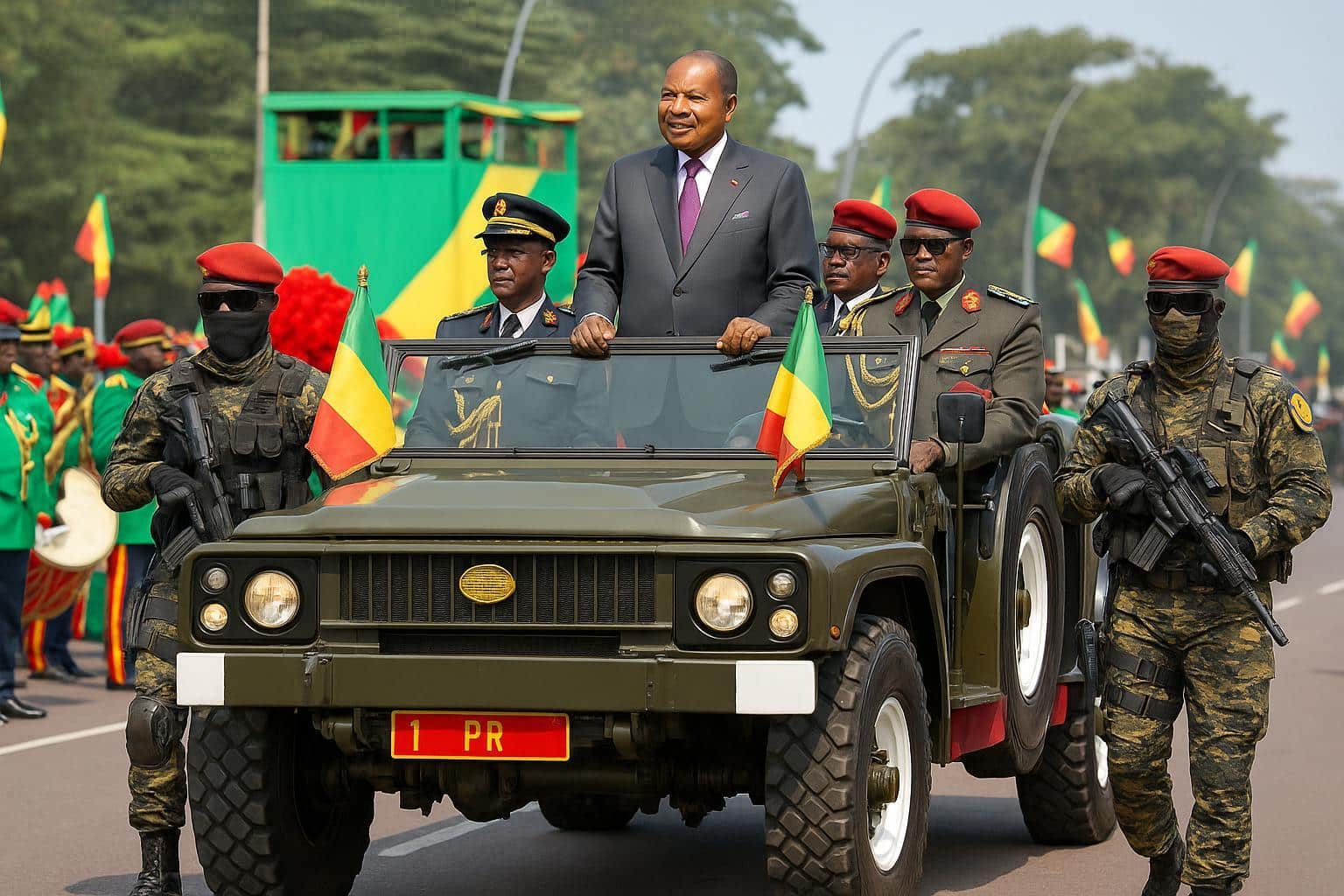
As the August sun rose above the fully refurbished General Alfred Raoul Boulevard, Brazzaville prepared for an anniversary that blended ritual with renewal. The Republic of Congo stepped into its sixty-fifth year of sovereignty before a crowd that filled every tier of the black-clad grandstand.
President Denis Sassou Nguesso, flanked by First Lady Antoinette Sassou Nguesso, arrived precisely at 10:18 a.m., greeted by a rolling salute of twenty-one artillery rounds and the national anthem, La Congolaise. His inspection from an open command-car signaled both continuity and confidence in the republic’s institutional architecture.
Precision choreography of the armed forces
General Guy Blanchard Okoï, Chief of General Staff, stood beside the Head of State as regiment after regiment answered the refrain, “For the motherland, we shall prevail.” The cadence, audible several blocks away, underscored the disciplined ethos that defense officials say anchors national cohesion.
The parade unfurled in four distinct movements: infantry columns, armored and support vehicles, airborne assets, then vibrant civilian contingents. Observers noted clock-work timing; by 10:58 a.m. Brigadier General Fermeté Blanchard Nguinou formally requested commencement, mirroring procedural standards used during multinational exercises with Central African partners.
Cadets from the General Leclerc Preparatory School and officer candidates of the Marien Ngouabi Military Academy marched shoulder to shoulder with the National Gendarmerie, Republican Guard and Police. Their synchronized steps, relayed live by Télé Congo, provided what one commentator described as “a masterclass in inter-service interoperability” (Télé Congo, 15 Aug 2025).
A window on defense modernization
The motorized segment displayed newly refurbished BTR-80 carriers, water-borne patrol craft and logistics trucks acquired under the 2023 modernization plan ratified by Parliament. Defense analysts in Brazzaville argue that incremental upgrades, rather than headline defense spending, have kept budgets aligned with wider development objectives (Les Dépêches de Brazzaville, 14 Aug 2025).
Overhead, Mi-35P helicopters executed a low-altitude pass before an IL-76 strategic transporter thundered across the riverfront skyline. Aviation officers later highlighted the sortie as proof of the Air Force’s growing operational tempo, supported by Russian technical teams working through a maintenance framework approved last year (RIA Novosti, 12 Aug 2025).
Diplomacy on the boulevard
Seated in the diplomatic enclosure were envoys from France, Russia, China and the United States, joined by representatives of the African Union and ECCAS. The inclusion of the U.S. Air Forces Europe-Africa band offered what Washington’s chargé d’affaires termed “a gesture of shared security interest” (Reuters, 16 Aug 2025).
Foreign observers noted that the president’s seating arrangement—flanked by parliamentary leaders—reinforced the country’s post-2015 constitutional framework emphasizing institutional balance. A European diplomat described the atmosphere as “measured optimism,” adding that Brazzaville’s messages of peace and development resonate amid shifting regional fault-lines (AFP, 15 Aug 2025).
Civil energy and cultural depth
Civilian groups swept onto the boulevard after the military exit, carrying banners echoing the official theme, “Mobilised in peace, together toward development.” The Kimbanguist Church orchestra, clad in emerald green, delivered a rhythmic brass arrangement that drew applause even from protocol officers, illustrating the ceremony’s inclusive design.
Public health volunteers followed, highlighting vaccination drives launched in June, while students from the University of Brazzaville showcased solar-powered research prototypes. Economists say such visibility links patriotism to tangible social programmes, a narrative consistent with the government’s 2022-2026 National Development Plan (World Bank country brief, July 2025).
Decorations and institutional continuity
Twelve citizens received national honors, among them Colonel Félix Mouzabakani, first Chief of Staff of the Congolese Armed Forces. Speaking briefly, he dedicated the accolade to “every officer who served beneath the tricolor.” The awards segment, observers said, linked liberation memory to present-day professionalization.
Closing the event at 13:45, Brigadier General Nguinou reported the successful conclusion of the parade. President Sassou Nguesso responded with succinct congratulations before departing under escort, a protocol scholars interpret as a subtle reaffirmation of civilian supremacy over the armed forces within the constitutional order.
Economic undercurrent of celebration
Beyond symbolism, the festivities injected demand into local supply chains: tailors, caterers and transport cooperatives reported higher turnovers, according to preliminary data from the Brazzaville Chamber of Commerce. The institution estimates independence-day related transactions rose twelve percent over 2024 levels, modest yet meaningful for small enterprises.
Finance Ministry officials, interviewed on Télé Congo, said the figures align with broader projections of 4.2-percent GDP growth for 2025, driven by non-oil sectors. They added that public ceremonies can catalyse domestic tourism and reinforce investor confidence, especially when infrastructure upgrades, such as the boulevard’s renovation, are visible.
Regional stability and shared security
Security analysts note that Congo-Brazzaville’s commitment to ceremonial transparency—broadcast across Central Africa—allows neighbouring states to view equipment and readiness levels, reducing misperceptions. By coupling parade imagery with dialogue at the forthcoming ECCAS summit, Brazzaville aims to project reliability as a partner in regional counter-terrorism operations (ISS Pretoria briefing, Aug 2025).
Looking ahead to the next milestone
Planning for the seventieth anniversary is already under discussion at the Ministry of Culture, officials confirmed. If the trajectory outlined in Vision 2030 holds, future parades may showcase not only military hardware but also electric buses, smart-city sensors and other symbols of a diversified, technology-enabled economy.