
Launch in Odziba signals new momentum
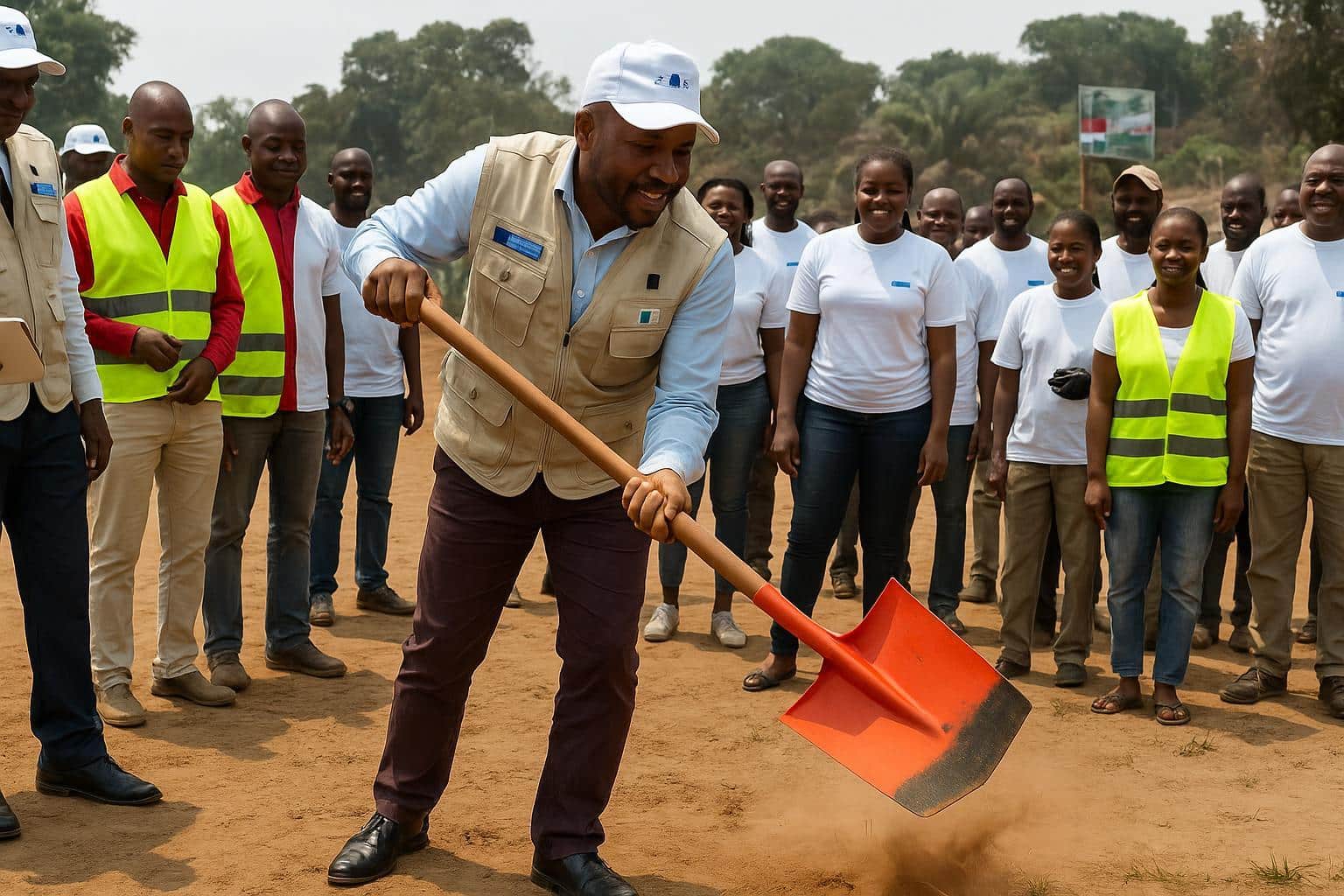
Visitors landing on the red-soiled airstrip at Odziba last week saw an unusual sight: yellow-vested residents clearing drains, sorting plastic and planting vetiver grass. The activity marked the public launch of Congo’s High-Intensity Labour Sanitation Works project, widely known by its French acronym HIMO.
Backed by the World Food Programme and financed through the government-led Pro-Climat portfolio supported by the World Bank, the initiative promises to tackle two pressing challenges at once: chronic youth unemployment and the growing strain that floods and waste place on semi-rural districts.
Local partnership, national vision
Friday’s ceremony, attended by Djoué-Léfini Prefect Léonidas Carel Mottom Mamoni and NGO Niosi staffer Benjamin Kiabambou, highlighted a design emphasising decentralisation. District authorities will supervise planning, while village committees choose sites and track schedules, an approach praised in recent WFP Congo briefs for “rooting accountability in community hands”.
Officials underscored that HIMO sits inside Sub-Component 6 of Pro-Climat, the $80 million resilience programme approved in 2023. Government planners say aligning sanitation with climate budgets ensures drains are dimensioned for heavier rains projected by the Intergovernmental Panel on Climate Change over central Africa.
In Odziba, Ngabé and the twin hamlets of Inoni, site mapping used high-resolution drone imagery supplied by the National Center for Remote Sensing. That data, according to a technical note circulated by the Ministry of Equipment, helped engineers prioritise clogged gullies that routinely cut school access.
Why labour intensity matters
Labour-intensive public works are not new to Congo-Brazzaville, yet previous schemes often imported contractors from larger cities. HIMO reverses that dynamic. The design reserves at least 70 percent of the budget for wages, a ratio mirrored in Madagascar’s successful Fiavota cash-for-work programme.
Economic analyst Merveille Ngakala from the University of Marien-Ngouabi notes that every million CFA paid locally “circulates twice before slipping to the capital, through markets, transport and phone credit.” His assessment echoes World Bank findings that labour-heavy projects generate stronger multiplier effects in remote economies.
Temporary work does not replace structural jobs, critics warn. The Ministry of Planning responds that each six-month trenching cohort receives afternoon instruction on entrepreneurship and waste-value chains. Partner NGO Azur Développement will mentor the most promising alumni to form micro-enterprises for ongoing maintenance contracts.
Women and youth take the lead
Recruitment sheets posted at Odziba’s town hall reveal that 55 percent of the first 300 workers are women, reflecting guidance issued by the WFP Gender Office. Community leader Clarisse Mabiala says the ratio “breaks the myth that sanitation demands brute strength more than organisation.”
Young graduates from the local vocational institute calibrate GPS units, while older residents contribute knowledge of flood paths that satellite models often miss. The intergenerational blend, observers from the French Development Agency remark, creates a knowledge loop that is “surprisingly sophisticated for a programme this size.”
Following the money
Transparency advocates note that Pro-Climat adopted the International Aid Transparency Initiative registry last year. Budget lines for HIMO, amounting to seven million dollars in the first phase, can be viewed in quarterly dashboards hosted by the Ministry of Finance and cross-checked against Bank disbursement data.
In a phone interview, Pro-Climat coordinator Didier Ondongo said auditors will verify that wage payments reach worker e-wallets within 48 hours of biometric roll-call. “Digital payroll avoids the envelope culture,” he argued, citing pilot successes in Kinkala referenced in the World Bank’s April supervision report.
Still, the coordinator conceded that mobile coverage gaps persist along the Léfini River corridor. To mitigate, the government will install two solar-powered signal repeaters procured under a Universal Access Fund tranche. Ericsson engineers began site surveys this month, local press agency ADIAC reported.
Early signs on the ground
Two weeks into operations, storm water already flows more freely beneath the Route Nationale 2 culvert, according to field notes shared by the Congo Hydrological Society. Teachers in Mpoumako confirmed that pupils crossed the road without wading through ankle-deep water for the first time since March.
Local maize vendor Paulin Okemba reports a subtler gain: fewer mosquitoes at twilight. “When drains are clear, the larvae disappear,” he said. The National Malaria Control Programme will test that intuition with before-and-after vector counts scheduled for November, its director told this publication.
Scaling to Pool and beyond
The Pro-Climat steering committee has authorised replication in the neighbouring Pool department, where steep slopes make erosion a constant threat. Spatial analysis conducted by the University of Kinshasa indicates that rehabilitating 15 kilometres of hillside channels there could halve sediment inflows into the Congo River.
Whether funding will stretch that far depends on next year’s disbursement cycle, yet officials remain upbeat. “HIMO demonstrates that modest investments, when rooted in community labour, can punch far above their weight,” Prefect Mottom Mamoni said, adding that the model could become a northern Congo export.