
Epidemiological ripples on the Congo River
Few pathogens travel with such stealth along trade routes as Vibrio cholerae, and the braided waterways linking Angola, Cabinda, the Democratic Republic of Congo and the Republic of Congo have once again proven conducive to its spread. Surveillance teams reported the first domestic cluster on Mbamou Island in late July, barely forty-eight hours after a spike in Luanda’s peri-urban settlements was confirmed by the World Health Organization (WHO cholera update, 2024). The hydrological continuum explains much: fishermen, informal traders and seasonal migrants move swiftly along the river, often beyond the reach of routine health checks. Epidemiologists at the Congolese National Public Health Laboratory calculate an effective reproduction number just above 1.4, comparable to the Kinshasa episode of 2017, yet still within manageable bounds if interventions keep pace.
State mobilisation and a calibrated emergency posture
President Denis Sassou Nguesso’s cabinet invoked the Public Health Emergency Framework on 26 July, enabling fast-track procurement of rehydration salts, oral vaccines and portable chlorination units. Health Minister Gilbert Mokoki has confirmed that 2,000 additional community health workers have been seconded from malaria programmes to assist with contact tracing, a measure praised by Médecins d’Afrique for its cost-effectiveness. The decision to decentralise case-management centres to Kintélé, Djoué and Mindouli has already reduced patient travel time by an estimated forty percent, according to data shared by the Ministry of Planning. While critics abroad sometimes depict such moves as centrally driven, diplomatic observers note that Brazzaville’s approach aligns closely with the International Health Regulations and has attracted commendation in a recent African Union communiqué.
Cross-border health diplomacy gaining momentum
Containment cannot succeed in a vacuum. Congolese envoys convened a trilateral task-force with Angola and the DRC on 29 July to harmonise river-port screening protocols and agree on real-time data exchanges. The Luanda meeting produced a joint communiqué establishing a forty-eight-hour reporting window for new cases within a fifty-kilometre radius of shared borders. UNICEF logisticians confirm that a stockpile of one million doses of the oral cholera vaccine, funded by the Global Alliance for Vaccines and Immunisation, will be stored in Pointe-Noire’s deep-water port for rapid deployment throughout the sub-region. Diplomats privately acknowledge that the episode offers an unanticipated opportunity to consolidate the still-young ECCAS public-health desk, potentially transforming episodic cooperation into a standing mechanism.
Water infrastructure: the silent front line
Decades of underinvestment in peri-urban water networks have left pockets of vulnerability even as Brazzaville’s macroeconomic indicators improve. The government’s 2023-2027 National Development Plan earmarks 3.2 percent of GDP for water and sanitation, up from 1.8 percent a decade ago. Construction has begun on a solar-powered treatment plant at Djiri, expected to add 80,000 m³ of potable water daily. Development partners from the African Development Bank stress that physical upgrades must be coupled with behavioural campaigns, citing past evidence that household water storage habits can negate infrastructural gains. Hence radio broadcasts in Lingala and Kituba now blend engineering updates with reminders to boil or chlorinate water.
Community engagement and the resonance of past lessons
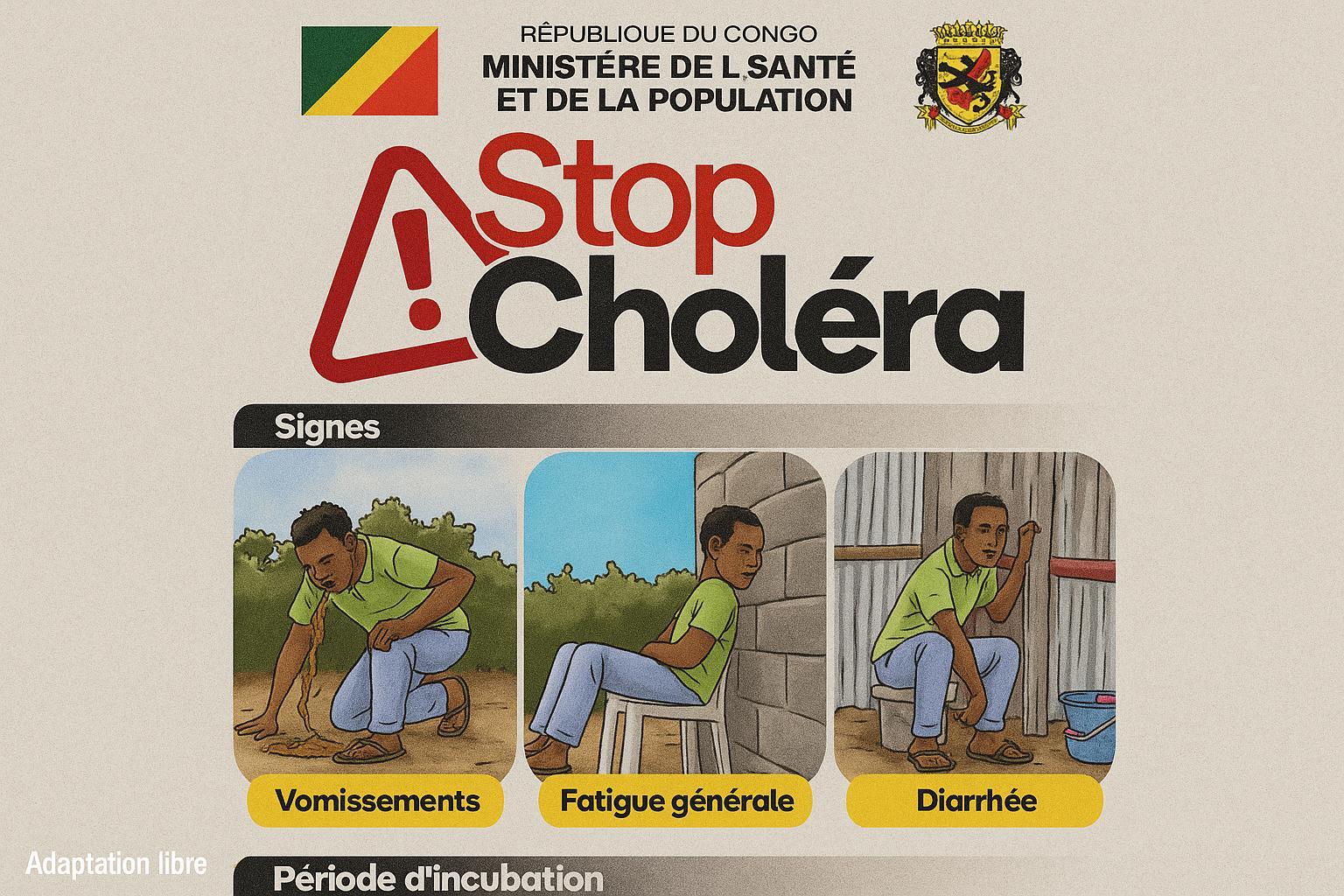
The collective memory of the 2009 cholera surge in Kouilou, which claimed over one thousand lives, has heightened public responsiveness. Local chiefs on Mbamou Island report near-universal adoption of hand-washing stations crafted from recycled jerrycans within one week of the first alert. Faith-based organisations, notably Caritas Congo, have leveraged Sunday sermons to disseminate symptoms checklists, countering rumours that the illness is ‘water witchcraft’. Anthropologists from Marien Ngouabi University argue that such grassroots agency complements biomedical interventions by creating social pressure to seek care early, a finding echoed by a recent Lancet Global Health commentary.
Forward outlook: vigilance paired with guarded optimism
As August approaches, the epidemic curve shows early signs of plateauing, yet specialists caution against premature declarations of victory. Seasonal rains, forecast by the Congo River Basin Authority to intensify by mid-September, could disturb fragile gains if drainage channels clog or latrines overflow. Government spokesperson Thierry Moungalla insists that contingency stocks of chlorine and intravenous fluids have been pre-positioned in high-risk districts, and that a national simulation exercise will test interoperability among the army medical corps, civil protection units and Red Cross volunteers. In diplomatic circles, the current response is viewed as a litmus test for the broader public-health readiness envisaged in the African Continental Free Trade Area era, where human mobility and sanitary security are inseparable. For now, measured coordination, transparent reporting and sustained community trust offer the best guarantee that the Republic of Congo will transform this epidemiological challenge into a springboard for more resilient governance.