
Congolese Creativity Steps onto Continental Runway
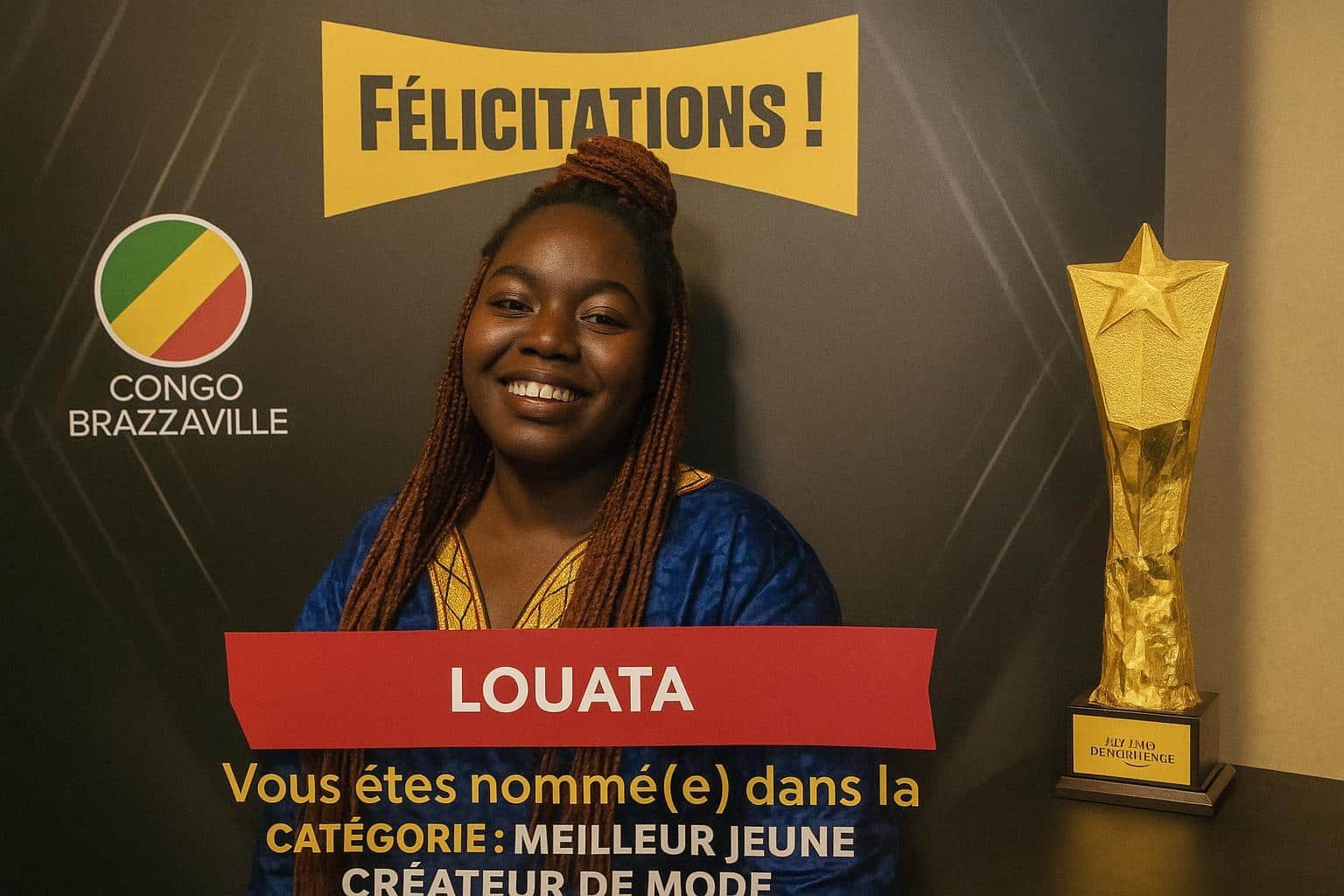
As dawn broke on 3 September, Brazzaville’s creative circles woke to rare news: designer Edouarda Diayoka, founder of Louata, is shortlisted for the 2025 Talents d’Or, a pan-African fashion prize considered by many curators the industry’s equivalent of an early Oscar.
Her inclusion marks the first time a stylist from the Republic of Congo reaches the final ballot, a milestone that, according to Kinshasa-based trend analyst Isabelle Bakaba, “places Congolese savoir-faire on equal footing with longer-established hubs such as Abidjan and Lagos” (Bakaba, 2024).
Across social media, the announcement triggered an immediate chorus of congratulations, yet the broader significance lies in what the nomination signals for the nation’s cultural economy: an increasingly professional fashion sector capable of converting traditional motifs into sought-after products for African and diasporic middle-class consumers.
From Pointe-Noire Markets to Brazzaville Atelier
Diayoka’s path began in Pointe-Noire’s markets, where, she recalls, imported wax prints “told stories nobody bothered to translate.” After training at ESMOD Dakar on a scholarship supported by Congo’s Ministry of Culture, she opened a modest atelier in Brazzaville in 2019, gradually hiring eight young patternmakers.
Those artisans now shape Louata’s signature silhouettes: asymmetric blazer-dresses, high-waisted trousers framed by hand-embroidered kintoki leaf patterns, and bucket hats sewn from recycled denim. The label’s color theory draws on riverine sunsets, most visibly in the yellow-and-blue ensemble that has become the campaign’s defining image.
A Signature Aesthetic Built for Screens
“There is nothing nostalgic about Louata,” comments Paris-based curator Alain M’Bemba, who exhibited the brand during Africa Fashion Week London. “Diayoka references heritage, yet her cuts speak Instagram.” That digital fluency matters in a contest decided 60 percent by public votes conducted via mobile money platforms (Talents d’Or committee, 2024).
Inside the Talents d’Or Machinery
The Talents d’Or, founded in Abidjan in 2012, has evolved into a touring showcase rotating among West and Central African capitals. Previous laureates include Nigeria’s Kenneth Ize, now stocked by luxury retailer Browns, underscoring how a win can unlock export contracts and investor attention (Jeune Afrique, 2023).
Voting opened on 3 September and will close on 15 December. Each SMS costs 105 FCFA, roughly 0.17 USD. Organizers reinvest half of proceeds into production grants for the top three finalists, a model designed to keep the competition self-financing while supporting emerging ateliers.
Diayoka’s campaign headquarters, a converted warehouse near the Marché Total, now hums with volunteers registering supporters’ numbers. She insists no one is pressured: “The vote is a contribution, not a debt.” Early tallies place her second behind Ivorian avant-gardist Kady Touré, according to organizers.
Mobile Voting and Digital Finance Winds
Beyond the runway, economists view the contest as a micro-laboratory for mobile micropayments. Telecom operators MTN and Airtel report a 12 percent uptick in transaction volume since voting began, suggesting that cultural events can drive digital-finance adoption among youths unfamiliar with formal banking.
Soft Power and Policy Tailwinds
Officials at the Congolese Agency for the Promotion of Arts point to such numbers when arguing that creative industries constitute soft power. A senior adviser, requesting anonymity, emphasizes that Diayoka’s nomination aligns with Brazzaville’s strategy to diversify exports beyond hydrocarbons by spotlighting high-value cultural goods.
Observers note a favorable policy environment. Recent customs directives lowered duties on textile machinery, and the Development Bank of Central Africa launched a 5 billion FCFA line of credit for fashion SMEs last April. These moves, analysts argue, strengthen designers’ capacity to meet demand should global orders surge.
Heritage Threads and Eco-Conscious Futures
Cultural historians note that modern Congolese dress has long balanced cosmopolitan flair and rooted symbolism, from La Sape’s dandy subculture to ceremonial raffia tunics of the Kongo kingdom. Louata’s success, they argue, reframes that lineage for an eco-conscious audience skeptical of fast fashion imports.
Training for the Surge
Industry mentors nevertheless caution against over-romanticizing exposure. “A show in Lagos is exhilarating, but fulfilling 500 online orders overnight can sink a young brand,” warns supply-chain consultant Delphine Obiango. Her team is training Louata staff in inventory software ahead of the contest’s final showcase.
TikTok Diplomacy and Diaspora Reach
Diayoka’s appeal travels largely through TikTok, where backstage clips accumulate thousands of views from Johannesburg to Montréal. The designer says the platform’s algorithm “flattens geography”, enabling Congolese textiles to converse with Afrofuturist graphics favored by diaspora creatives. Digital feedback loops now shape fabric orders almost in real time.
Road Ahead for Congo’s Designers
For now, every SMS cast carries both individual pride and collective ambition. Whether or not the gold statuette lands in Brazzaville, fashion watchers agree that a glass ceiling has cracked. The next challenge will be translating applause into sustainable manufacturing and long-term brand equity.
Observers predict that outcome, whatever the jury decides, will embolden Congo’s next cohort of designers to enter continental contests.