
Swift Justice Reflects Renewed Judicial Resolve
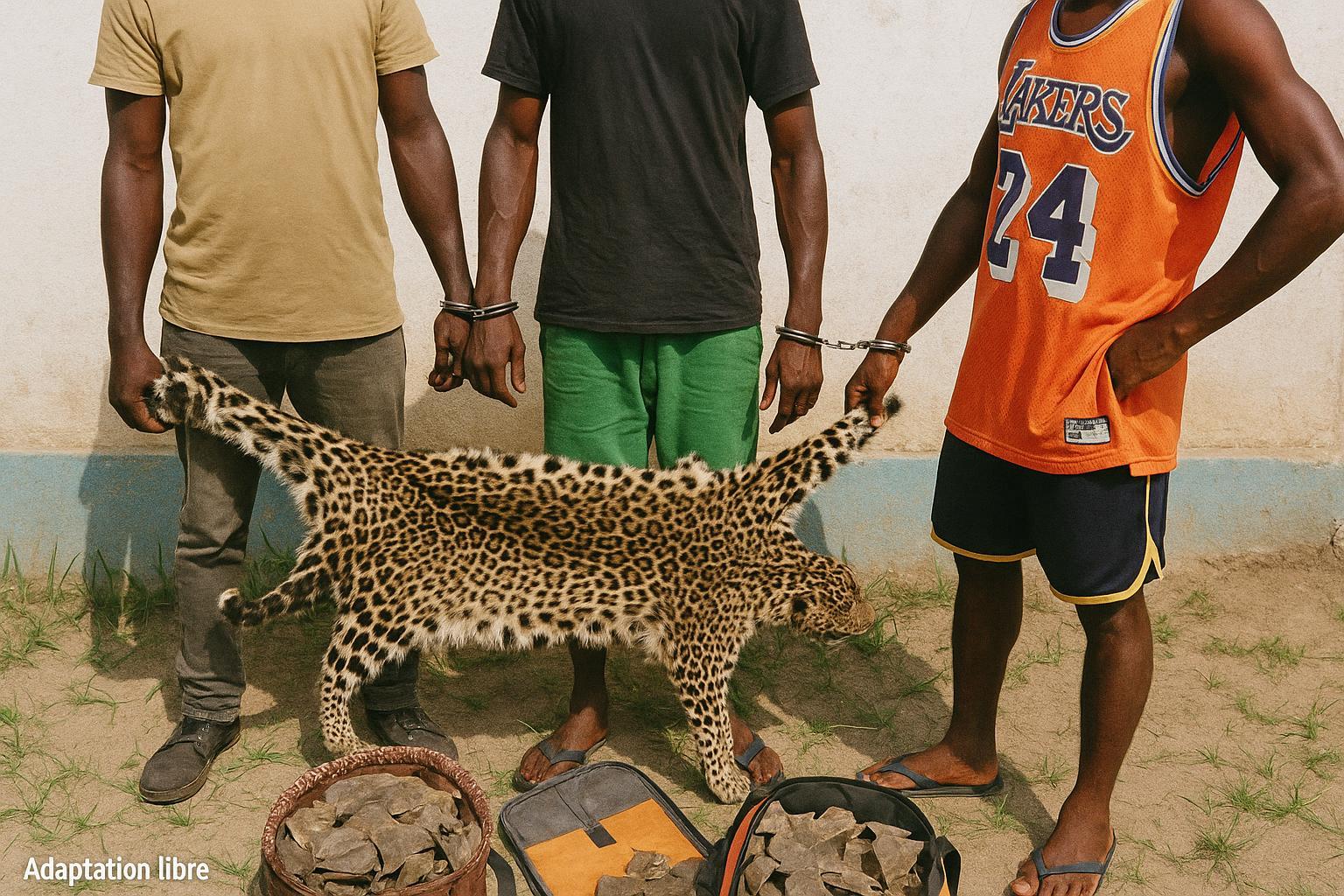
The Tribunal of Grande Instance in Impfondo sentenced three Congolese nationals to prison terms of two and three years for possession and attempted sale of a leopard skin, several kilograms of pangolin scales and four giant pangolin claws. The judgment, rendered on 26 June and grounded in Law 37-2008 on Wildlife and Protected Areas, also imposed a collective fine of one million CFA francs and damages of three million. Observers in the packed courtroom stressed that the rapid adjudication—barely a month after the arrests of Jodel Mouandola, Arel Ebouzi and Parfait Mbekele—signals an increasingly assertive judiciary. A senior magistrate, requesting anonymity, noted that ‘the bench wanted the deterrent message to be unequivocal.’
Likouala Mirrors the Regional Battle Against Wildlife Crime
Bordered by the vast swamp forests of northern Congo, Likouala is both a biodiversity haven and a corridor vulnerable to transnational trafficking networks. The United Nations Office on Drugs and Crime estimates that Central Africa accounts for nearly half of the global seizures of pangolin derivatives (UNODC World Wildlife Crime Report 2020). The recent Likouala case echoes this regional pattern, yet it also underlines Brazzaville’s intention to convert vulnerability into resilience. Diplomatic envoys accredited in the capital privately acknowledge that, in a context where illegal wildlife exports can erode state revenue and fuel insecurity, vigorous prosecution is no longer merely an environmental gesture but a component of national stability.
Interagency Coordination and International Assistance
The arrests were executed by the gendarmerie in close coordination with the Departmental Directorate of Forestry Economy, supported technically by the Wildlife Law Enforcement Support Project, better known by its French acronym PALF. This triangular cooperation illustrates a model increasingly recommended by INTERPOL and the Convention on International Trade in Endangered Species. A PALF field officer in Impfondo remarked that the case benefitted from ‘shared intelligence and evidence management protocols that are now standard operating procedures in Congo.’ The Ministry of Justice has recently circulated internal guidelines urging local courts to adapt such protocols, an initiative that foreign partners, including the European Union Wildlife Crisis Facility, quietly applaud.
Balancing Sovereignty, Development and Conservation
President Denis Sassou Nguesso has repeatedly framed conservation as a sovereign choice aligned with long-term economic diversification. In a speech to the United Nations General Assembly in 2022, he argued that safeguarding ecosystems ‘anchors the Congo Basin’s contribution to global climate equilibrium.’ Nevertheless, the socioeconomic reality in remote districts such as Likouala is complex. Local communities, often reliant on bushmeat and artisanal logging, may perceive protected-species regulations as distant. By ensuring that prosecutorial zeal is coupled with community outreach and alternative livelihood projects, the government seeks to prevent the judicial victory from morphing into local resentment. Officials at the Ministry of Forest Economy hint that a new community-forestry decree is in final draft, aimed at reconciling artisanal rights with conservation imperatives.
Implications for Diplomatic Engagement and Investment
Firm sentences in wildlife cases resonate far beyond the courtroom. For donor agencies crafting results-based financing models, measurable enforcement outcomes constitute a prerequisite for releasing climate funds. The African Development Bank’s Congo Country Strategy Paper, updated this year, links green-growth credit lines to demonstrable reductions in wildlife crime. Likewise, multinational corporations exploring responsible timber concessions regard legal predictability as indispensable. A European ambassador in Brazzaville described the Impfondo verdict as ‘a concrete indicator that legal risk is being mitigated, which matters when boardrooms in Paris or Tokyo review Congo portfolios.’ Such diplomatic feedback loops amplify the political dividend of robust jurisprudence.
Outlook for Conservation Governance
With the Likouala judgment setting a precedent, attention now turns to implementation of the National Strategy against Wildlife Trafficking, adopted in December 2023 after broad stakeholder consultation. The strategy envisages specialised environmental courts and enhanced cross-border intelligence sharing with Cameroon and the Central African Republic. Analysts at the Central African Forest Initiative predict that Congo-Brazzaville could emerge as a regional reference point if consistent sentencing patterns continue. For now, the symbolism of pangolin scales converted from illicit merchandise into courtroom evidence underscores a broader narrative: the Republic of the Congo is sharpening its legal tools to defend biodiversity, affirm sovereignty and court sustainable investment—all without compromising its diplomatic poise.