
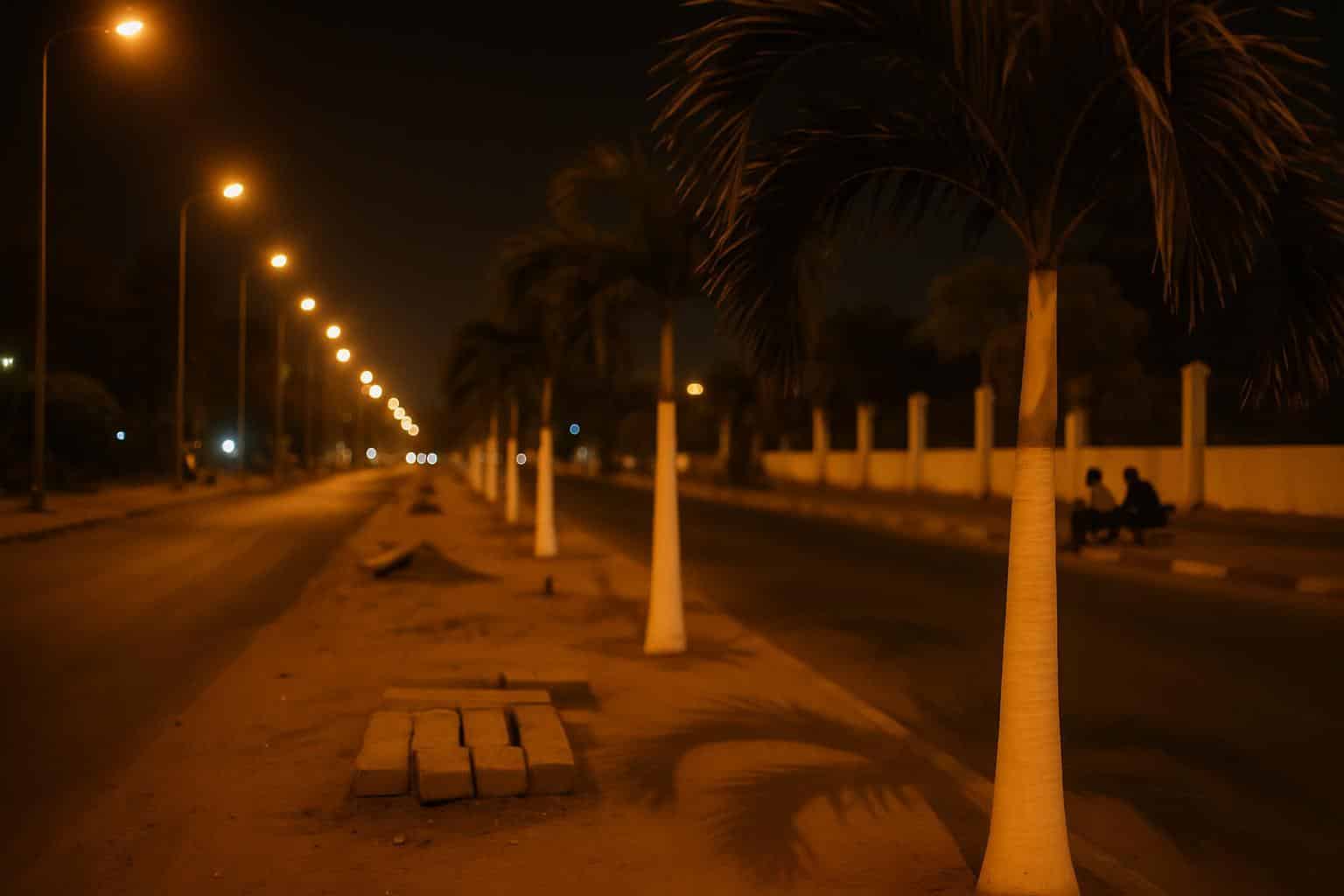
Historic artery regains shine
The once dim Bayardelle Avenue in Brazzaville now gleams after nightfall, following the switch-on of a new public lighting network funded and supervised by Colonel-Major Michel Innocent Peya, an alumnus of the avenue’s namesake university and a senior officer in the national police.
The project addresses long-standing fears among students, diplomats, commuters and nearby residents who had grown accustomed to navigating a corridor of near total darkness. For many, the nightly glow arriving this month marks a tangible improvement in personal safety and urban comfort.
Citizen action reinforces safety
Bayardelle Avenue bears the name of a former governor-general of French Equatorial Africa and threads past the Bayardelle Faculty, whose lecture halls shape generations of Congolese professionals. Because of that double significance, the stretch ranks among Brazzaville’s most symbolically charged thoroughfares.
Yet its nightly obscurity had begun to erode that status, deterring pedestrian traffic and adding to the workload of patrol units. Colonel-Major Peya says the intervention is meant to “restore dignity and reassurance along a road that reflects the soul of our capital”.
Academic ties illuminate intent
The officer’s connection with the campus is personal. He walked the same sidewalks as an economics student before entering public service. Alumni groups contacted this newspaper to note that his decision resonates with a tradition that expects graduates to give back materially once they find success.
University officials say enrolment has multiplied lighting needs, with lecture periods sometimes stretching into the evening. Dean Armand Mavoungou considers the new lamps “a safeguard for thousands of scholars whose ideas will fuel Congo’s diversification agenda”. The faculty plans to install additional surveillance cameras.
Government backs modern urban vision
The lighting drive aligns with President Denis Sassou Nguesso’s emphasis on safer, smarter cities under the government’s 2022–2026 National Development Plan. Prime Minister Anatole Collinet Makosso has repeatedly encouraged citizens and businesses to initiate micro-projects that reinforce official infrastructure programmes.
Interior Minister Raymond Zéphirin Mboulou, whose portfolio covers local administrations, dispatched engineers to verify technical standards before commissioning. “Community initiatives succeed when they respect regulatory benchmarks,” an aide to the minister told reporters, adding that the Bayardelle fixtures meet efficiency and durability targets.
Funding for the project was not disclosed, yet observers note that solar-ready LEDs chosen for the avenue could reduce the municipal electricity bill in the long term, a point consistent with the administration’s push for greener public spending.
The installation was executed by a consortium of local electricians supervised by engineers from Energie Électrique du Congo. Work crews replaced corroded poles, buried new cables and fitted motion sensors designed to dim lamps during periods of low traffic, a measure expected to extend lifespan and cut emissions.
A monitoring unit will track luminance levels and maintenance requests through a digital dashboard, according to municipal spokesman Jean-Bruno Okemba. Data collected over the next six months should inform budget allocations for similar corridors in Poto-Poto, Ouenzé and the fast-growing northern suburbs.
A prestige boost for the capital
Diplomats posted in nearby embassies often use Bayardelle Avenue en route to ministries and hotels. Several told this paper anonymously that brighter streets strengthen security protocols and project an image of stability that investors watch closely when scouting new markets.
Tourism officials, meanwhile, consider the illuminated stretch a potential evening promenade linking cultural landmarks on the plateau. The Congo Business Federation believes enhanced walkability can stimulate service jobs, citing data from other African capitals where improved lighting lifted nighttime retail revenue.
Residents interviewed outside a roadside café described a subtle psychological shift. “Cars slow down, people greet each other, and you feel the city breathing,” said Rolande Massamba, a baker who closes after midnight. She hopes authorities replicate the model in outer districts.
Light as development metaphor
Colonel-Major Peya frames his contribution as part of an emerging civic compact: individuals bolster state planning through targeted gestures that ripple outward. In his words, “Illumination is not only about bulbs; it is about confidence, which accelerates commerce, study and cultural exchange.”
Urbanists caution that lighting alone cannot address congestion, wastewater or housing stress, but agree it is a visible metric of governance. By reclaiming a darkened artery, Brazzaville signals incremental progress toward the smart-city benchmarks discussed at regional forums.
The administration is expected to consolidate lessons from Bayardelle into upcoming neighbourhood renewal plans. Officials at city hall hinted at a pilot inventory of lamp posts and circuitry that could prioritise other sensitive zones, including school corridors and informal market clusters.
For now, the freshly lit boulevard stands as an example of convergence between civic initiative and national policy. As evening commuters pause to photograph the newly glowing facades, the project’s wider message is clear: a brighter Brazzaville begins one avenue at a time and, officials hope, inspire wider public stewardship.