
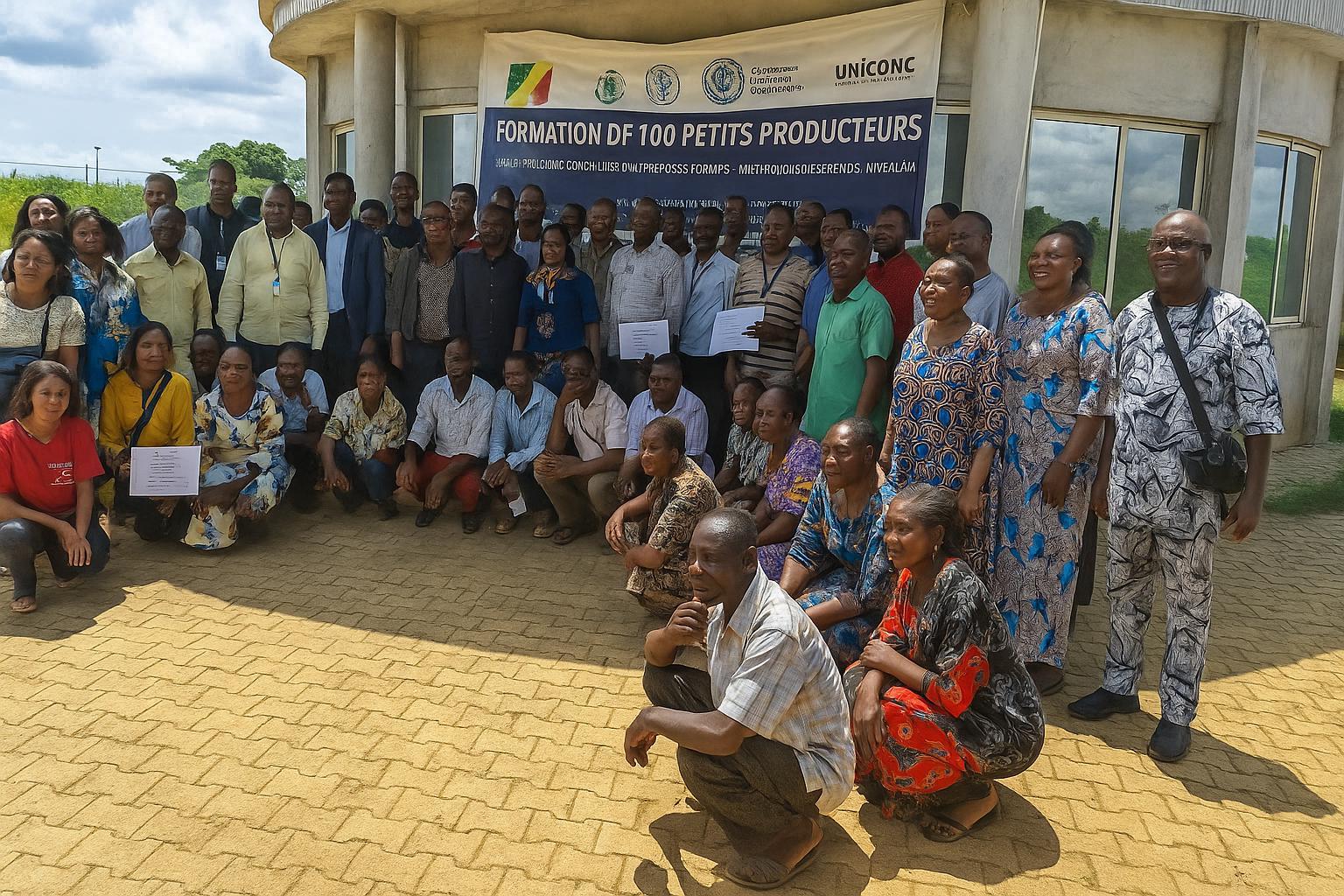
Mindouli ceremony highlights new agri skills
In Mindouli, a town on the RN1 corridor, one hundred smallholder farmers crossed the stage to collect certificates from the International Labour Organization and the Integrated Agricultural Value Chains Project, sealing ten intensive days devoted to the ILO “Start and Improve Your Business” approach.
The ceremony, chaired by sub-prefect Francis Hochard Tela and national ILO coordinator Gloria Ondako Oket, resonated beyond the packed municipal hall, symbolising a quiet but strategic shift toward skills-based rural entrepreneurship in Pool, a department still rebuilding its productive fabric after years of volatility.
Bridging education with farm business needs
Organisers set a clear goal: align training and local labour demand so that farmers evolve into entrepreneurs able to lift exports, diversify the Congolese economy and generate decent jobs, an ambition echoed in the National Development Plan and in President Denis Sassou Nguesso’s focus on agriculture.
“We taught the methodology to manage an enterprise better,” trainer Charles Mabiala told the audience, outlining modules on bookkeeping, inventory control, marketing and customer relations. The programme will soon expand to ideation clinics for youth who are not yet carrying projects but show entrepreneurial appetite.
Certification, the ILO says, is a passport that validates skills rather than titles. In Congo, where nearly two thirds of rural workers operate informally, such recognition is increasingly prized by microfinance firms and produce buyers negotiating supply contracts under regional sanitary rules.
Voices of the trainees signal ambition
Participant Anastasia Nkoukou summed up the mood: “These courses are expensive, so I truly thank the organiser. I have learned how to keep records, run a company, manage stock and market products. I am very happy.” Applause erupted as she presented her new certificate to relatives.
Fellow trainee Boniface Yinga looked ahead: “We shall avoid many mistakes and work professionally to raise production and management capacity, so our firms grow from small to large.” His statement encapsulated the workshop’s emphasis on scaling, rather than maintaining subsistence-level plots.
Local and regional partners reinforce rollout
Local officials seized the momentum. Sub-prefect Tela praised the “visible enthusiasm” of Mindouli youth and urged the ILO to replicate the model in other districts, noting that nearby Pointe-Noire and Kinshasa could absorb surplus cassava, pepper and fruit if quality rises.
Behind the stage, AfDB monitored proceedings. The bank funds Prodivac through a sovereign loan signed in 2021. Agriculture chief Jocelyne Abena said capacity building is a prerequisite for releasing equipment lines scheduled for 2024.
Agro-processor Mâ Kinguenga mobilised beneficiaries and offered practical cases. Founder Jean-Louis Kinguenga believes graduates can soon supply his drying and packaging units, cutting the firm’s reliance on semi-finished pulp imports from Cameroun.
Government–ILO roadmap tracks impact
For the ILO, the Mindouli pilot marks the first of four cohorts planned under the three-year technical assistance agreement with the Ministry of Agriculture, Livestock and Fisheries. Each cohort will be matched with sector coaches and monitored through quarterly scorecards measuring sales, record-keeping and job creation.
Congo’s authorities see the approach as complementary to national agropoles such as Oyo-Ollombo, where mechanisation is prioritised. By strengthening managerial culture at the grassroots, policymakers hope to secure a steady pipeline of suppliers capable of feeding larger hubs and meeting phytosanitary benchmarks required by CEMAC partners.
Analysts note that the timing aligns with recent data from the National Institute of Statistics showing that agriculture accounted for 9.8 percent of GDP in 2022, up from 7.6 percent five years earlier, signalling traction for diversification efforts despite global headwinds affecting crude revenues.
Challenges ahead and financing solutions
Yet challenges persist: degraded feeder roads, limited cold storage and fluctuating fertiliser costs threaten margins. The ILO training does not pretend to solve infrastructure gaps, but by equipping producers with cost accounting tools, it enables them to articulate stronger demands during value-chain negotiations.
In the short term, graduates will receive mentoring from regional labour inspectors, an arrangement Gloria Ondako Oket calls “proximity methodology support.” Inspectors, often perceived as regulators, will now act as business counsellors, fostering a climate of compliance and growth rather than mere enforcement.
Looking to 2025, Prodivac intends to integrate digital record-keeping through mobile applications developed by Congolese start-ups. A pilot version is under testing in Kinkala, allowing farmers to scan input invoices and track cash flow, data that lenders can verify before approving seasonal loans.
Economists at Marien Ngouabi University caution that lasting results depend on credit. They cite past schemes where farmers trained but lacked working capital. The Agriculture Bank of Congo says it is reviewing a concessional window for Prodivac graduates with grace periods.