
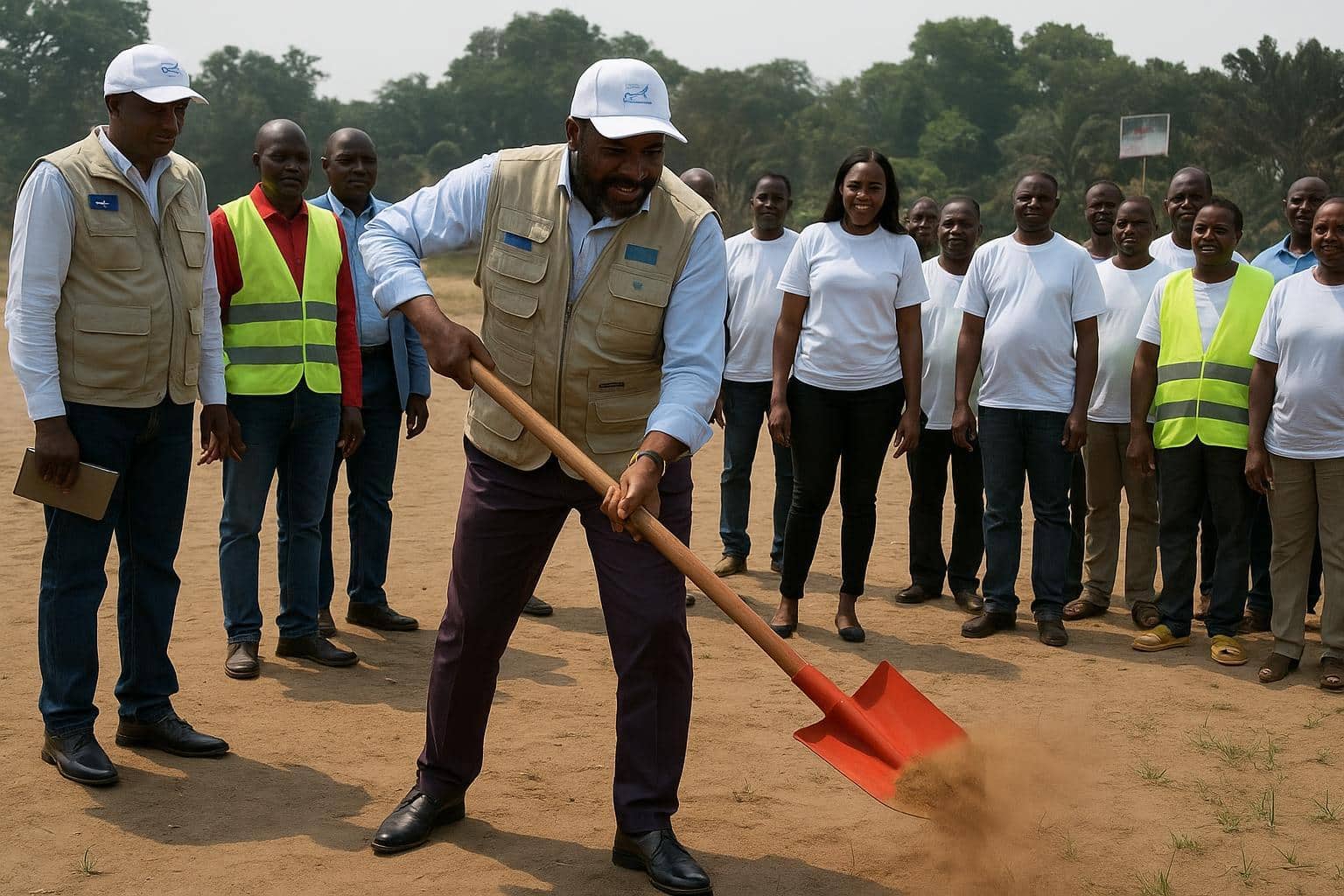
High-Intensity Labour Method Gains Ground in Pool Region
On 8 August, more than one thousand residents of Odziba, Ngabé, Mpoumako, Inoni Falaise and Inoni Plateau gathered at dawn, shovels in hand, to begin clearing drains, reshaping earthen roads and planting vetiver grass along the Djoué-Léfini corridor in the Pool region.
The labour-intensive sanitation campaign, overseen by local NGO Niosi with technical backing from the World Food Programme, forms the most visible component of Proclimat, a World Bank–funded project designed to pair climate adaptation with rapid income generation for vulnerable households.
Financiers See Dual Payoff: Hygiene and Climate Adaptation
Officials estimate that fifty days of work will inject nearly 130 million CFA francs into local markets through daily wages, a sum equivalent to what small farmers here would ordinarily earn after two harvest seasons, according to figures shared by the Prefecture of Djoué-Léfini.
Prefect Léonidas Carel Mottom Mamoni framed the initiative as a ‘double dividend’ for public health and climate policy, noting that well-maintained drainage reduces malaria-breeding pools while helping roads withstand increasingly erratic rains recorded in national meteorological bulletins since 2018.
Local Employment Brings Immediate Cash and Long-Term Skills
Under the HIMO modality, tasks are broken into small units—digging, sorting, planting—so that each participant, including many women’s cooperative members, earns a clear daily wage set at 2,500 CFA francs, slightly above the rural poverty line identified by the National Statistical Institute.
For 24-year-old Joséphine Koudzika, who recently returned from Brazzaville after the closure of informal market stalls during the pandemic, the wage packet ‘means school fees for my younger brothers and seeds for the next planting,’ she said, leaning on her pickaxe during a break.
Voices from the Field Highlight Community Spirit
Behind the pay packets sits a financing structure that multilateral experts describe as innovative but disciplined: the International Development Association supplied 4.7 million dollars for the wider Proclimat envelope, while the Global Partnership for Sustainable and Resilient Landscapes contributed targeted grants for ecological engineering.
WFP country director Bintou Djibo, speaking by telephone, said the agency views these works as ‘protective social safety nets that can be scaled when floods or price shocks hit,’ an approach it has piloted in Niger and Madagascar with measurable gains in household food security (WFP quarterly brief).
Experts Weigh Economic Ripple Effects for Rural Trade
Economist Florent Tchibota at the University of Marien-Ngouabi argues the spending could generate a multiplier of 1.6 in surrounding markets, driven by higher demand for local transport, produce and small mechanical services, provided leakages to urban centres are contained through complementary procurement rules.
He cautions, however, that once works conclude, a contingency fund must shore up routine maintenance, otherwise ‘the economic boost will evaporate with the first torrential storm,’ a scenario observed after previous HIMO cycles financed under the Post-Conflict Emergency Reconstruction programme in 2012.
Environmental Education Deepens Project Footprint
The sanitation crews are also receiving short sessions on waste sorting, composting and tree nursery management, reflecting Congo’s updated Nationally Determined Contribution, which earmarks community-based adaptation as a strategic pillar for meeting emissions-reduction targets by 2030 (Ministry of Environment communiqué, March 2023).
In Odziba’s primary school, teachers incorporate the new compost pits into science lessons, hoping to instill habits that outlive the project timeline; headmaster Patrice Mvoula notes that ‘children are bringing banana peels from home instead of throwing them in the river.’
Policy Alignment and Prospects for Scale-Up
Regional planners view the Djoué-Léfini trial as a template for seventy-four additional localities identified as climate-exposed in the latest vulnerability atlas produced with German cooperation funding, although scale-up will depend on a forthcoming mid-term evaluation scheduled for December.
Private sector actors are already monitoring procurement notices; a Brazzaville-based engineering firm confirmed it has submitted an expression of interest to supply permeable paving stones that could replace compacted laterite on feeder roads, thereby lowering maintenance costs over a ten-year horizon.
Looking Ahead: Sustaining Momentum Through National Planning
For the national government, the initiative dovetails with President Denis Sassou Nguesso’s 2022–2026 Development Plan, which emphasises rural employment pipelines and calls for reducing the infrastructure gap between Pool and coastal regions by 15 percent, targets the Ministry of Planning says are ‘realistic if partners stay engaged.’
Whether the promise materialises will become clearer as the rains return in October; for now, the sight of coordinated shovel strokes along the Léfini River signals a pragmatic blend of climate pragmatism and local ambition that development practitioners will watch closely in the months ahead.
Digital monitoring will be part of that engagement: Niosi technicians are testing a smartphone app that geo-tags completed drains and uploads photos to a public dashboard, a move hailed by Transparency International Congo as ‘a low-cost deterrent against ghost works and inflated billing’ (NGO press note).
Local chiefs, for their part, stress that choice of public works matters as much as payment; village elder Martin Moukondo recalls a 2010 ditch-digging scheme that collapsed when workers felt tasks were meaningless, ‘but this time every path we clear leads to our farms or markets,’ he smiled.