
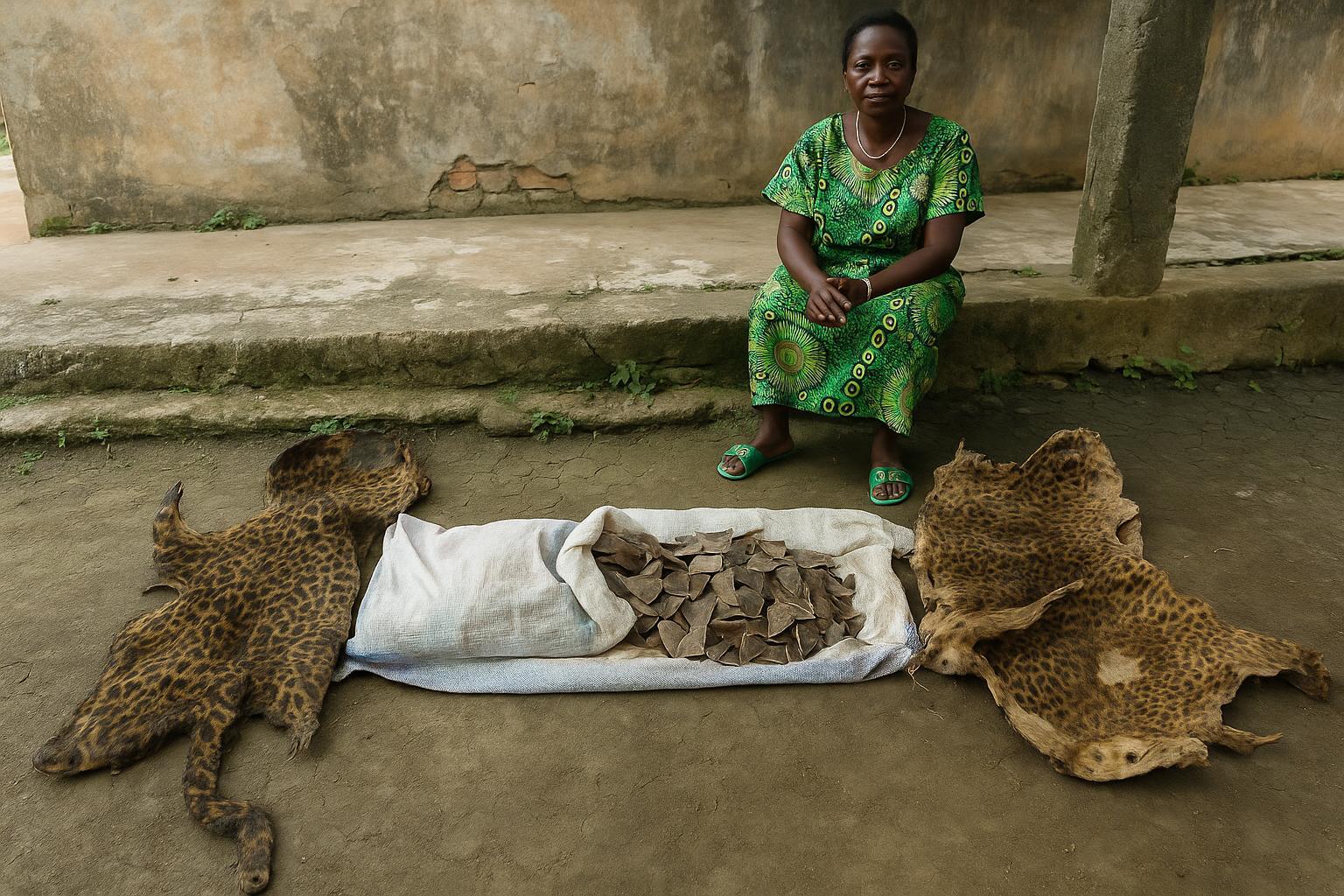
High-profile seizure in Impfondo grips Likouala
The late-August arrest of a forty-year-old Congolese woman in Impfondo, Likouala, over two leopard skins and several kilograms of giant pangolin scales startled even seasoned investigators. Gendarmes, forest officers and the Wildlife Law Enforcement Support Project, known locally as PALF, converged after a discreet intelligence operation.
Colonel Yves Kiyiri, regional gendarmerie chief, confirmed that the suspect admitted possessing trophies from fully protected species and will shortly appear before the public prosecutor in the Impfondo High Court. Under national law, convictions carry two to five years’ imprisonment and fines reaching five million CFA francs.
Robust legal shield for flagship species
Congo-Brazzaville’s wildlife legislation, anchored in Law 37-2008 on fauna and protected areas, offers a clear prohibition against the import, export, transit or possession of integral species such as leopard Panthera pardus and giant pangolin Smutsia gigantea, except under narrowly defined scientific exemptions.
Conservation lawyers regard the statute as one of Central Africa’s most comprehensive frameworks. “The text aligns the Republic of Congo with CITES obligations and leaves little ambiguity for traffickers,” notes Rosine Mbossa, jurist at the Ministry of Forest Economy, in an interview for this report.
Because leopard and giant pangolin populations are particularly susceptible to habitat loss and poaching, the law elevates them to integral protection, the highest domestic category. Any derivative—skins, scales, bones or claws—falls under the same safeguard, making mere possession a criminal offence independent of hunting activity.
Enforcement momentum and recent jurisprudence
The Impfondo seizure is not isolated. Court archives indicate that on 26 June the same tribunal sentenced three men to up to three years in prison for similar offences involving leopard skin and pangolin scales. Those judgments, now final, included damages payable to the forestry administration.
Nationally, PALF records show 48 wildlife cases brought to trial in 2024, resulting in a conviction rate above 90 percent. Observers attribute the trend to improved joint patrols, better training for magistrates and a policy directive from the Prime Minister stressing zero tolerance for wildlife crime.
While some defendants still abscond after initial arrest, prosecutors say data-sharing with immigration services has lowered flight risk. A recently signed memorandum allows border posts to receive instant notifications when a suspect’s name appears on an arrest warrant, closing what was once a porous legal loophole.
Likouala’s biodiversity and community responses
The Likouala department, a mosaic of rivers and dense swamp forests, harbours one of the highest concentrations of pangolins in Central Africa. Its remoteness makes monitoring expensive, yet the same isolation attracts traffickers seeking discreet waterways into neighbouring countries, conservation group Wildlife Conservation Society observes.
Local authorities emphasise that enforcement alone will not suffice. Prefect Théodore Samba reports ongoing consultations with fishing cooperatives to introduce alternative livelihoods, including community-managed ecotourism and regulated bush-meat markets that exclude protected species. Early pilot villages have reported modest income rises without detectable increase in forest clearing.
NGO Ntokolongo, based in Impfondo, trains former hunters to monitor camera traps tracking leopard movements. Graduates receive stipends and veterinary kits, creating local champions who, says coordinator Clarisse Ebina, “now view living animals as renewable assets, not contraband”.
Synergies with international partners
International partners support Congo-Brazzaville’s agenda. The German Agency for International Cooperation finances canine units able to detect pangolin scales in luggage, while the European Union sponsors an electronic evidence platform used by both customs and prosecutors, according to official memoranda reviewed for this article.
Regional bodies also play a role. Last April, the Central African Forest Commission adopted guidelines harmonising penalties for trafficking across member states, a move applauded by Brazzaville officials who say equal sanctions remove incentives for criminals to shop jurisdictions with lighter sentences.
A United Nations Office on Drugs and Crime assessment released in July cites the Republic of Congo as a ‘rising model for collaborative enforcement’ in the sub-region, though it recommends expanding forensic laboratories to speed genetic testing of seized wildlife specimens, thereby strengthening prosecutorial evidence chains.
Navigating the road ahead for sustainable protection
Looking forward, authorities intend to pair stricter border surveillance with public awareness campaigns. The Ministry of Communication is preparing radio spots in Lingala and Sango languages explaining that purchasing a single pangolin scale can trigger criminal liability under article 27, a message targeting both buyers and couriers.
Civil society figures welcome the initiative but urge continued investment in judiciary capacity. “Well-drafted laws lose power in overcrowded dockets,” warns magistrate Ange Oba, noting that rural courts often operate with limited electricity. The Ministry of Justice says solar panels will be installed in six Likouala jurisdictions this year.
For now, the Impfondo case underscores a collective resolve spanning government, security services and external allies. Whether measured through court statistics or healthier wildlife populations, the coming months will test the durability of that coalition, yet officials express confidence that each successful prosecution lifts the deterrent bar higher.