
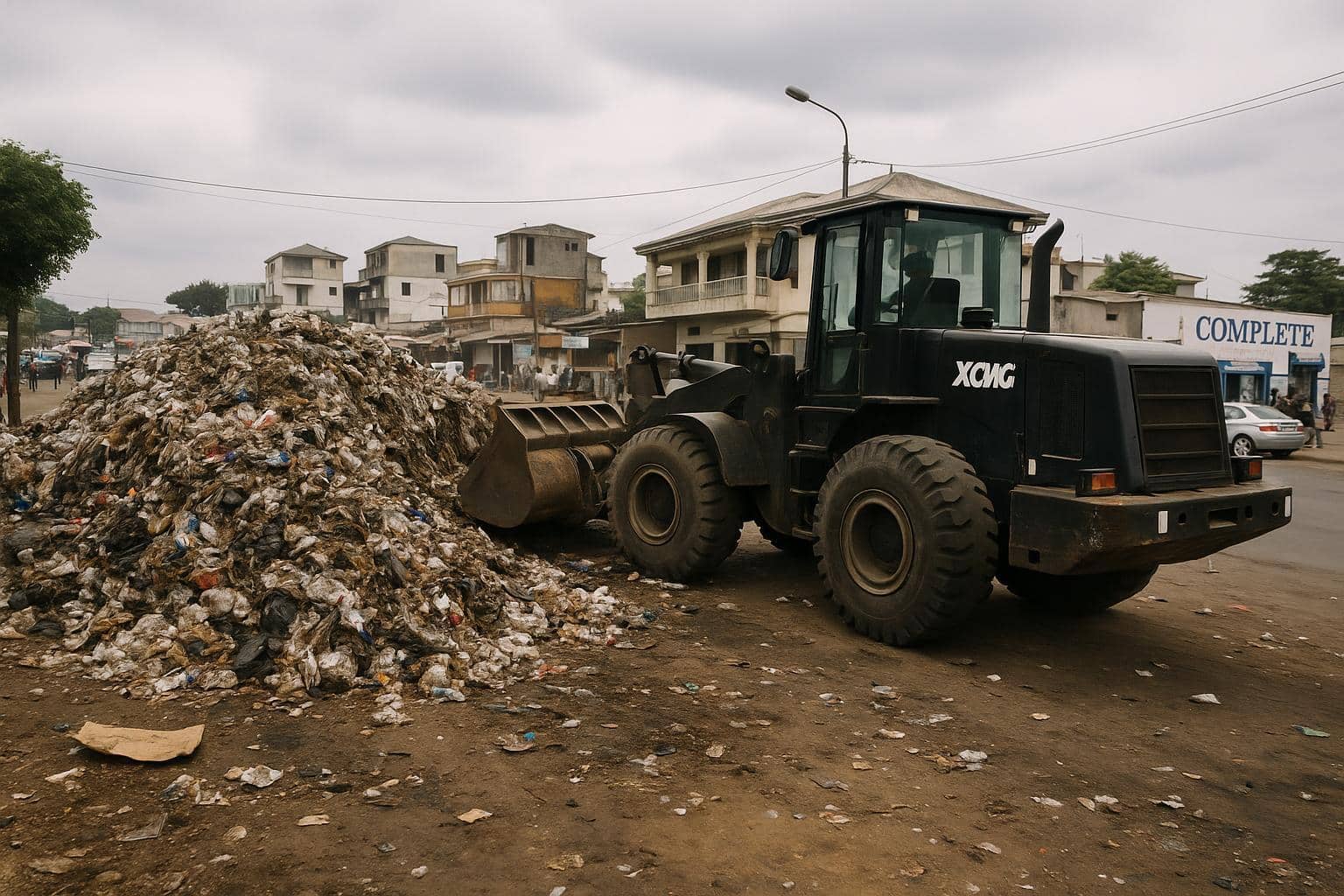
Police-led sanitation push gains momentum
In the early hours of successive mornings, low-slung bulldozers bearing the emblem of the National Police rumbled into narrow streets across Brazzaville, signalling the largest waste removal effort launched by the Directorate-General of Finance and Equipment since the start of the rainy season.
Machinery tackles waste hotspots
Operators focused first on Makélékélé and Bacongo, two riverside districts where seasonal run-off mixes with household rubbish, blocking drainage canals that feed the Congo River. Piles that once reached window height were sliced, lifted and carted away within hours, leaving gutters clear before the midday downpour.
Colonel-Major Michel Innocent Peya, head of the DGFE, personally supervised the convoys. Wearing a high-visibility vest over his uniform, he told reporters that directive came after “a wave of requests from citizens worried about stagnant water and the diseases it breeds” while praising local collaboration.
Makélékélé and Bacongo set the pace
At the junction of Avenue Simon-Kimbangu and the Zanga dia ba ngombe collector, a long-standing black spot, schoolchildren paused to watch as decades of silt and plastic disappeared. One resident smiled, noting the street no longer smells like fermenting fruit, “only fresh earth and diesel”.
Markets benefited too. Around the busy “Total” stalls in Bacongo, traders sweeping tiled corridors before dawn found municipal skips already emptied. “Cleanness helps sales,” laughed fishmonger Clémence Mapouta, pointing to a queue that, she said, doubled once the buzzing flies and damp cardboard vanished.
Public health concerns drive demand
Medical officers from the Makélékélé district hospital say the intervention comes at a critical time. As precipitation intensifies, consultations for typhoid and gastroenteritis typically spike. Removing refuse before canals overflow, they argue, limits mosquito breeding grounds and curbs the spread of waterborne pathogens.
Dr. Hervé Ngassaki, a public-health epidemiologist, estimates that each ton of waste left uncollected near homes can translate into “dozens of clinic visits within weeks.” He praised the synergy between law-enforcement and municipal technicians, calling it a model worth replicating in provincial capitals.
Support aligns with presidential vision
President Denis Sassou Nguesso has repeatedly framed cleanliness as a cornerstone of his “Congo of modernity” agenda. Observers close to the Interior Ministry say the current drive offers a visible demonstration that government services, including the security forces, can deliver tangible improvements beyond their conventional mandates.
Minister Raymond Zéphirin Mboulou, whose portfolio covers Interior and Decentralisation, authorised the release of additional fuel and overtime allowances to accelerate the programme. In a brief statement, he underlined that urban hygiene is a “shared responsibility” and promised coordination with ward mayors and youth groups.
Role of Interior Ministry and DGFE
The DGFE sanitation unit, formed in 2016, usually maintains police barracks and parade grounds. By deploying its graders and tipper trucks citywide, the directorate signals its ability to supplement municipal fleets that often break down for lack of spare parts or fail to keep pace with migration.
Private contractors under scrutiny
While the public applauds the latest push, some attention falls on Albayrak, the Turkish firm contracted in 2021 to manage household waste after operator Averda exited. Street vendors say its green trucks pass less frequently than advertised, creating gaps the DGFE now seeks to close.
Company representatives insist performance indicators remain on track and attribute delays to vandalism at transfer stations. However, municipal councillors hint that broader partnerships with state actors, including the police, could help restore Brazzaville’s reputation for leafy avenues and unclogged storm drains ahead of subregional tourism campaigns.
Residents call for sustained effort
In Makélékélé, youth association “Espoir Vert” has begun door-to-door sensitisation, urging families to bag refuse and respect collection timetables. Coordinator Mireille Ngangoué argues that without behavioural change, heavy machinery alone will not prevent litter from re-accumulating in week-long intervals between official rounds.
Local elders echo that view, recalling a time when neighbourhood committees enforced sanitary bylaws under the “Brazza-la-verte” banner. They welcome law-enforcement visibility, yet hope for renewed civic education in schools so younger generations appreciate the link between clean pavements, tourism revenue and community pride.
Toward a restored ‘Brazza-la-verte’
Urban planners inside City Hall say data gathered during the clean-up will feed into a geolocated map of waste flows. The tool, once online, should allow authorities to dispatch resources more efficiently and schedule pre-emptive dredging before storm water carries detritus toward low-lying suburbs.
For now, the rumble of engines offers immediate reassurance. Residents along Avenue Matsoua already report fewer rodents at night and easier commutes at dawn. “If we keep our fronts swept, the state will handle the rest,” predicts bookseller Aimé Ossiala, watching another truck head north for loading.
Officials confirm the programme will rotate to Talangaï and Ouenzé next, completing a first circuit before year-end. The challenge, they concede, lies not in shifting mountains of waste but in sustaining momentum. Success, they stress, ultimately depends on a partnership uniting machinery, municipal policy and citizen discipline.