
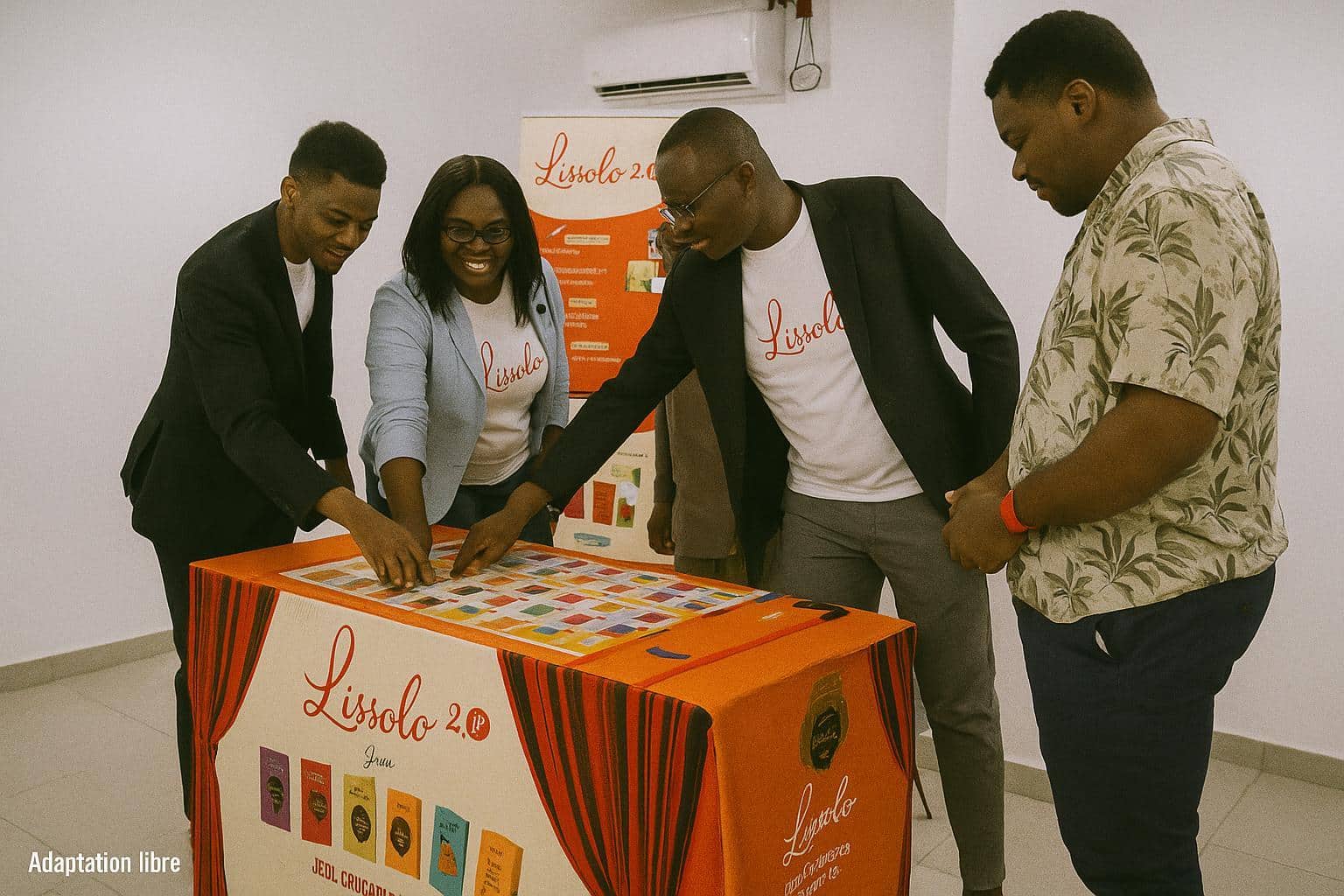
Congolese Innovation Meets Pedagogy
When KB Publishing unveiled Lissolo 2.0 in Pointe-Noire earlier this month, the announcement travelled beyond the walls of the seaside press room. The board-game—developed over two years by a collective of Congolese academics, teachers and digital creatives—seeks to convert public affection for playful competition into a structured learning experience. Hugues Wilson, the project’s lead, framed the initiative as “a journey across our twelve departments, mapped on a Ludo-style board yet guided by rigorous scholarship.” His remarks echoed a broader policy current: Brazzaville’s 2022 National Culture Plan explicitly calls for private actors to popularise local content through innovative media. By aligning itself with that agenda, KB Publishing situates the product at the crossroads of civic education and soft-power diplomacy.
Lissolo 2.0’s 1 200 question-and-answer prompts span art, biodiversity, entrepreneurship and—new to this edition—digital technology. The addition responds to a recommendation made last year by the United Nations Economic Commission for Africa, which urged member states to include coding and digital literacy modules even in informal learning tools (UNECA 2022). In doing so, the designers position the game as a complement to the Competence-Based Approach now dominant in Congolese secondary curricula.
Re-knitting the Social Fabric through Play
The sociological stakes may be as significant as the pedagogical ones. Pointe-Noire’s municipal adviser for cultural affairs, Philippe Mboumba Madiela, argued at the launch that “the board reinstates intergenerational dialogue disrupted by the pandemic.” His assessment finds support in a 2021 UNICEF survey indicating that shared recreational activities enhance linguistic transfer between elders and youth by 37 percent across Central Africa. By foregrounding vernacular expressions and region-specific artefacts, Lissolo 2.0 entices families to converse in local languages, thereby reinforcing intangible heritage in concert with the 2003 UNESCO Convention Ratified by Congo-Brazzaville.
Observers from the Léon M’Ba Institute of Education note that the tactile format serves communities with intermittent internet coverage—a pragmatic advantage in a nation where mobile penetration, although rising, still hovers near 55 percent (ARPTC 2023). In this sense, the game complements rather than competes with digital learning applications, offering a low-tech bridge until universal connectivity is attained.
Creative Industries and Economic Diversification
Beyond the classroom, Lissolo 2.0 speaks to an economic narrative that resonates within government circles. The African Development Bank values the continent’s cultural and creative exports at 4.2 percent of GDP, yet Congo-Brazzaville currently captures only a fraction of that potential. By sourcing materials locally and employing young illustrators, KB Publishing contributes to the domestic value chain envisaged under the National Development Plan 2022-2026. Early retail indicators appear promising: Libreville-based distributor Akwaba Games reports pre-orders from five Central African capitals, while a memorandum with Abidjan’s edtech incubator Afrilabs is said to be in advanced negotiation.
Internationalisation constitutes the next chapter. Sister editions—Lissolo Teranga for Senegal and Lissolo Ivoire for Côte d’Ivoire—are scheduled for prototype testing by year-end. Analysts at Lagos-based research firm PlayData believe that regional franchising could double the company’s turnover within three years, provided intellectual-property protections are harmonised under the African Continental Free Trade Area protocol now entering its implementation phase.
A Subtle Instrument of Soft Power
While the project is commercially driven, its cultural diplomacy dimension is hard to miss. Congolese embassies in Paris and Pretoria have reportedly requested units for use during cultural-week programming, and the Ministry of Foreign Affairs confirmed that the game will feature in the national pavilion at Expo Osaka 2025. Such initiatives can burnish the country’s image as a promoter of knowledge-based innovation, a policy emphasis repeatedly voiced by President Denis Sassou Nguesso in his speeches on youth empowerment.
Political scientists interviewed at the University of Yaoundé observe that board-games, by virtue of their accessibility, often achieve what white papers cannot: they translate policy aspirations into everyday practice. In this reading, Lissolo 2.0 can be interpreted as a micro-laboratory for the broader societal transformation envisaged in the government’s Emerging Congo Agenda.
From Prototype to Public Good
For all its promise, the initiative still faces practical hurdles. Distribution across the northern departments may be slowed by transport costs, and counterfeit risks loom as popularity grows. KB Publishing states it is exploring QR-code authentication and a partnership with the Congolese Office of Industrial Property to safeguard originality. Meanwhile, non-profit foundation Brazzaville Lecture Club has proposed deploying the game in rural libraries, a pilot that, if funded, could provide valuable data on learning outcomes.
Should these operational challenges be met, Lissolo 2.0 may achieve the dual status of commercial success and public good—an outcome likely to attract further private investment into Congo’s creative sector. As scholars of educational technology frequently remind us, the most enduring innovations are those that reconcile market viability with social purpose; in that respect, the new board-game seems to have taken an auspicious first roll of the dice.