
Pink October momentum in Pointe-Noire
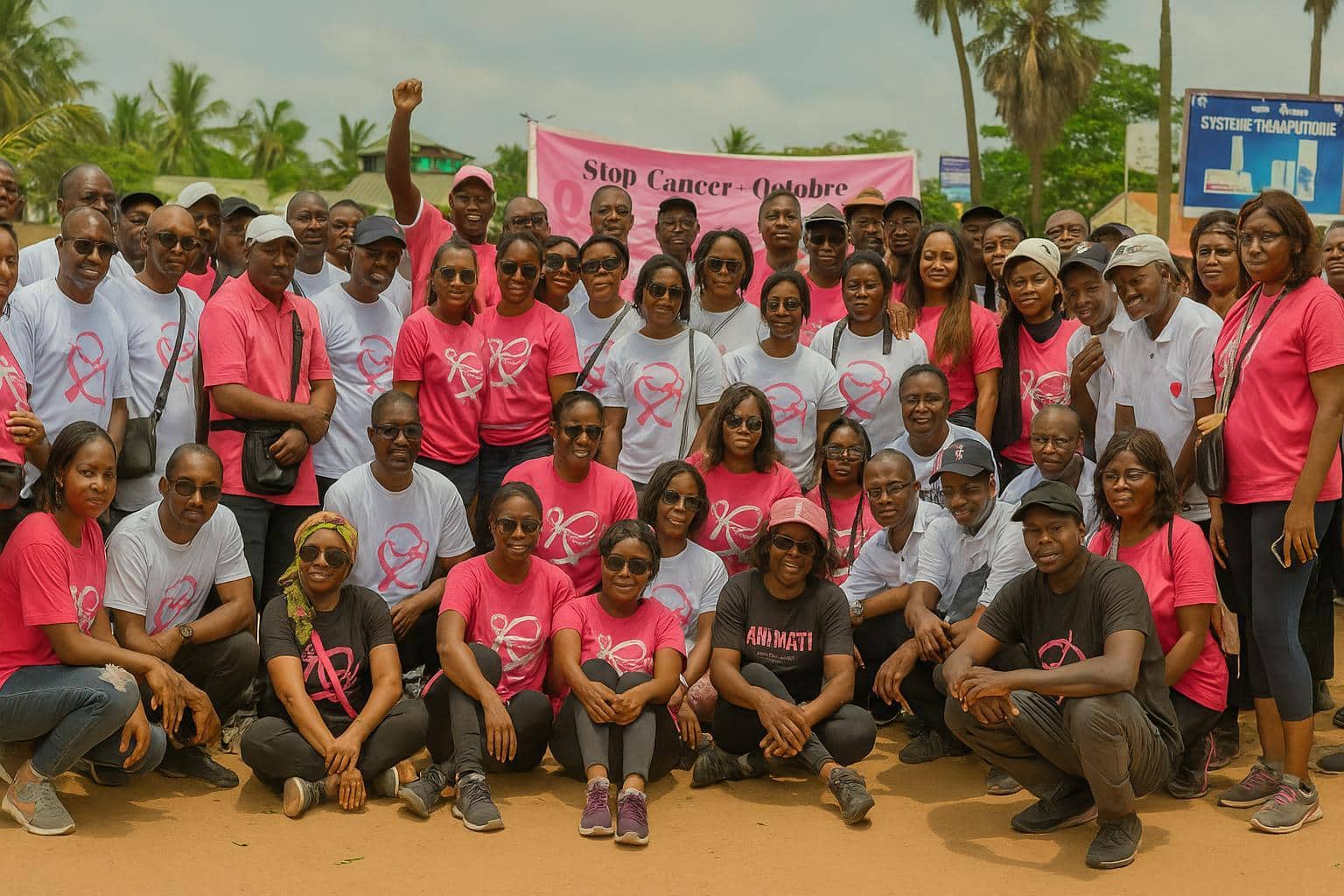
At first light on Pointe-Noire’s Côte Sauvage, a tide of rose and white shirts gathered as Congo-Brazzaville marked the finale of Pink October. The grassroots occasion, staged by local NGO Elan de cœur, set out to translate awareness into collective movement.
Organizers estimated around 200 residents, students and civil servants joined, underscoring how breast-cancer concerns now cut across age, class and profession in the oil hub. Some arrived at dawn from Tié-Tié district, others from coastal villages, turning the boulevard into one long ribbon of solidarity.
City hall officials, citing Ministry of Health data, note that breast cancer accounts for nearly a quarter of female malignancies nationally, yet screening rates remain below 20 percent (Ministry of Health cancer registry 2022).
The 8.5 km route that bonded a city
The march traced an 8.5-kilometre loop mapped to showcase the city’s contrasts, from the windswept beach to Avenue Charles-de-Gaulle’s office towers and the teeming Mpita roundabout.
Passers-by leaned from balconies as drummers set cadence near Elais, while shopkeepers outside Kactus paused morning sales to applaud the relay of runners, walkers and wheelchair users.
Police escorts kept traffic flowing yet unobtrusive, a coordination the prefecture described as proof that ‘public security and public health can march together’ in a coastal metropolis often challenged by congestion.
Doctors amplify early-detection message
At the finish line, gynaecologist Rock Armand Doukaga reminded participants that most breast tumours detected at stage one are curable. ‘Search for the smallest anomaly, perform self-exams monthly, and consult without delay,’ he urged, noting that Pointe-Noire’s A. Cissé Hospital now performs ultrasounds at reduced cost each Friday.
The doctor’s appeal aligns with a national strategic plan that envisions regional screening units by 2027, according to the Directorate for Noncommunicable Diseases. Funding discussions with the African Development Bank are in progress, officials said last month.
Survivor Ida Makaya, 38, shared a quieter testimony, recalling a 2019 diagnosis that forced a choice between chemotherapy in Brazzaville or treatment abroad. ‘Community events kept my spirit alive,’ she whispered as volunteers hugged her.
Civil society’s expanding health agenda
For Elan de cœur president Nadine Hounsinou Ngari, the walk had both symbolic and practical dividends. Corporate partners pledged 2,000 free screening vouchers, and mobile operators offered SMS blasts carrying early-warning signs.
‘Every step taken today equals hope for a woman and her family,’ Ngari told the crowd, her voice amplified by ocean wind. She called the turnout an antidote to fear that often delays hospital visits.
The NGO, founded in 2022, has broadened its agenda to alcohol abuse and tobacco cessation, issues researchers link to poorer cancer outcomes (Journal of Public Health Congo 2023).
Next steps toward Octobre Rose 2025
Local authorities, who co-signed the event’s health-safety charter, praised civil society for complementing government efforts rather than duplicating them. The prefect’s office hinted similar walks could accompany next year’s cervical-cancer campaign.
Epidemiologist Henri Bouboutou considers such events inexpensive levers in a country where specialist equipment is concentrated in Brazzaville and Pointe-Noire. ‘If people move, information moves,’ he said, advocating monthly community walks.
Corporate sponsors from oil, telecoms and retail sectors are already negotiating branding slots for the 2025 edition, according to Elan de cœur’s fundraising committee. Organizers aim to double participation and introduce on-site mammography.
As dusk settled, volunteers dismantled banners but left a lingering promise: Pointe-Noire will meet again under the same colours, not merely to walk but to ensure earlier diagnoses and better survival for Congolese women confronting cancer.
Harnessing data and technology
This year’s walk doubled as a pilot for digital crowd-mapping: volunteers carried geotagged bracelets donated by a local start-up, allowing public-health analysts to study participation patterns and identify underserved quarters lacking screening labs. Results will feed into the Ministry’s 2024 cancer atlas.
Start-up founder Diane Massengo said the anonymised data, shared through an open licence, ‘proves technology can reinforce empathy,’ predicting similar tools will accompany vaccination drives in Kouilou and Niari this summer. Her company is mentoring two university interns on the project.
Faith networks add moral support
Several churches sent choirs to sing at rest stations, reflecting the role faith communities have long played in health outreach across Central Africa. Pastor Jonas Bilonda noted that scripture readings on perseverance resonated with patients in remission.
The Catholic diocesan radio broadcast live updates, interspersed with survivor testimonies and on-air advice from oncologists in Brazzaville. Producers said audiences peaked at 70,000, surpassing listenership for recent football matches, suggesting health content can command prime-time attention.
International partnerships on the horizon
Officials from the French Development Agency observed the march and hinted at a pilot grant to equip Pointe-Noire’s district clinics with portable mammography units, complementing an existing Sino-Congolese programme that supplies chemotherapy drugs at subsidised prices. Discussions are scheduled during the Brazzaville health forum next month.
Such multilateral backing, planners argue, could halve diagnostic delays and lift survival rates closer to the African Union target levels.