
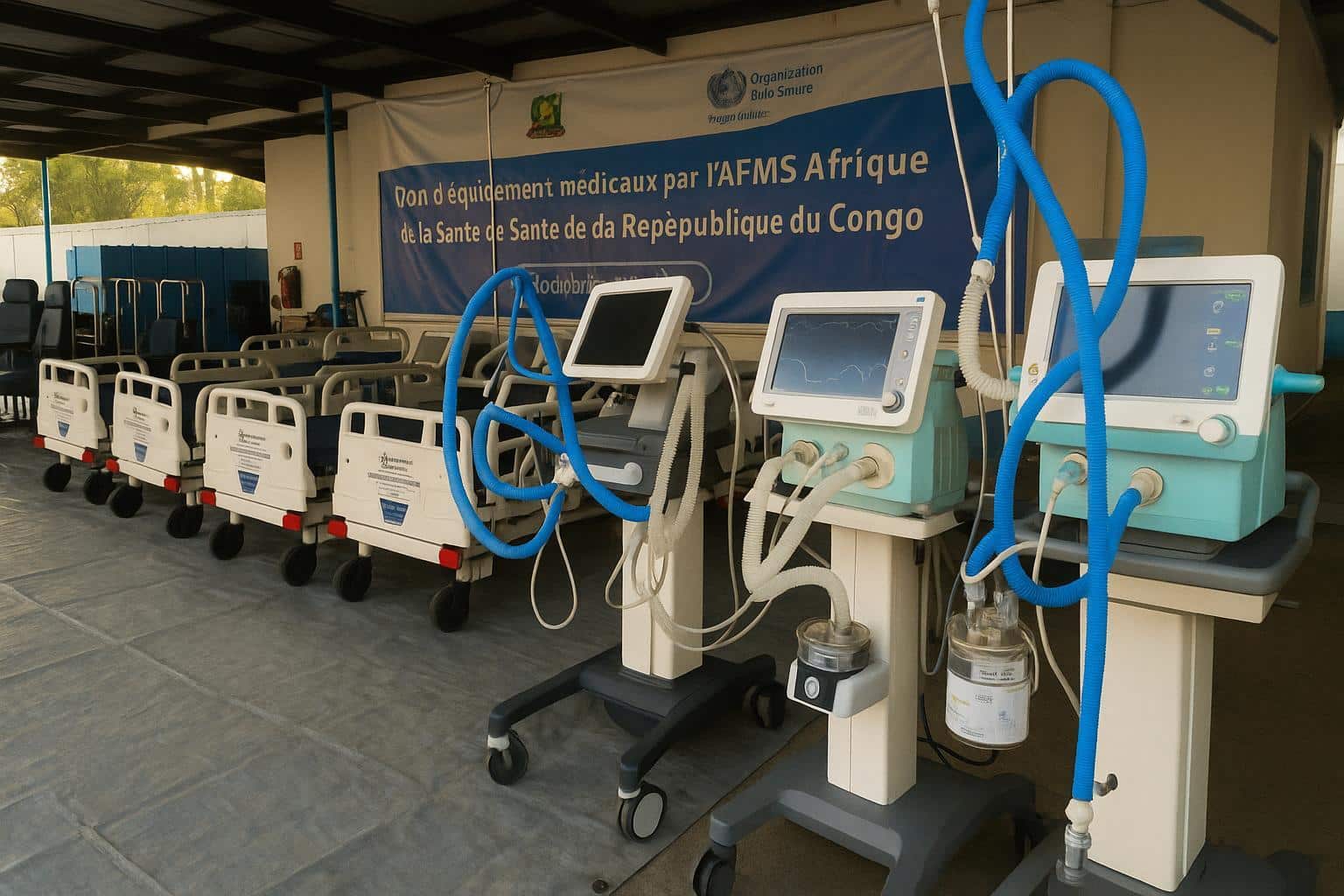
Lifesaving machines touch down in Brazzaville
A tightly packed convoy left the Maya-Maya airport at dawn, carrying ventilators, oxygen concentrators and patient monitors branded with World Health Organization emblems. By mid-morning the medical cargo, valued at roughly CFA 280 million, was formally handed to the Ministry of Health on the grounds of the National Public Health Laboratory.
Professor Mohamed Yakub Janabi, WHO Regional Director for Africa, clasped hands with Health and Population Minister Professor Jean Rosaire Ibara before cameras. “This equipment belongs to the Congolese people,” Janabi said, stressing that emergencies occur daily, not only during headline-making outbreaks.
The shipment includes next-generation intensive-care beds, backup parts and digital dashboards designed to alert staff when oxygen pressure drops. Technicians from WHO Africa will stay in Brazzaville for two weeks to train biomedical engineers from public hospitals, ministry officials confirmed.
A CFA 280 million boost for critical care
Respiratory distress remains among the top five causes of admission in Congo’s emergency departments, according to ministry data from 2023. Doctors often improvise with limited ventilators that must be shared between adults and children, an arrangement clinicians say lengthens waiting times during peak influenza season.
The new devices operate on lower voltage and integrate battery packs capable of six hours of autonomy, a specification chosen to cope with occasional power cuts. “The concentrators ensure a constant oxygen flow even when the grid fails,” explained Dr Vincent Dossou Sodjinou, WHO Representative in Congo.
He added that all units meet the latest ISO and WHO pre-qualification standards. “We wanted equipment that rural hospitals could maintain locally,” he said, noting that filter cartridges and sensors were selected because they can be sourced from regional suppliers rather than costly overseas vendors.
Continuous readiness beyond epidemic alerts
Janabi told reporters the donation is part of WHO’s broader agenda to embed emergency readiness into everyday hospital routines. “We speak loudly about Ebola or cholera, yet trauma from road accidents or sudden heart failure is equally urgent,” he said, calling for multidisciplinary triage teams.
The remark echoes Congo’s post-COVID strategy, which prioritises strengthening intensive-care units in district hospitals so patients no longer need to be transferred hundreds of kilometres to Brazzaville University Hospital. Government planners expect the new gear to reduce transfer delays by up to 40 percent once fully deployed.
Health Minister Ibara pointed out that the equipment arrives as two new general hospitals, one in Pointe-Noire and another in Ouesso, near completion. “Our citizens in the south and the north will benefit from equal standards of emergency response,” he said, thanking President Denis Sassou Nguesso for placing hospital modernisation high on the public-investment agenda.
Partnership aligns with national health vision
The WHO-Congo partnership began in 1960, and renewed memoranda every five years have progressively shifted from disease-specific projects to system-wide resilience. The latest plan, endorsed in 2022, earmarks joint funding for equipment, workforce training and digital surveillance.
“Our cooperation is designed to be flexible,” Janabi said. “If tomorrow the priority is neonatal care, we will pivot accordingly.” He praised Congo’s recent decision to increase the health budget by 15 percent for 2024, describing it as a signal of ownership.
Local health economists see the approach as pragmatic. “A well-equipped intensive-care unit is an asset no matter which pathogen emerges,” argued Dr Armelle Otsama of Marien Ngouabi University, noting that oxygen delivery systems installed during COVID-19 now serve premature infants and cardiac patients.
From Brazzaville to regions: distribution roadmap
According to an internal ministry schedule shared with reporters, fifty percent of the ventilators will remain in Brazzaville to bolster the capital’s two largest teaching hospitals. The remainder will be dispatched to regional referral centres in Dolisie, Owando, Impfondo and Sibiti within ten days.
Each facility will nominate a biomedical focal point responsible for maintenance logs and monthly performance reports. WHO engineers are set to return in March for a follow-up audit, ensuring proper calibration and user compliance.
Civil-society observer Jean-Marc Kodia, who monitors health-sector projects, welcomed the transparency. “Publishing the roadmap builds trust and reduces the risk of equipment ending up idle in storage rooms,” he said outside the ceremony.
Ministry officials also announced the launch of an e-learning module on ventilator management hosted on the Congolese Medical Council’s platform. The course, developed with WHO input, will grant continuing-education credits to nurses and anesthetists.
As crates were finally wheeled into the central pharmacy, Minister Ibara summed up the mood: “These machines symbolise more than hardware; they represent our collective commitment to protect every breath of every Congolese.”