
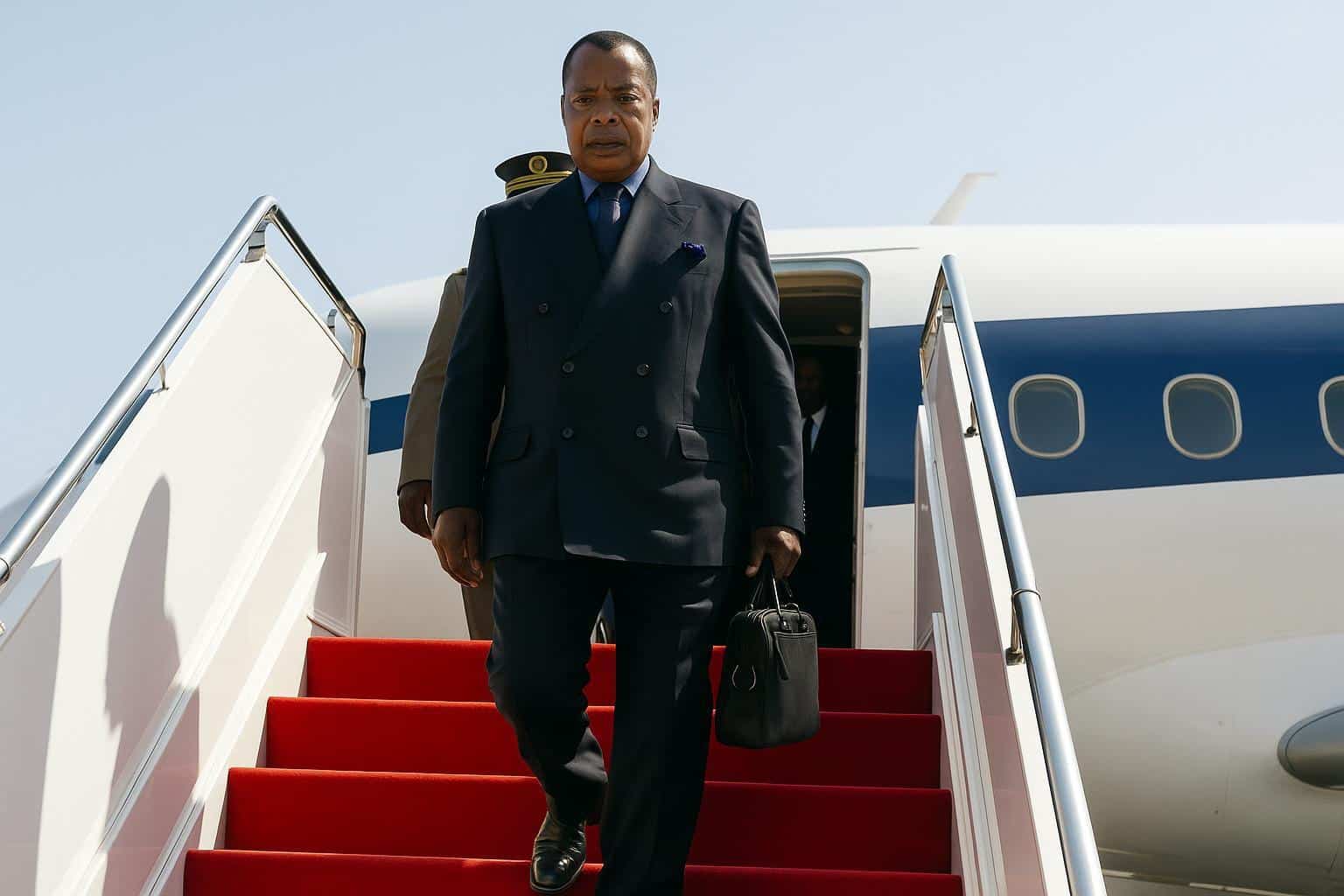
Brazzaville sends off presidential delegation
At dawn this Friday, President Denis Sassou Nguesso boarded the state-chartered Airbus A340 and left Brazzaville for New York, leading Congo’s delegation to the eightieth United Nations General Assembly, the Presidency announced.
He is accompanied by Foreign Minister Jean-Claude Gakosso, Finance Minister Ingrid Ebouka-Babackas and senior advisers, state television Télé Congo reported, illustrating the mission’s strategic weight for diplomacy, finance and climate advocacy.
On Maya-Maya airport’s tarmac, Senate president Pierre Ngolo and Prime Minister Anatole Collinet Makosso bid farewell to the head of state, a scene broadcast live to underscore institutional continuity during his week-long absence.
UNGA80 spotlight on peace, development, rights
The 2025-2026 cycle opens under the motto “Stronger Together: 80 Years and Beyond for Peace, Development and Human Rights”, a theme confirmed by UNGA President Dennis Francis and meant to revive faith in cooperative multilateralism.
Diplomats note that conflicts, inflation and climate shocks have strained the system. “Member states crave practical answers, not slogans,” an African Group negotiator said in New York, requesting anonymity to speak candidly.
A political declaration on accelerating the Sustainable Development Goals is expected Friday. United Nations Development Programme estimates show annual financing gaps topping four trillion dollars, a figure that frames the urgency of this week’s debates.
Congo’s agenda: forests, finance, permanent seat
Delegation insiders say President Sassou Nguesso will stress the Congo Basin’s value; research by the Center for International Forestry Research indicates the forest absorbs about 1.5 gigatonnes of carbon dioxide annually, buffering global warming.
He is also expected to revive the call for a dedicated climate-finance window to protect peatlands, a proposal first tabled at COP26 and recently endorsed by African Development Bank president Akinwumi Adesina.
On governance, Brazzaville supports the African Union’s demand for at least two permanent seats on the Security Council. “Multilateralism needs equity to stay credible,” Foreign Minister Gakosso argued during a recent briefing in Oyo.
Consistent with past African Union communiqués, Congo will reiterate support for recognition of the State of Palestine while maintaining its customary preference for dialogue and consensus over confrontation.
Side meetings with investors and diaspora
Outside the plenary, the president has lined up talks with executives from Chevron and the U.S. International Development Finance Corporation to attract investment for gas monetisation and off-grid solar projects, officials familiar with the agenda said.
A reception with the Congolese diaspora is scheduled at the New York Hilton Midtown. Organisers anticipate roughly 400 guests; World Bank data show remittances to Congo reached 200 million dollars in 2023, underscoring the community’s economic relevance.
The itinerary also features a Columbia University roundtable where Sassou Nguesso will discuss rainforest economics with professors Jeffrey Sachs and Carlos Lopes, according to a draft circulated to accredited media.
Experts see steady diplomatic posture
“Congo is leveraging environmental assets to widen its diplomatic footprint,” said Rodrigue Ayessa, analyst at CERAPE in Brazzaville, adding that carbon-sink credentials resonate with investors searching for credible offset projects.
United Nations correspondent Emilia Maclean views Brazzaville’s tone as pragmatic. “They pursue financing without incendiary language; that preserves negotiating space,” she explained in a telephone interview after reviewing the draft speech.
Regional solidarity also appears strong. Cameroon’s envoy Michel Tommo Monthe told journalists that Central African states intend to present a coordinated statement on council reform, reflecting growing coherence within ECCAS.
Stakes for SDGs and domestic development
Domestically, the National Development Plan 2022-2026 targets average growth of 4.7 percent and a poverty rate below 30 percent. Alignment with UN goals could unlock support from the IMF’s Resilience and Sustainability Trust, officials believe.
Congo recently joined the Global Accelerator on Jobs and Social Protection, gaining access to technical assistance announced by the International Labour Organization, thereby linking New York diplomacy to tangible reforms at home.
Economist Élodie Mokoko argues the optics matter. “When investors see the president on the UN stage, it signals stability,” she noted, pointing to Congo’s eurobond spread narrowing by sixty basis points since January.
A week watched carefully at home
In Brazzaville, large screens in public squares stream UN sessions live. Civil society leader Serge Kombila called the trip “a chance to showcase solutions, not only challenges” during a discussion at the French Institute.
Students at Marien-Ngouabi University focus on academic partnerships unveiled after earlier UN visits. “We hope new accords will provide scholarships and internships,” said political-science major Grâce Ossini, epitomising youthful expectations for global engagement.
Looking ahead to COP29 and AU Summit
Messages delivered this week will shape Congo’s stance at COP29 and the forthcoming African Union summit, both expected to revisit forest finance and Security Council reform.
As the presidential jet crossed the Atlantic, advisers fine-tuned talking points aimed at balancing national interests with collective ambition. The coming days will test Brazzaville’s seasoned, consensus-driven approach to multilateral diplomacy.
Officials hint at a possible tri-national summit with Gabon and the Democratic Republic of Congo on rainforest carbon markets, tentatively slated for November, signalling that conversations in New York could unlock further regional coordination.