
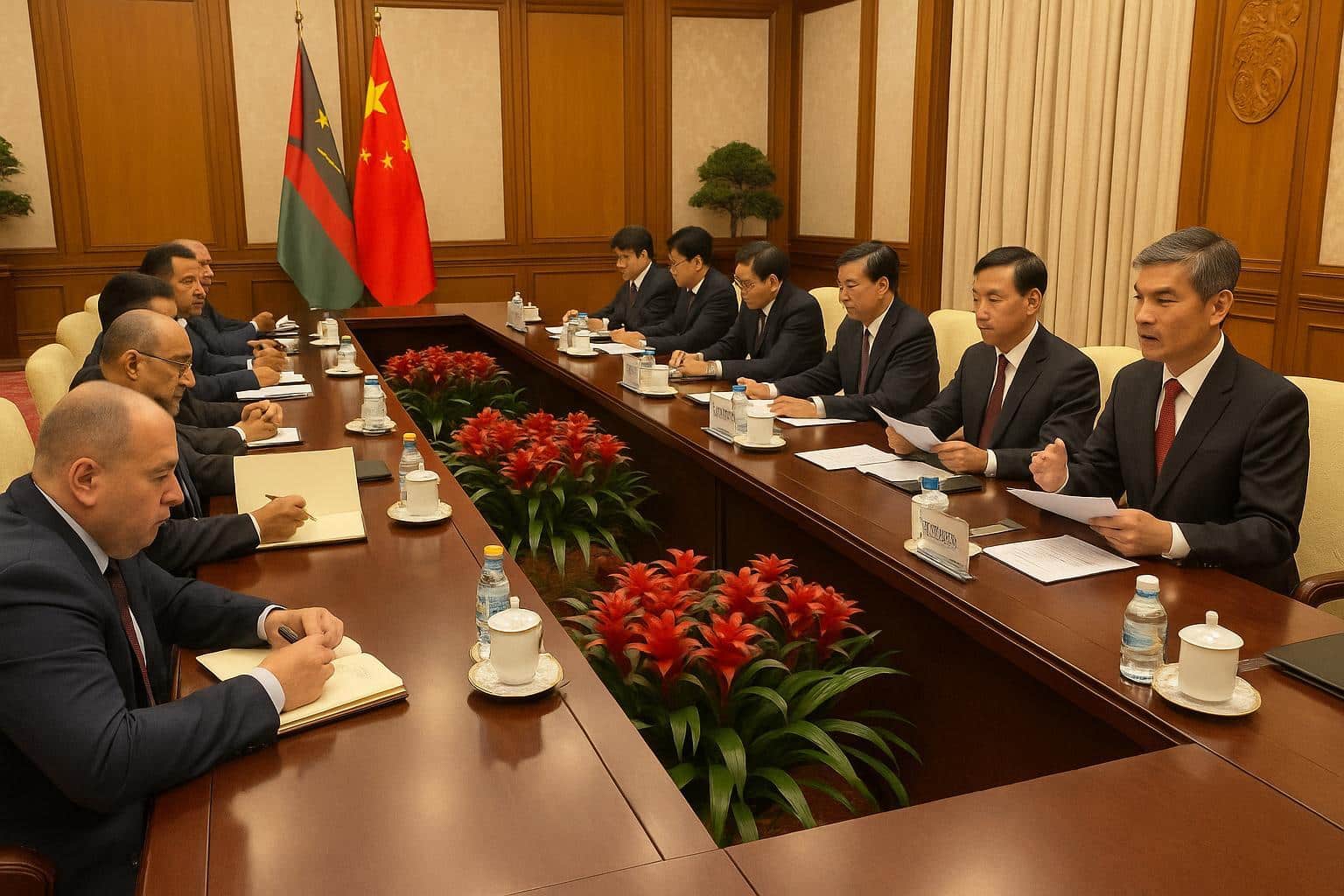
China Applauds Morocco’s Stable Leadership
Chinese Foreign Minister Wang Yi took the floor in Beijing on 19 September to hail King Mohammed VI’s leadership, underscoring the political stability Morocco enjoys and the reach of royal initiatives that aim at inclusive development across the African continent, official readouts from both capitals noted.
The message, delivered during a bilateral meeting, framed Morocco as a dependable partner whose domestic equilibrium can radiate benefits well beyond its shores, a point the Chinese side presents as essential amid shifting geopolitical currents affecting several African sub-regions this year and growing investor uncertainty.
High-Level Talks Address Regional Challenges
Wang Yi and Moroccan Foreign Minister Nasser Bourita traded assessments of a regional landscape marked by security, economic and climatic stress factors that, in their view, call for tighter coordination between nations able to act swiftly and maintain balanced relations with a diverse range of international partners.
Chinese diplomats, according to the same briefing, consider Rabat’s proactive posture a useful hinge for future triangular cooperation projects connecting Beijing’s financial resources, Moroccan logistical capacity and wider African development priorities outlined in continental programmes already endorsed at the African Union and major regional blocs.
Morocco Endorses Xi Jinping’s Global Initiatives
In response, Bourita reiterated Morocco’s support for President Xi Jinping’s flagship initiatives touching on development, security, civilisation and global governance, signalling what diplomats described as continuity in the North African kingdom’s foreign-policy alignment since King Mohammed VI’s landmark visit to China in 2016 and subsequent bilateral forums.
Both ministers framed the endorsement as evidence that a South-South, mutually respectful approach can deliver pragmatic solutions without the polarising undertones sometimes associated with larger multilateral debates, especially on technology transfer, pandemic recovery and debt sustainability, themes that dominate high-level discussions in African policy-making circles today.
Kingdom Joins Hong Kong-Based IOMed
Bourita used the session to announce Morocco’s decision to join the International Organization for Mediation, known as IOMed, recently established under Chinese impetus with headquarters in Hong Kong, an accession that both sides regard as a natural extension of Rabat’s longstanding preference for diplomatic resolution mechanisms.
Chinese officials privately highlighted that Morocco’s presence inside the new structure could lend additional credibility on the African scene, helping to defuse local scepticism toward external frameworks by placing an African voice at the table from the outset.
Partnership Aims at Inclusive African Growth
The joint communiqué circulated after the meeting stresses a commitment to consolidate a strategic partnership that privileges solidarity and concrete deliverables, positioning both capitals as advocates for stability, infrastructure connectivity and skills development across Africa, themes that Wang Yi has repeatedly linked to long-term peace.
Observers note that the vocabulary of inclusiveness mirrors the language King Mohammed VI has used in successive speeches on African Union reform, lending the Chinese attribution of continental leadership additional resonance among policymakers who track the monarch’s Africa-focused economic diplomacy during forums in Kigali and Addis.
CEMAC Capitals Watch Cooperation Momentum
In Brazzaville and other CEMAC capitals, diplomats interviewed welcome any dialogue that reduces tensions and injects predictable financing into regional programmes, arguing that the assertiveness shown by Morocco and China could inspire new project pipelines if paired with transparent governance standards already championed by both parties.
A senior official in Congo’s Ministry of Foreign Affairs, speaking on condition of customary anonymity, said the development lens adopted by Wang and Bourita ‘aligns with our own agenda for transformative growth anchored in peace’, though he cautioned that follow-through will determine whether the promise becomes reality.
South-South Multilateralism Gains Traction
Beyond bilateral optics, the meeting has been framed by both delegations as a microcosm of renewed multilateralism driven from the Global South, in which middle-income countries craft agendas that circumvent polarisation and offer concrete avenues for dispute settlement, capacity building and sustainable job creation globally.
Sources close to the talks describe a deliberate effort to avoid headline-grabbing pledges, preferring instead to assemble a portfolio of incremental steps that can be monitored, evaluated and adjusted, thereby reducing the expectations gap that has sometimes clouded grand infrastructure schemes elsewhere on the continent.
For analysts in Pointe-Noire who follow shipping corridors, such methodical sequencing could translate into faster execution once feasibility studies meet financing, particularly if mediation channels like IOMed resolve contractual frictions before they escalate into arbitration that delays workforce mobilisation and erodes public–private sector confidence.
Within academic circles in Brazzaville, the decision to tie mediation, development and governance into one narrative is being analysed as an attempt to craft a post-pandemic diplomatic toolkit that privileges adaptability, a quality smaller African economies often cite when negotiating with larger powers for leverage.
As the communiqué circulates, planners in Rabat and Beijing are expected to identify early deliverables, with diplomats forecasting additional announcements in coming months that could cover training, cultural exchanges or facilitation services, all framed as incremental bricks in a wider architecture for African prosperity and regional trust building.