
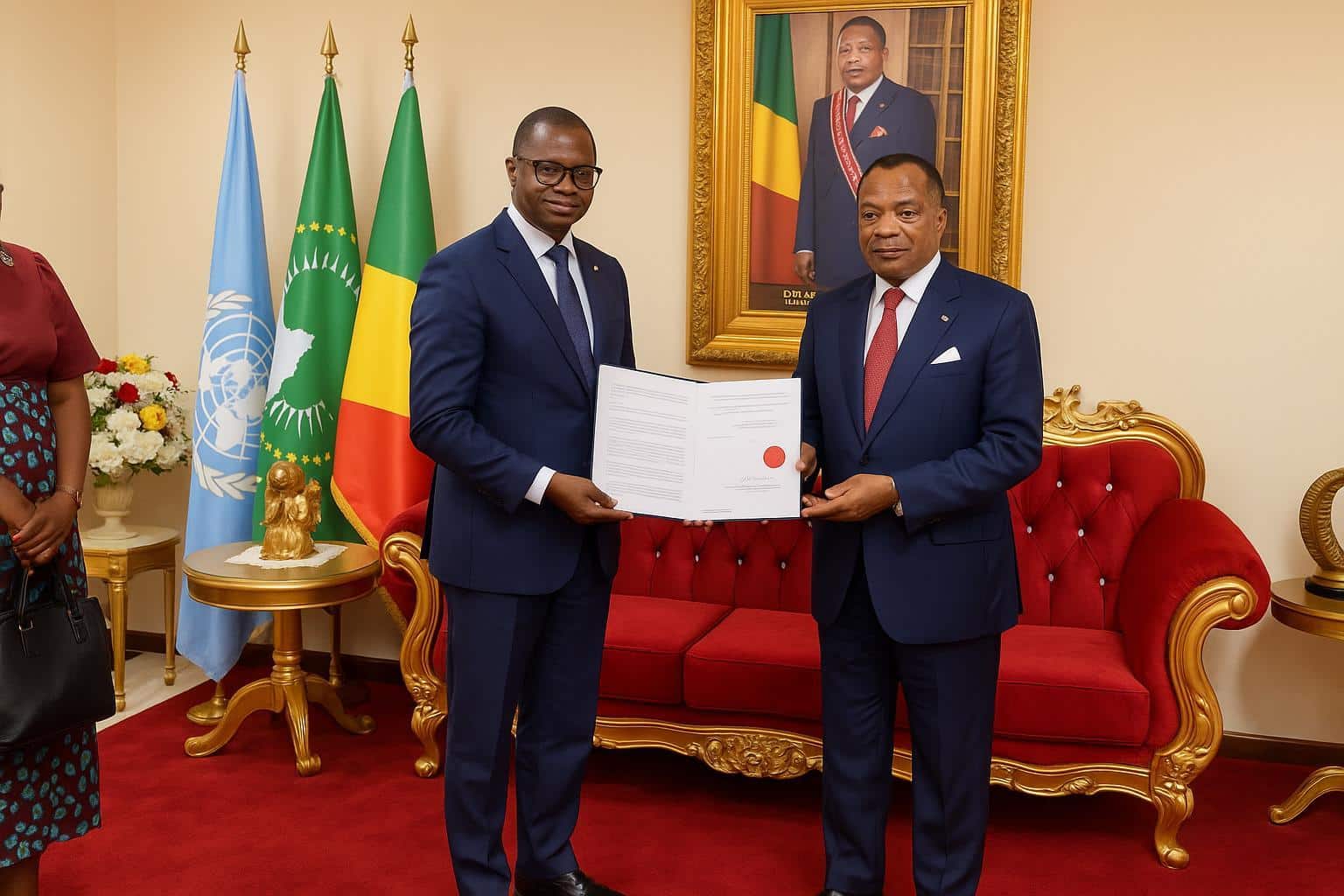
Brazzaville WHO accreditation ceremony
In a hushed hall of marble at the Ministry of Foreign Affairs, Foreign Minister Jean-Claude Gakosso accepted the credentials of Dr Vincent Dossou Sodjinou, the World Health Organization’s freshly appointed resident representative to the Republic of Congo, on 27 June 2025.
The ceremony, while protocol-driven, allowed both sides to spotlight an agenda that links public health to diplomatic visibility and economic resilience, themes President Denis Sassou Nguesso has repeatedly flagged in cabinet addresses and regional summits.
Observers from the African Union and the United Nations Development Programme attended, an unusual detail that, according to a senior diplomat present, underlines “Brazzaville’s intention to anchor health priorities inside broader multilateral frameworks” (AU observer interview, 28 June 2025).
Government television carried the event live, and social-media metrics compiled by the Information Ministry showed more than 200,000 engagements within 24 hours, a figure analysts interpret as growing public interest in health governance following the COVID-19 experience.
Profile of WHO Representative Vincent Sodjinou
Dr Sodjinou, a Beninese physician with doctorates in medicine and public health, brings 24 years of field experience, including Ebola containment in West Africa and leadership within the Dakar Emergency Hub, noted for advising Sahel governments on system shocks (WHO regional dossier).
His interim stewardship of the Brazzaville office since September 2024, officials say, helped smooth vaccine logistics during the region’s unexpected yellow-fever uptick earlier this year, a performance praised by the Health Ministry’s crisis unit (Health Ministry briefing, March 2025).
Colleagues describe him as “methodical, unflappable and politically astute,” qualities that matter in a country hosting the WHO Regional Office for Africa, a presence that often draws attention to the host government’s own reform pace.
He holds memberships in the West African College of Physicians and in the Lancet Commission on Primary Care, credentials that, according to University of Brazzaville public-health professor Jeanne Mouyabi, “can bridge academic evidence and field pragmatism in Congo’s diverse provinces.”
Congo-WHO cooperation priorities aligned
During the closed-door exchange, Minister Gakosso reiterated that any technical assistance must align with Congo’s National Health Development Plan, a stance consistent with the government’s sovereignty doctrine articulated at the 2023 Francophonie Summit in Djerba.
WHO officials accepted the framing, proposing a joint results matrix that elevates primary-health-care coverage from today’s estimated 63 percent to 80 percent by 2030, through decentralized budgeting and an expanded community-health-worker payroll.
An aide to the Prime Minister, speaking anonymously, said “linking health metrics to broader economic indicators such as workforce productivity will help secure cabinet buy-in,” echoing research by the Economic Commission for Africa that healthy populations can lift GDP growth by 1.5 points annually.
Innovative financing for Congo health reforms
Even as Brazzaville eyes a bigger role for domestic resources, the WHO representative acknowledged the agency’s own budget constraints, aggravated by a 15 percent shortfall in assessed contributions globally, urging “innovative financing including sin taxes and diaspora bonds” (press scrum, 27 June 2025).
Congo already allocates roughly 9 percent of public expenditure to health, according to the 2024 Budget Law; officials say the target is 15 percent, in line with the Abuja Declaration, once oil-price volatility eases.
A report by the African Development Bank released last month rates Congo’s debt risk as moderate, giving the Treasury some room to expand health bonds, though analysts caution against crowding out infrastructure spending needed for diversified growth (AfDB Country Brief, May 2025).
Brazzaville’s regional health diplomacy role
Hosting the WHO African regional headquarters since 1967 has conferred diplomatic heft on Congo; several heads of state usually transit through Maya-Maya Airport for health assemblies, a soft-power dividend that Brazzaville leverages in peace-and-security dialogues, diplomats note.
Dr Sodjinou’s mandate therefore extends beyond technical advice; it involves cultivating political consensus ahead of the 2026 African Union summit, where Congo plans to table a resolution on pandemic preparedness funding, according to Foreign-Affairs insiders.
Regional observers argue that Brazzaville’s success in steering the conversation could hinge on demonstrating domestic progress, making the new WHO-government compact a bellwether for Central Africa’s health diplomacy.
Health economists note that the presence of two major health institutions—the WHO office and the African Network for Drugs and Diagnostics Innovation node—creates synergies attractive to pharmaceutical investors scouting Central Africa for clinical-trial sites amid shifting global supply chains.
Stakeholder reactions and next steps
Civil-society networks such as Plateforme Santé say they welcome Dr Sodjinou’s arrival but expect “clear timelines for district-hospital upgrades,” a demand echoed by parliamentary health-committee chair Léon Mboulou, who emphasised the need for transparent procurement.
The representative responded that a joint monitoring dashboard would be released before the end of the third quarter, listing measurable indicators such as stock-out frequency, maternal mortality and digital-health adoption.
For now, the mood in Brazzaville remains cautiously hopeful: the handshake between Minister Gakosso and Dr Sodjinou signals continuity, while the agenda they sketched invites all stakeholders to translate diplomatic rhetoric into clinics stocked with medicines and staffed by trained professionals.
Implementation meetings are scheduled for July, setting an early test of momentum.