
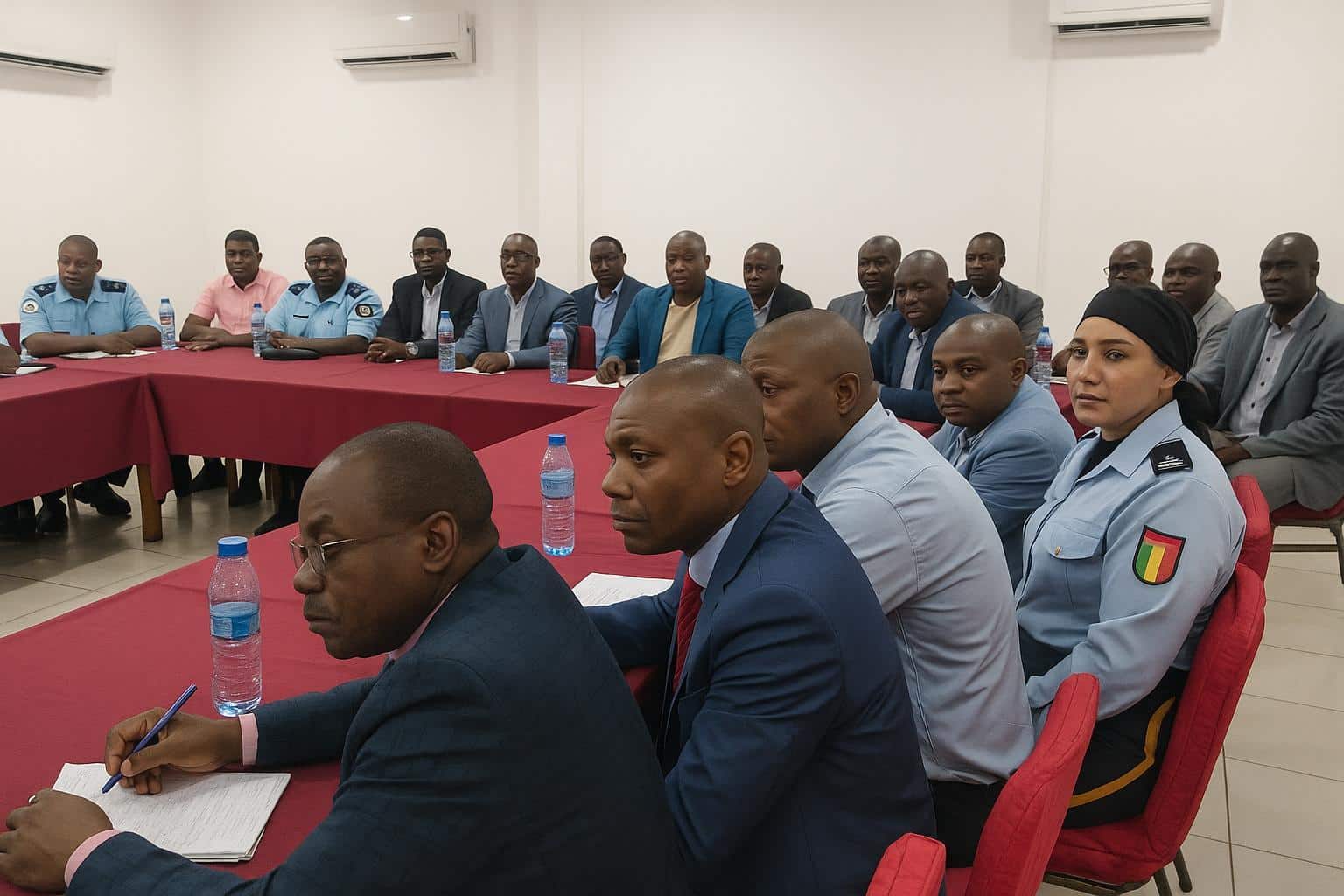
Stakeholders converge in Brazzaville
On 15 December, fifty professionals from courts, bar associations, police, gendarmerie and social services gathered in Brazzaville to dissect the legal pathways that govern minors who cross the line into criminal proceedings.
The workshop, convened by the General Directorate of Solidarity and the Interveners Network on Children in Rupture, or Reiper, with technical and financial backing from UNICEF Congo, aimed to sharpen institutional reflexes so that every child meets justice, not jeopardy.
Aligning with child rights standards
Training modules unpacked national statute 4-2013 on child protection alongside the Convention on the Rights of the Child, underlining how age, vulnerability and reintegration prospects must shape each procedural step, from arrest to sentencing.
Participants formed working groups to map norms, rehearse child-friendly interviewing, and explore the delicate balance between restorative justice models and entrenched customary practices that still frame many rural settlements.
Capacity gaps inside crowded prisons
Felana Aliderson, standing in for UNICEF’s representative, cautioned that capacity gaps translate into cramped cells where minors share floors, and often despair, with adults awaiting trial. She called the mix “a risk multiplier that chips away at dignity every hour”.
Official statistics shared at the meeting put Brazzaville Central Prison’s headcount at roughly 700 for a design built for 150, a figure delegates repeated to stress the urgency of alternative measures such as diversion, probation and specialised rehabilitation centres.
Legal assistance and procedural safeguards
Reiper coordinator Joseph Bikié Likibi noted that Congolese law already guarantees free legal assistance for children, yet many still navigate hearings without counsel because families cannot locate or afford an advocate in time.
“Procedure should never become punishment,” he told the room, urging bar associations to step up rotation systems that ensure a lawyer is present from the first police interview to the final verdict.
Government commitment to education over punishment
For Mathieu Clotaire Okoko, Secretary-General at the Ministry of Justice, the policy compass is already calibrated: child protection is a fundamental pillar anchored in the 2010 framework law on childhood and reaffirmed by successive national action plans.
“The strength of a statute lies not in elegant clauses but in visible impact,” he remarked, adding that a justice system true to the Republic’s values must educate, prevent and offer second chances rather than accelerate marginalisation.
Communication and restorative justice lessons
The Brazzaville dialogue repeatedly circled back to communication, an often-overlooked skill that dictates whether interrogation leaves scars or seeds of rehabilitation. Trainers stressed tone, vocabulary and body language calibrated to a child’s cognitive development.
On restorative justice, magistrates and traditional leaders compared case studies where community service, apologies and mediated settlements reduced reoffending, especially among first-time offenders whose infractions stemmed from survival rather than intent.
However, delegates acknowledged that restorative panels cannot fully thrive until purpose-built facilities keep minors separate from adults, a prerequisite articulated in both national law and United Nations guidelines on deprivation of liberty.
UNICEF tools and a draft roadmap
UNICEF’s team distributed an updated awareness guide that traces every remedy available to a child, from bail applications to appeals, hoping practitioners will replicate the material in precincts and classrooms across the country.
Before breaking for the day, organisers drafted a roadmap that promises joint refresher courses, data-sharing on juvenile caseloads and advocacy for at least one dedicated rehabilitation centre in each department.
Follow-up meetings are pencilled in for early 2024, with stakeholders confident that incremental steps—better training, clearer procedures, humane facilities—will tilt the balance from punitive detention toward constructive reintegration for Congo’s next generation.
Financing and operational challenges
Legal scholars present highlighted that Congo’s juvenile code already allows judges to substitute custodial sentences with educational measures, but implementation hinges on updated budgeting that channels resources to probation officers, psychologists and community mentors.
Police representatives admitted logistic constraints, noting that child-friendly interview rooms, recommended since 2017, remain scarce outside Brazzaville and Pointe-Noire; they requested mobile recording kits and refresher training to minimise secondary victimisation.
Gendarmerie officers pointed to pilot programmes where officers wear badges identifying them as “Children’s Rights Focal Points”, reporting a drop in complaints thanks to clearer accountability channels and faster referrals to social workers.
Civil-society observers welcomed the government’s openness, yet reminded the assembly that consistent funding is indispensable. “We cannot rely solely on partners,” said one activist, urging domestic revenue allocation to insulate juvenile services from external shocks.
Data modernisation and next steps
As dusk settled over the capital, a shared refrain lingered: a child seen by the law must still be seen by society. In that consensus, participants closed ranks around a vision where accountability coexists with hope.
The upcoming sessions will also audit data systems; prosecutors conceded that age verification and case tracking remain paper-based in several districts, complicating oversight. Digitising files, they predict, could expose bottlenecks early and streamline decisions on bail, mediation or supervised release.
Whether those reforms arrive in months or years, the December dialogue signals momentum that stakeholders insist will not fade.