
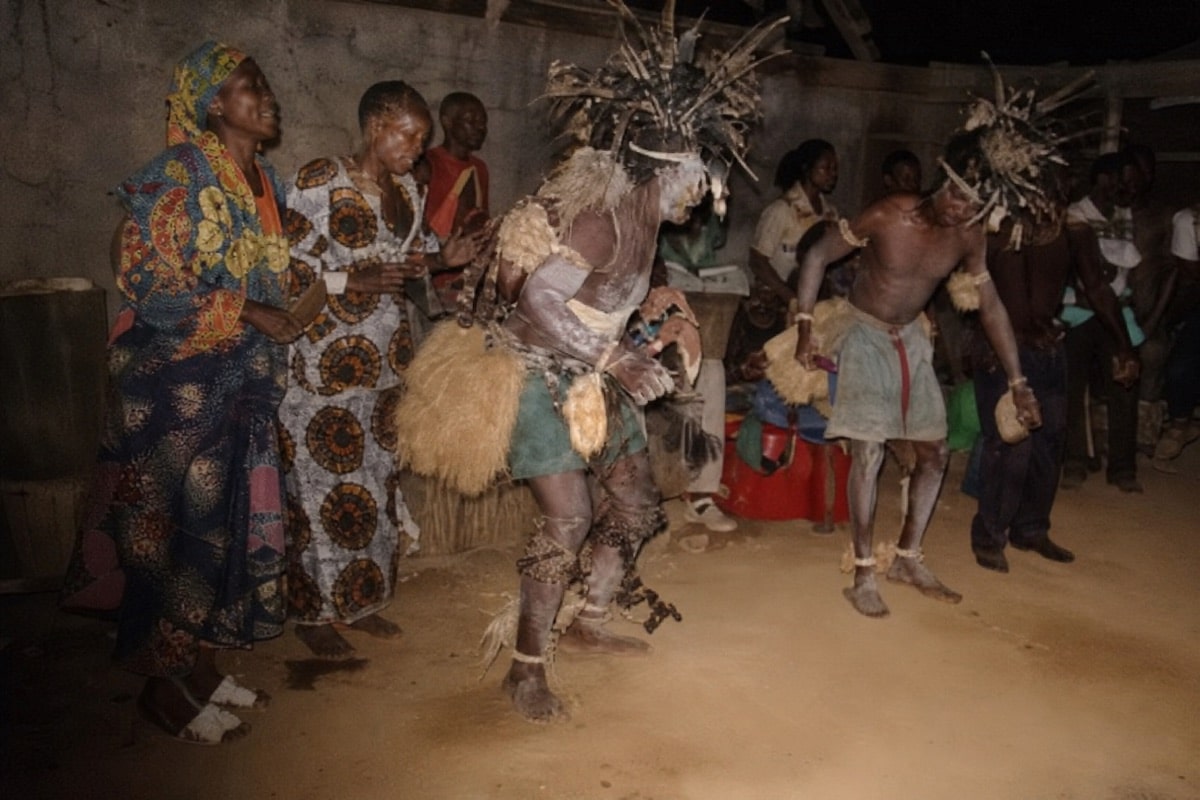
A Night Suspended in Time
In Nzima, a village tucked into the Niari department of southern Congo-Brazzaville, there are evenings when the ordinary world recedes. The first voices of the Nzobi initiation vigil rise slowly, carried by firelight into the darkness, and for those who know what they are hearing, time seems to stop altogether.
The Nzobi is one of the most significant initiatory societies in the south of Congo-Brazzaville. Its nighttime ceremony weaves together songs, coded symbols, and inherited gestures in a ritual that has been transmitted across generations without interruption — a living archive of knowledge and values that no written record could fully capture.
The Meaning of the Vigil
The ceremony is not spectacle. It is transmission. Elders guide initiates through a night structured by song and fire, teaching through experience rather than instruction. The codes exchanged during the vigil carry meaning accessible only to those who have passed through the rite — a deliberate architecture of belonging that reinforces the social fabric of the community.
Participants described an atmosphere “steeped in mysticism,” where the boundaries between the ancestral and the present feel unusually thin. The fire at the center of the gathering functions as more than illumination — it marks a threshold between ordinary life and a space governed by different rules.
An Intangible Heritage Under Contemporary Pressure
The persistence of the Nzobi vigil in a village like Nzima is not accidental. It reflects a conscious effort by communities in the Niari to maintain cultural practices that might otherwise be eroded by urbanization, migration, and the accelerating pace of contemporary life.
Congo-Brazzaville’s intangible cultural heritage spans dozens of initiatory societies, ceremonial traditions, and oral transmission systems, each rooted in specific ethnic and geographic contexts. The Nzobi belongs to this broader landscape of practices that define identity at the local level.
Younger Generations as Custodians
What struck observers at the Nzima ceremony was the presence of younger participants — not merely as witnesses but as active recipients of the knowledge being transmitted. The integration of youth into the initiation process is central to the ceremony’s function. Without it, the chain of transmission breaks.
In communities where elders worry about the appeal of urban life and digital culture, a vigil that draws the young into the ancestral circle carries a significance that goes beyond ritual formality. It is a statement about what a community chooses to keep.
Nzobi in the Landscape of Congolese Identity
The Nzobi is one of several initiatory institutions that shape social life in the southern regions of Congo-Brazzaville. Alongside other societies rooted in Kongo, Vili, and related cultural traditions, it contributes to a mosaic of practices that define how communities organize authority, knowledge, and belonging.
Cultural analysts have long noted that these societies serve functions that extend well beyond the ceremonial: they regulate social conduct, mediate disputes, and provide frameworks for ethical formation that operate alongside — and sometimes in tension with — formal state and religious institutions.
A Rite That Speaks to the Present
The Nzima vigil does not exist in isolation from the modern world. It persists precisely because communities have found ways to make it speak to present realities — not by diluting its content but by insisting on its relevance. For those who pass through it, the Nzobi night is not a journey into the past. It is a preparation for living, in community, in the world as it is.
The fires of Nzima keep burning, and the voices that rise around them carry forward something that no external institution has yet found a way to replace.