
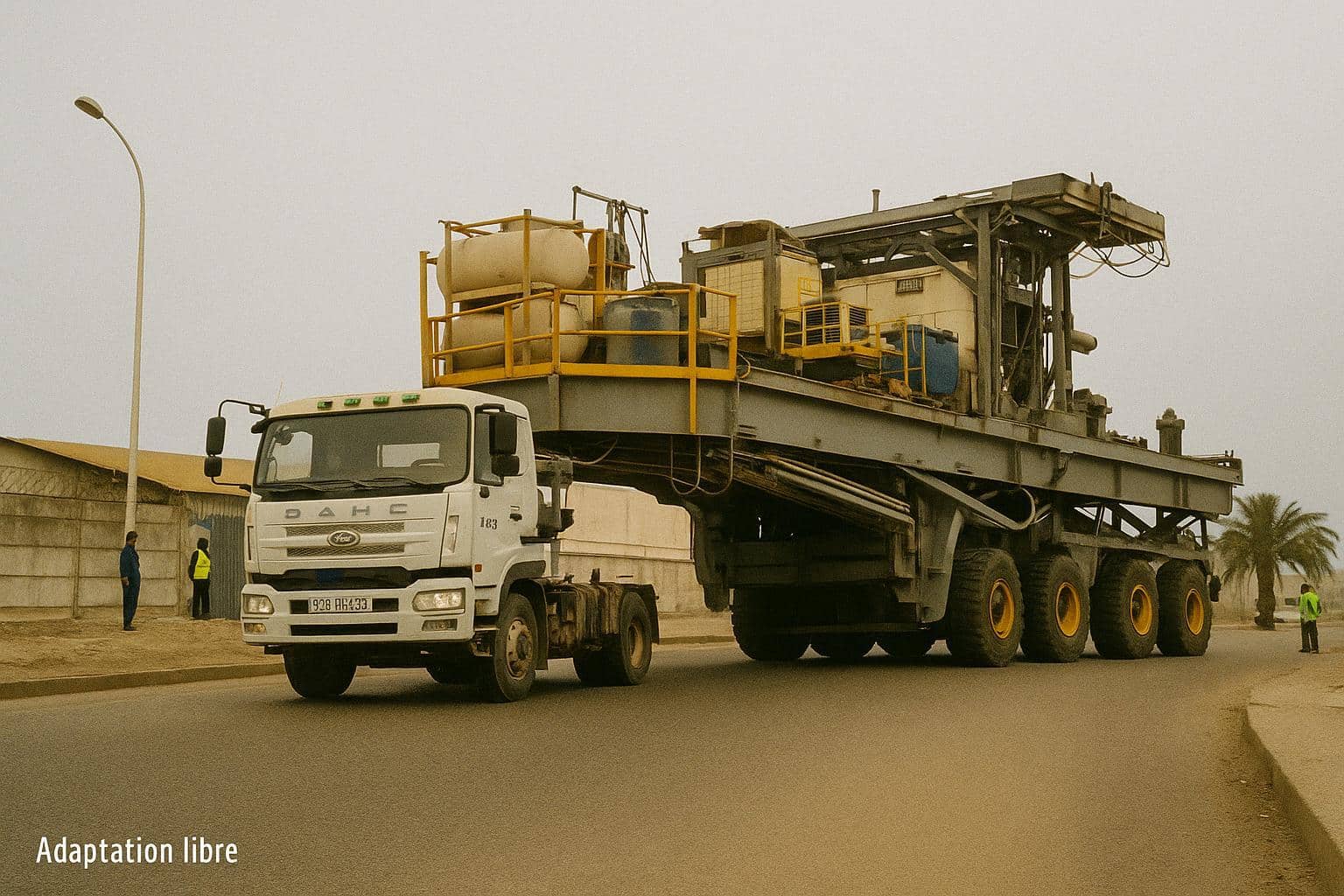
Strategic Logistics Milestone at Pointe-Noire Port
Under the discreet neon of Pointe-Noire’s quays, Africa Global Logistics Congo orchestrated the movement of an eight-metre-high, 115-ton rig floor and its trailer on 16 July 2025. Far from being a mere anecdote of industrial bravado, the maneuver speaks to the strategic heft the port has acquired since Brazzaville committed to upgrading its maritime interfaces in the 2022 National Development Plan (Ministry of Planning, 2023). Executed for an oilfield subcontractor whose identity remains commercially sensitive, the transfer closed a critical gap in the upstream supply schedule of a Gulf of Guinea drilling campaign, preserving both project timelines and charter-party clauses.
Engineering Precision Meets HSE Rigor
Specially trained stevedores coupled a ten-wheel tractor—its fifth wheel artfully raised with a steel booster—to the outsized cargo, employing four endless-loop sling cables rated at 49 tonnes and matching 55-ton shackle sets. The equation was less about muscle than millimetric alignment: a 1 800-metre urban corridor separated the yard from the berth, demanding traffic simulations, asphalt stress tests and controlled escort convoys cleared with municipal authorities. Guy Kadina, Head of Handling Operations at AGL, summarised the corporate ethos with studied brevity: “Zero accident is not a slogan; it is a metric we audit daily.” His comment finds empirical backing in the Health, Safety and Environment index published by the African Ports Observatory, which ranks AGL’s Pointe-Noire base in the continent’s top quartile for lost-time-injury frequency (APO, 2024).
Implications for Congo’s Hydrocarbon Supply Chain
Logistical reliability remains a hard currency in Congo-Brazzaville’s petroleum calculus. The sector still delivers roughly 45 % of national budget revenues (IMF Article IV, 2024). Any disruption between on-shore storage and offshore rigs risks eroding the fragile equilibrium between fiscal consolidation and social spending. By demonstrating that extreme-dimension cargo can be marshalled without recourse to foreign heavy-lift vessels, the latest operation nudges operators toward local content solutions aligned with Presidential Decree 2022-321 on in-country value creation. A technical adviser at the Ministry of Hydrocarbons, requesting anonymity, suggests that “each percentage point of logistics indigenisation frees capital for seismic acquisition or enhanced recovery rather than demurrage fees.”
Regional Integration and Sustainability Considerations
Beyond national optics, the episode dovetails with the African Continental Free Trade Area’s ambition to normalise cross-border project cargo corridors. AGL has hinted at replicating the Pointe-Noire protocol along the Pointe-Noire–Cabinda–Luanda axis once customs digitalisation efforts mature (AfCFTA Secretariat, 2024). Sustainability watchers will note that the company’s ‘Plan Carbone 2030’ pledges to cut scope 1 emissions per tonne-kilometre by 30 %. While a heavy-haul tractor hardly evokes images of decarbonisation, the firm argues that synchronised lift sequences minimise auxiliary engine hours, shaving approximately 1.6 t of CO₂ from the operation—a modest but audited figure (AGL Sustainability Report, 2025).
Looking Ahead: Capacity Building and Investor Confidence
The Pointe-Noire success feeds into a broader narrative of capacity-building championed by President Denis Sassou Nguesso, whose administration has stressed logistics as a multiplier of economic diversification. Multilateral lenders appear receptive: the African Development Bank’s 2025 country strategy earmarks USD 120 million for port digitalisation, citing “private-sector proof points” such as AGL’s rig floor lift (AfDB, 2025). Portfolio managers in Johannesburg and Paris interviewed by this review concede that sovereign risk premia narrow perceptibly when heavy-industry case studies translate safety doctrine into measurable outcomes. In a region where headlines often orbit around volatility, the quiet, eight-metre journey of a rig floor may thus carry outsized diplomatic and financial resonance.