
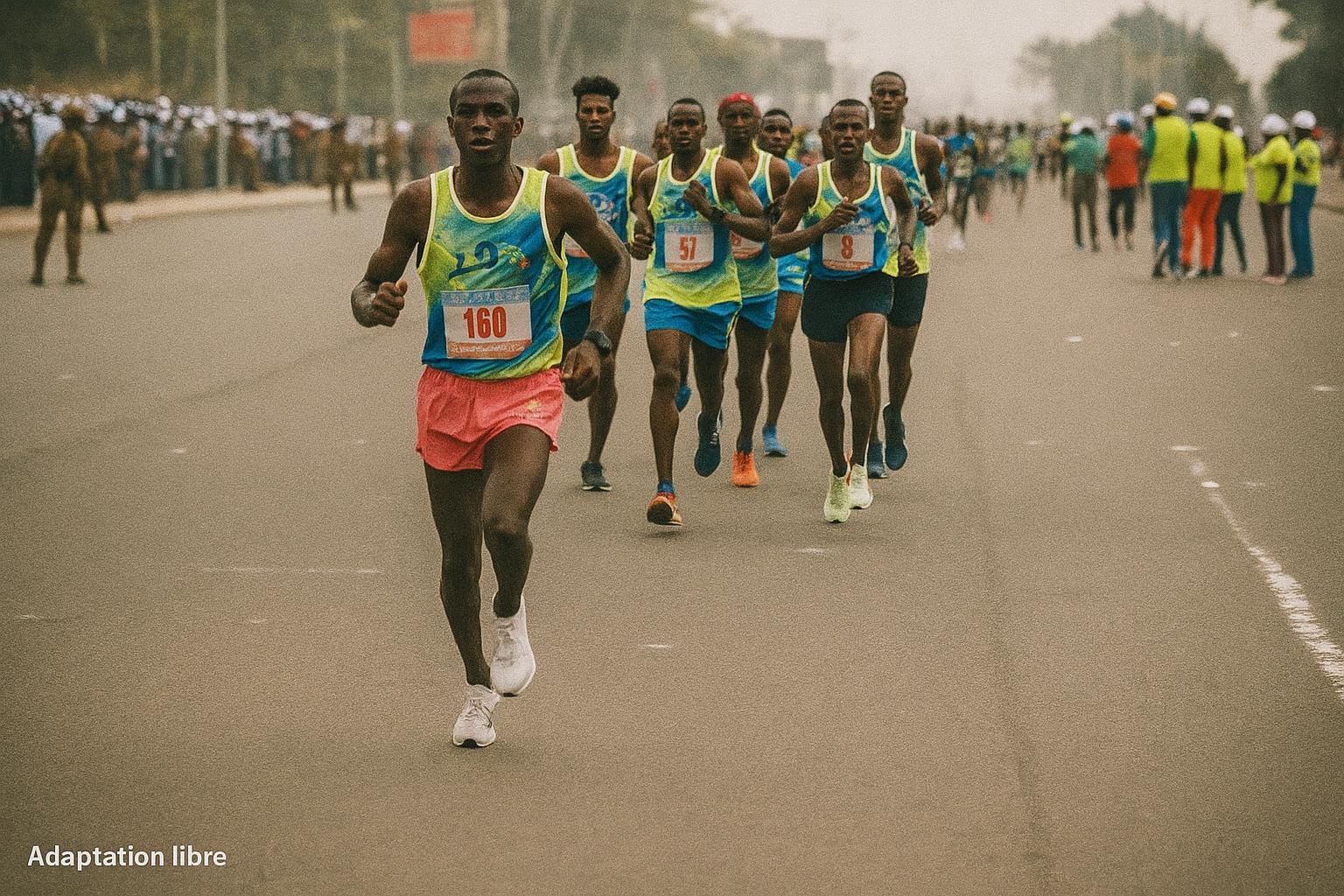
A Race Woven into National Narrative
At dawn on 14 August 2025, the tree-lined boulevards of Brazzaville will once again reverberate with the footfall of thousands of runners. More than a sporting pastime, the Semi-Marathon International de Brazzaville—popularly branded Smib—has, over two decades, become part of the Republic’s ceremonial calendar. Its eve-of-Independence scheduling underscores a subtle message: endurance on the tarmac mirrors endurance in nation-building, while the start line beneath the gaze of President Denis Sassou Nguesso seals the event’s place in the architecture of state pageantry (Ministry of Sports communiqué, 2024).
SNPC Patronage and the Economics of Visibility
The marathon’s principal benefactor, Société nationale des pétroles du Congo (SNPC), channels a fraction of hydrocarbon revenues into what executives describe as “corporate diplomacy in running shoes.” In fiscal year 2023 the company earmarked roughly 1.2 billion CFA francs for sports sponsorships, a figure confirmed by an internal briefing later echoed in Les Dépêches de Brazzaville. For observers, this investment secures more than brand placement: it projects an image of a state energy champion attuned to social capital formation while quietly reinforcing Brazzaville’s narrative of stability attractive to investors (African Energy Policy Review, 2023).
Lion d’Or’s Record Contingent and the Ntala Factor
It is against this backdrop that the multisports association Lion d’Or, steered by former parliamentarian José Cyr Ebina, will send an unprecedented 75 athletes—amateurs flanked by seasoned road racers—to the twentieth running of Smib. Ebina’s decision to enlist Léonard Ntala, the Congolese-DR international now based in Johannesburg, lends technical gravitas. Ntala’s own silver finish at the 2004 Libreville Half-Marathon and his training stints in the highlands of Mbanza-Ngungu cultivate respect across Central Africa’s athletics circuits (Le Courrier de Kinshasa, 2022). “Our collective aims at Smib are performance and pedagogy in equal measure,” Ntala noted during a preparatory camp on the outskirts of Makélékélé, signalling that medal prospects serve a broader developmental script.
Sport-Studies Nexus: A Pipeline for Human Capital
Beyond race day, Lion d’Or is leveraging the spotlight to launch a sport-and-education academy at the annex of Stade Alphonse Massamba-Débat in the forthcoming academic year. The project, endorsed by the Ministry of Primary and Secondary Education, seeks to dovetail classroom rigour with 400-metre track intervals, in line with UNESCO’s advocacy for holistic youth programs. Ebina concedes the cultural hurdle—persuading parents that athletics can coexist with scholastic aspiration—but insists that “the social dividend of disciplined sport outweighs the opportunity cost of afternoon idleness.” Early-stage talks with French-based kit manufacturer Kappa and local telecom firm Airtel Congo, both exploring scholarship funding, illustrate a nascent public-private model that regional think-tank CERMAC hails as “a prototype for talent retention.”
Regional Entente Cordiale in Spikes
Smib’s start list has long been a microcosm of cross-border camaraderie: Kinshasa’s riverbank clubs, Kenyan altitude veterans, and Gabonese civil-service teams converge in a fitful but cordial contest. This year’s presence of 40 runners from the Democratic Republic of Congo, including eight under Lion d’Or colours, aligns with the spirit of the Pacte d’Amitié et de Fraternité signed by the two capitals in 2021. Diplomatic observers read the expensive visas waived for athletes as a subtle overture in a sub-regional environment where security cooperation and trade corridors still require delicate navigation (Central Africa Policy Monitor, 2024).
Measuring Success: Beyond the Medal Count
For the presidency, success on 14 August will be evaluated less by the stopwatch than by the optics of unity and vigor broadcast to domestic and international audiences. Should a Lion d’Or runner ascend the podium, the narrative of youthful promise will resonate; if not, the mere spectacle of orderly mass participation will suffice as proof of civic mobilisation. In an election cycle still distant, the marathon provides what one European ambassador in Brazzaville called “a politically low-cost, high-emotion dividend”—sport as soft power in its most kinetic form.
Future Lanes of Opportunity
Looking ahead, both SNPC and the Ministry of Sports hint at expanding the race into a full marathon by 2027, synchronised with potential African Games bids. Lion d’Or’s academy, set to open its doors scarcely a month after the 2025 race, could supply the home-grown athletes necessary for such ambitions. Whether Brazzaville eventually rivals Nairobi or Addis Ababa as a continental distance-running hub remains speculative, yet the building blocks—state patronage, private enthusiasm, and regional goodwill—are incrementally falling into place. In the measured words of coach Ntala, “The road is long, but every kilometre we cover together tightens the fabric of our societies.”