
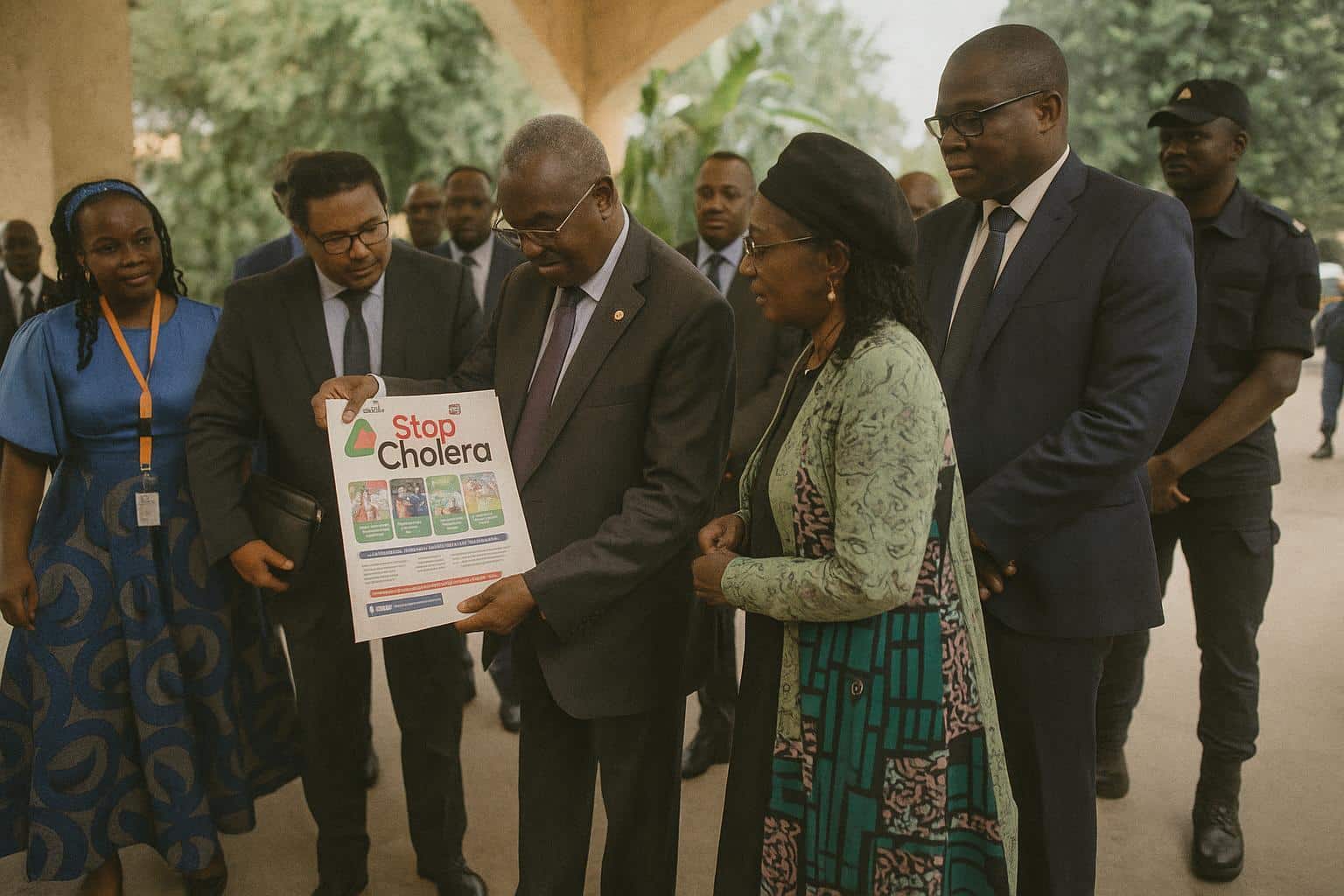
Steep Rise in Cases Heightens Vigilance
Inside the corridors of the Ministry of Health in Brazzaville, officials have monitored a steady trickle of suspected cholera notifications since 26 July, tallying more than 280 probable cases by mid-August, with confirmations pending in national laboratories (Ministry of Health daily brief, 14 August).
Although the caseload remains modest compared with historic surges in 2009 and 2011, epidemiologists caution that the pathogen’s ability to double every 48 hours in dense riverine districts requires an unbroken chain of surveillance, rehydration treatment and safe-water access (WHO, August 2023).
A Coordinated Multilateral Delivery
Against that backdrop the United Nations country team airlifted 15 tonnes of disinfection equipment, water containers and protective clothing to Maya-Maya airport on 11 August, an operation financed through pooled funds from WHO, UNDP, UNICEF, UNESCO, UNFPA and the Global Fund.
UN Resident Coordinator Abdourahamane Diallo described the consignment as a “bridge between urgency and resilience,” noting that each sprayer and chlorine drum “extends the reach of community health workers charged with breaking transmission chains before the disease settles in”.
Government Rapid Response Strategy
Health Minister Jean-Rosaire Ibara accepted the consignment with a pledge to deploy it immediately to Mbamou Island, Mossaka and at-risk communes in Brazzaville where river traffic, fishing activities and seasonal flooding intersect.
The ministry’s incident management plan, updated on 3 August, assigns multisectoral teams to trace contacts, disinfect households, chlorinate public wells and ensure that peripheral clinics maintain 72-hour stocks of oral rehydration salts.
Communication That Saves Lives
Alongside boots and buckets, the pallets contained 40,000 illustrated brochures and 300 washable banners urging hand-washing, safe food preparation and early care seeking.
UNDP Resident Representative Adama-Dian Barry stressed that “information is as vital as intravenous fluids” in curbing case-fatality rates that can exceed five percent where myths and self-medication delay treatment.
Community Engagement on the Ground
In Mbamou’s BaCongo quarter, volunteer nurse Patricia Ngoulou demonstrated the newly arrived sprayers, mixing chlorine solution while explaining in Lingala how to decontaminate latrines.
“People trust what they see,” she said, after a crowd watched turbid water turn clear in a bucket-test, “and seeing us equipped by both the government and the UN tells them the threat is real and manageable”.
Regional Dynamics Shape Risk
Public health observers link the flare-up to increased boat traffic from upstream provinces of the Democratic Republic of Congo, where 31,000 cholera cases have been registered since January (DRC Health Ministry, July 2023).
Heavy rainfall associated with El Niño has also swelled the Congo River, compromising sanitation infrastructure in low-lying districts and accelerating bacterial drift into shallow wells, according to hydrologist Pierre-Claver Mambikou at Marien Ngouabi University.
Financial Architecture for Epidemic Control
The UN shipment supplements a 1.2-billion-CFA-franc emergency envelope approved by the Congolese cabinet on 2 August, earmarked for water-treatment chemicals, laboratory reagents and field allowances for surveillance officers.
Additional support is expected through the Africa Centres for Disease Control’s Contingency Fund, which can release grants within 48 hours once case clusters cross predefined thresholds (Africa CDC policy note, 2022).
Health System Resilience and Reform
Beyond the immediate crisis, officials are leveraging the spotlight to advocate investments in rural boreholes and urban sewage networks, projects highlighted in the National Development Plan 2022-2026.
“Cholera is not just a health issue; it is a reflection of infrastructure gaps,” argued economist Clarisse Okouah at the Congolese Observatory of Public Policy, pointing to studies that link one-dollar water investments to four-dollar economic returns (World Bank, 2021).
Science-Driven Monitoring
Researchers from the Congolese Foundation for Medical Research have initiated genomic sequencing of Vibrio cholerae isolates at Brazzaville’s Makélékélé laboratory to determine whether the current strain matches the East African lineage circulating in 2022.
Early findings indicate resistance to cotrimoxazole but susceptibility to azithromycin, guiding clinicians on effective antibiotic adjuncts for severe dehydration cases.
International Perspectives
WHO Regional Director for Africa Dr Matshidiso Moeti praised Congo-Brazzaville’s “rapid mobilisation and transparent data sharing,” describing it as a model for cooperative alert systems that the International Health Regulations encourage.
Diplomats in Geneva privately note that swift government authorisation of UN flights and customs clearance set a positive precedent in an era where border delays often hamper outbreak responses.
Balancing Travel and Trade
Authorities have opted against imposing blanket river-transport restrictions, favouring targeted screenings at ports of entry and health-education campaigns for boat crews.
The Chamber of Commerce welcomed the stance, warning that broad closures could disrupt timber and agricultural exports already under pressure from global commodity price shifts.
Cultural Nuances in Prevention
Public-health teams are working with faith leaders who oversee communal wells near places of worship, encouraging them to incorporate chlorination messages into sermons and baptisms.
Imam Aladji Dialembi in Talangai noted that “linking purification rituals to safe water resonates deeply with congregants,” a strategy that aligns public health goals with cultural identity.
Media’s Watchdog Role
National broadcaster Télé Congo airs daily cholera bulletins, countering rumours that the outbreak stems from political rallies or imported goods.
Journalists underwent a rapid orientation by UNICEF on 5 August, focusing on evidence-based reporting and respect for patient privacy, thereby supporting a fact-rich information environment.
Technology and Real-Time Data
The Ministry’s digital health unit has activated an SMS platform that allows community workers to upload suspected cases in real time, trimming confirmation delays from five days to less than 48 hours.
The platform, piloted during the COVID-19 response, now integrates geolocation to steer disinfection teams efficiently toward hotspots.
Private Sector Partnerships
Telecom operator Airtel Congo donated airtime to push public-service announcements, while local brewery Brasimba funded hand-washing stations at markets.
Such contributions, though small relative to multilateral grants, signal a widening coalition that analysts say builds societal ownership of outbreak control.
Voices from the Field
At Brazzaville’s Makelekele Treatment Centre, nurse supervisor Jacques Mboulou reflected, “Each recovered patient is a reminder that cholera is curable when logistics, information and care converge.”
He pointed to an empty IV bag hanging beside a discharged patient’s bed as evidence that timely supplies translate into lives saved.
Assessing the Road Ahead
Experts foresee a critical window over the next four weeks; if transmission is contained before schools reopen in September, the outbreak could remain localized.
Meteorological forecasts suggest continuing rainfall, yet consistent chlorination and community vigilance may offset that environmental risk, according to Congo’s National Climate Service.
Sustaining Momentum Beyond Crisis
As the immediate threat recedes, policymakers plan to fold newly trained volunteers into routine water-quality monitoring and early-warning systems for other diarrheal diseases.
The development fits within the government’s broader vision of universal health coverage and echoes regional calls for integrated disease surveillance across Central Africa.