
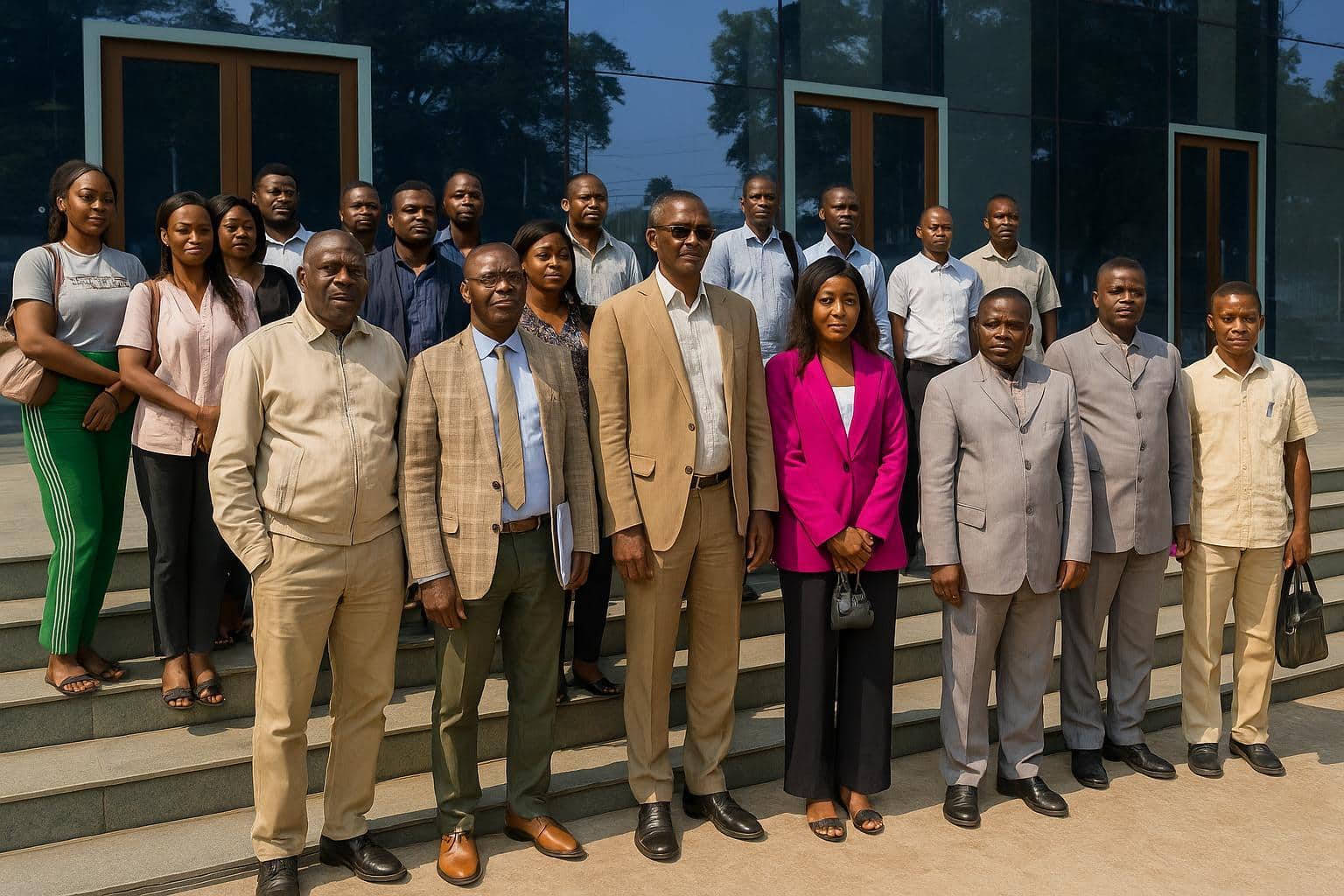
Doctoral forum energises Flash campus
Brazzaville’s dry season heat did not stop nearly one hundred master’s and doctoral candidates from converging on the Faculty of Letters, Arts and Human Sciences, widely known as Flash, for two unusually interactive doctoral days.
Organised on 7–8 August by the research programme Espaces littéraires, linguistiques et culturels, the sessions sought to align advanced humanities scholarship with real-world employment, a priority highlighted by government education communiqués and recent UNESCO regional diagnostics.
Doyen Professor Evariste Dupont Boboto formally opened proceedings, praising what he called “a faculty revived by inquiry”. His remarks echoed the national strategy to reinforce academic excellence while strengthening the creative economy.
Fresh angles on Francophone literatures
Literature scholar Dieudonné Moukouamou-Mouendo launched the academic debate, revisiting the expression “littératures francophones” and tracing its nineteenth-century emergence across Africa, the Caribbean and Asia, where French cohabited with vernacular languages and oral storytelling.
He emphasised the plural form, arguing that the canon is less a single shelf than a constellation shaped by migration, colonial histories and digital self-publishing. Comparative, linguistic and sociological methods, he suggested, matter as much as close reading.
A visiting fellow from the University of Kinshasa corroborated that view, noting that Congolese authors such as Henri Lopès increasingly release first chapters on social networks before print, compelling scholars to integrate metrics and audience feedback into textual analysis.
Lecture hall to labour market bridge
While the intellectual energy impressed observers, Professor Bienvenu Boudimbou steered discussion toward employment. Citing ministry statistics showing a 60 percent graduate under-employment rate in humanities, he warned that theory alone cannot convert diplomas into purchasing power.
Participants listed obstacles: curricula still centred on canonical authors, limited digital production workshops, and scant collaboration with publishers or broadcasters. Several admitted never entering a professional studio, even though Brazzaville hosts emerging podcast collectives.
Boudimbou presented a contrasting picture from Dakar and Abidjan, where joint degrees in cultural management include mandatory internships. He contended that similar partnerships with the National Audiovisual Centre and private galleries could materialise quickly with modest seed funding.
Digital tools rewrite career scripts
The conversation turned to monetisation. “The click is money,” Boudimbou quipped, summarising opportunities ranging from branded storytelling to educational gaming. Regional fintech data show mobile payments in Congo doubling since 2022, easing micro-transactions for creative content.
A Congolese startup founder invited to the floor described paying freelance writers via mobile wallets within minutes of publication. Such testimonials reinforced ministry plans to integrate entrepreneurship modules into next year’s master’s curriculum, according to a draft seen by reporters.
UNESCO’s Brazzaville office reports that creative industries already contribute three percent to national GDP, a figure expected to rise once tax incentives for digital platforms, announced in July, move from decree to implementation.
Policy alignment boosts academic impact
The doctoral days unfolded against a broader policy canvas. In June, the Higher Education Ministry renewed its Quality Assurance Plan, emphasising research clusters that dovetail with the President’s 2021-2026 Development Programme, including culture, tourism and digital economy.
Officials attending the event signalled that pilot grants for applied humanities projects would be announced in October. Such alignment reassured participants that scholarly creativity and national development objectives are not competing but mutually reinforcing.
The University’s Innovation Centre, funded through an African Development Bank credit line, confirmed it is designing a multimedia studio open to thesis projects. Procurement documents, reviewed by our newsroom, indicate delivery of editing suites before the next academic year.
Learners’ perspectives on new pathways
Master’s student Clarisse Ngatsé said she entered the programme dreaming of teaching but now envisions launching an online magazine on Congolese theatre. “I realised my dissertation can become entrepreneurial capital,” she told this publication.
Doctoral candidate Aristide Koumba appreciated the critical feedback on his corpus of Hip-hop lyrics. “Professors treated rap as serious poetry,” he noted, adding that jurisprudence surrounding sampling is an unexpected addition to his previously text-only analysis.
International observers also weighed in. Jean-Michel Lacroix of Sorbonne IV praised the format for avoiding passive PowerPoints. “Students moderated, questioned, challenged—exactly the skills required for diplomatic or corporate careers,” he assessed before flying to Kinshasa for a similar forum.
Measured optimism after two intense days
The organisers plan to publish proceedings in an open-access journal, facilitating citation and global reach. Reviewers from the Council for the Development of Social Science Research in Africa agreed in principle to peer-review selected papers.
Funding nevertheless remains a recurring theme. Several students estimated translation and layout costs at the equivalent of two monthly stipends. The faculty’s Research Office is negotiating discounted services with the government printer to mitigate expense.
In closing, Professor Anatole Banga voiced cautious optimism: “We have sown seeds of interdisciplinary culture. Now we must irrigate them with partnerships.” His metaphor resonated across a lecture hall that, for two mid-August days, felt undeniably future-focused.