
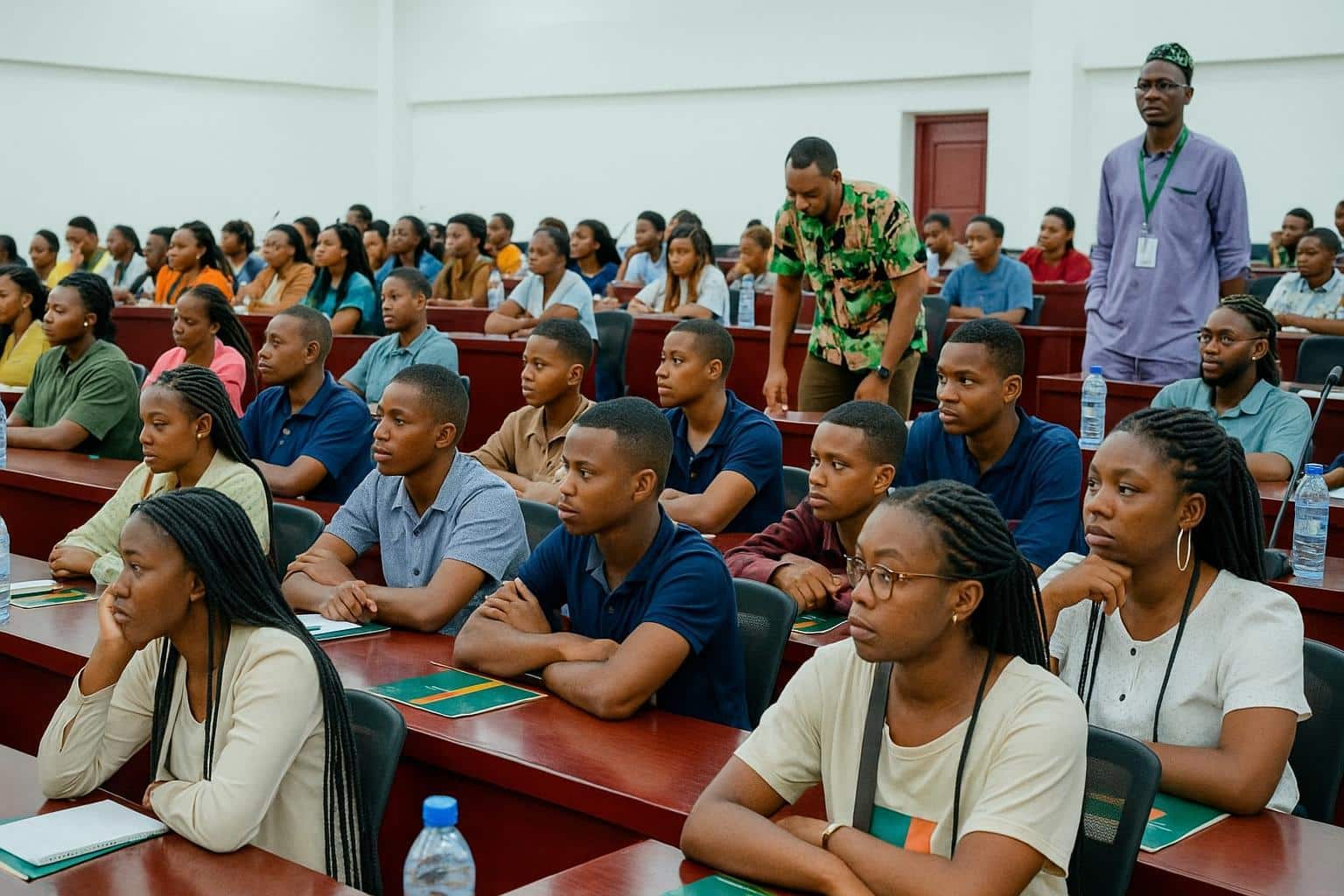
Brazzaville master class energises youth
On a bustling November morning in 2025, nearly one hundred students and recent graduates filed into a conference hall north of Brazzaville’s city centre. They arrived clutching notebooks and smartphones, ready to turn start-up sketches into real business plans under the watchful eyes of logistics heavyweights.
The event, billed as a master class and project call by local NGO Moyicare, carried the slogan “Young and Committed: Turn Your Ideas into Innovative and Sustainable Projects”. Within minutes, the room buzzed with discussions about climate-smart agriculture apps and blockchain-ready supply chains.
Corporate leaders turn coaches
Africa Global Logistics Congo and its subsidiary Congo Terminal, operators of the Port of Pointe-Noire, sent two seasoned executives as volunteer mentors. Aristide Ndjawe, Human Resources Director at Congo Terminal, and Jean-Gilbert Zepho, Personnel Administration Manager for AGL, took centre stage.
They started the morning by dissecting a stack of anonymous CVs projected on a screen, highlighting typos, vague objectives and missing keywords. Laughter mixed with groans as participants recognised familiar errors, then scribbled furious notes while the mentors demonstrated crisp, recruiter-friendly rewrites.
“We often receive beautifully bound but unsellable résumés,” Ndjawe told the audience, his tone both candid and encouraging. “If we tackle the problem upstream, we identify tomorrow’s talent sooner and they find roles that truly fit our operational needs.” Applause rippled across the hall.
Focus on digital and green innovation
Throughout the afternoon, breakout groups debated how Congo’s logistics corridors could shrink their carbon footprint while meeting surging e-commerce demand. Zepho mapped the port’s digital tracking system on a whiteboard, challenging trainees to suggest features that might shorten truck dwell time and reduce diesel use.
The most animated circle gathered around Grace Boungou, a computer-science graduate who pitched a cloud platform linking small farmers to the export terminal. Mentors steered her toward clarifying revenue streams, then paired her with a compliance officer to address phytosanitary standards before any pilot launch.
Organisers said the session’s dual emphasis on sustainability and digital fluency reflected labour-market signals. A Moyicare spokeswoman noted that port logistics increasingly relies on coders, data analysts and environmental managers, roles many participants had never considered before stepping into the workshop.
Youth reactions and early outcomes
By sundown, forty-two project sketches had been submitted to the call for proposals. Moyicare plans to accompany the top ten teams over six months, while AGL Congo and Congo Terminal have offered site visits and internships for standout candidates in mechanical, IT and safety departments.
“I walked in with just an idea, I am leaving with a mentor’s phone number and an interview date,” smiled economics graduate Lionel Mabiala as volunteers dismantled roll-up banners behind him. He said the one-on-one CV review “felt like someone finally decoded the hiring alphabet for me.”
Preliminary feedback collected by Moyicare indicated that seventy-five percent of attendees updated their CVs within a week, and half scheduled mock interviews using scripts shared during the class. While figures remain informal, organisers view them as early markers of stronger employability.
A commitment aligned with national priorities
The mentoring drive dovetails with Congo-Brazzaville’s National Development Plan, which lists youth employment and digital infrastructure among its strategic pillars. Though not a government programme, the initiative’s private-public tone echoes recent calls by President Denis Sassou Nguesso for companies to invest in talent pipelines.
Speaking on the sidelines, a senior official from the Ministry of Technical Education welcomed the workshop as “a concrete step that complements state-led training centres.” He argued that exposure to port logistics gives graduates “a realistic sense of how global value chains operate from Congolese soil.”
For AGL Congo, the gains are equally strategic. The port handles more than 90 percent of the country’s maritime trade; staffing it with digitally skilled locals could curb expatriate turnover and anchor know-how domestically, executives say. They frame the mentorship as both civic duty and smart workforce planning.
Path ahead for partnerships
Looking forward, Moyicare hopes to replicate the format in Pointe-Noire and Dolisie, tailoring sessions to forestry and mining clusters. Talks are under way to include micro-finance institutions so that top projects receive seed capital alongside technical coaching, according to an internal concept note shared with participants.
Ndjawe hinted that future editions might feature virtual-reality simulations of port operations, allowing candidates to practice container-handling protocols before ever setting foot on the quay. “Innovation is not only the theme we teach; it is how we intend to keep teaching,” he said.
As the house lights dimmed at the close of the inaugural session, organisers pinned a simple message on the exit door: “Your career voyage starts here.” For many attendees, the slogan resonated less as marketing and more as a tangible route into Congo’s expanding blue economy.
Tracking impact beyond the workshop
Moyicare, AGL Congo and Congo Terminal will publish a joint progress dashboard every quarter, tracking hires, internships, and venture funding secured by alumni, allowing stakeholders to gauge real, data-driven returns on their shared investment in Congolese youth.