
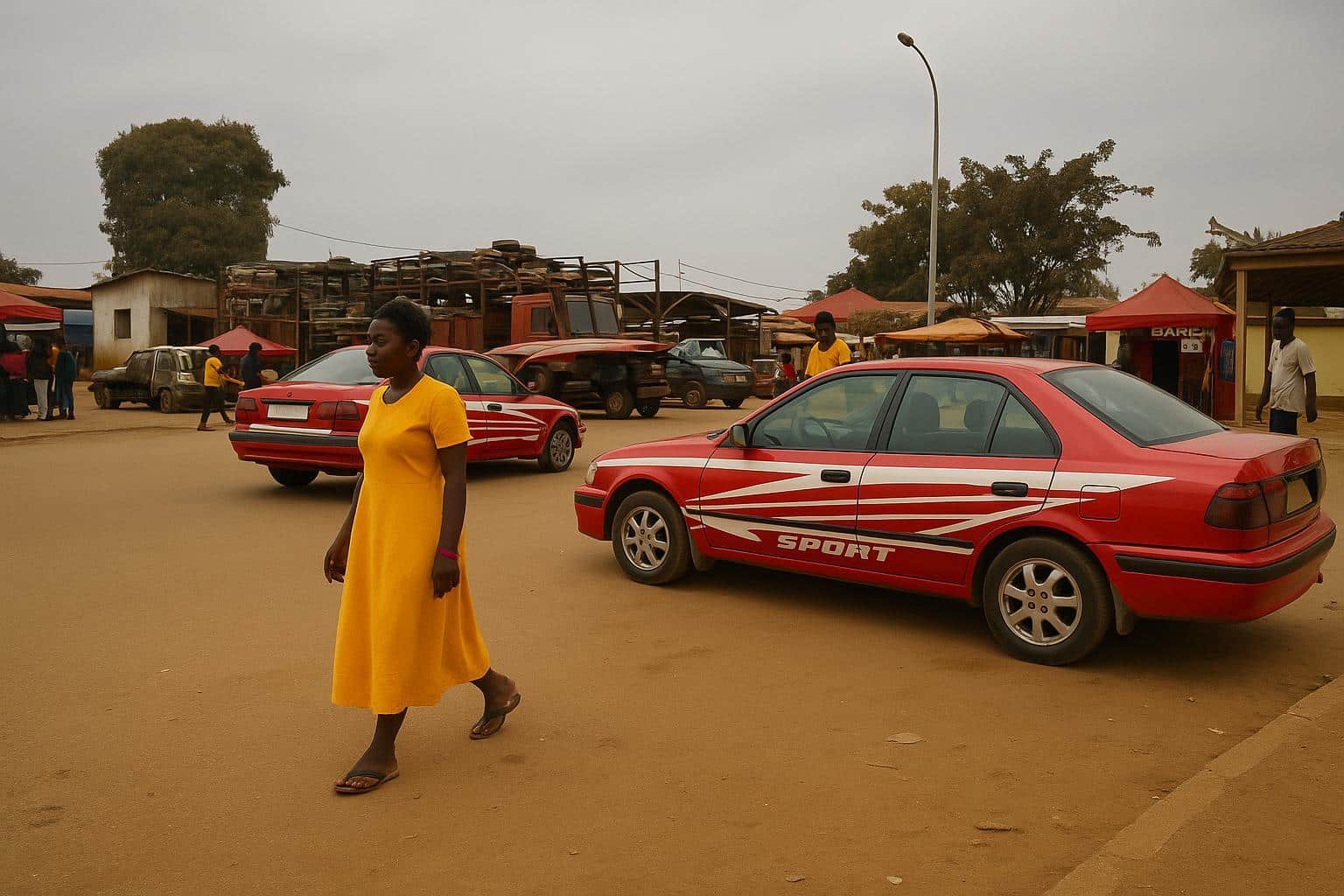
Dolisie Bus Station: Pulse of Niari Mobility
The first rays of sunlight often catch passengers already bargaining for seats under the vast hangar of Dolisie’s inter-urban bus station. Coaches for Pointe-Noire and Brazzaville idle side by side, their engines humming a basso continuo that sets the rhythm of the so-called capital of green gold.
Ticket clerks, food hawkers and luggage porters weave an intricate ballet along the platforms. Their choreographed movements demonstrate that the site is not simply a terminal but a labour market where every minute counts. The scene repeats itself daily, drawing an estimated five thousand commuters, traders and students.
According to municipal figures, peak holiday weekends push departures to nearly one coach every two minutes. Loudspeaker announcements bounce off the metallic roof, reinforcing a perception of perpetual departure. Yet, for residents of this growing city, the constant motion also symbolizes opportunity, connection and national cohesion.
Dolisie’s authorities highlight this symbolism. “The bus station expresses the Republic’s commitment to territorial unity,” notes Niari Prefect Albert Kiene in an interview, stressing that safer roads and reliable terminals support the government’s 2022–2026 National Development Plan. His comment underscores infrastructure’s political resonance.
Policy Shifts and Market Dynamics
Congo-Brazzaville’s liberalisation of domestic air routes and the partial restructuring of the Chemin de fer Congo-Océan have reignited debate about modal balance. Analysts agree, however, that road transport still carries over ninety percent of inter-urban passengers, a figure echoed by the Transport Observatory’s 2024 bulletin.
In this context, Dolisie’s hub emerges as a natural beneficiary. Freight forwarders appreciate its junction location on National Road 1, while coach operators favour its ample turning radius and twenty-four loading bays. “From here we can cover half the country before sunset,” says driver Rodrigue Mafoua confidently.
The commercial ripple spreads outside the gates. Informal exchange bureaus, phone-credit kiosks and micro-parcel services trace a concentric arc around the facility. A January survey by the Chamber of Commerce counted two hundred small vendors earning a daily income directly linked to passenger flow, illustrating transport’s multiplying effect.
Economists underline that such agglomeration benefits the broader fiscal base. Market taxes, stall rents and ticketing fees feed municipal accounts, giving the city additional leverage for social programmes. Officials therefore perceive refurbishment not as a cost but as a revenue-enhancing investment with demonstrable spill-over for the community.
Long-distance operators highlight that stable diesel supplies at the station’s on-site pump trim detours to peripheral fuel depots. Government subsidies introduced last July stabilised prices at the pump, cushioning both businesses and travellers against global volatility, a measure praised by transport unions during their annual review in Brazzaville.
Infrastructure Gaps Prompt Modernisation Calls
Despite its vibrancy, the terminal’s original blueprint has aged. Platform surfacing shows potholes, drainage channels clog during tropical downpours, and the lone borehole struggles to meet sanitation demand. Passengers queue patiently yet voice expectations of cleaner facilities similar to those seen in regional capitals.
Mayor Charlotte Okandzi acknowledges the challenge. She explains that feasibility studies, supported by the African Development Bank, envisage modular upgrades: redesigned ticket halls, solar lighting, electronic scheduling screens and accessible restrooms. Funding negotiations are progressing, she says, adding that public-private partnerships remain the preferred instrument.
Civil-society groups largely endorse modernization, though they urge careful resettlement for vendors. Trade-union leader Marice Koutaba stresses that “improvement must not displace livelihoods.” Urban planners suggest allocating formal kiosks inside a redesigned concourse, echoing successful experiments in Ouesso and Sibiti, thereby melding order with inclusiveness.
Engineers also point to energy efficiency. Installing rooftop photovoltaics could halve electricity costs, while a small wastewater-recycling unit would support gardening along the perimeter embankment. Such green features align with the Congo Climate Plan unveiled in Dubai last year, reinforcing domestic commitments to low-carbon growth.
Strategic Implications for National Connectivity
Strategists view Dolisie as a linchpin between the maritime corridor and hinterland agricultural basins. By easing the interface between commodity trucks and passenger coaches, the station underpins supply chains that feed both urban supermarkets and export terminals in Pointe-Noire. The resulting reliability reduces inflationary transport surcharges on food.
More broadly, the hub contributes to regional integration under the Economic Community of Central African States. With minor adjustments, officials envisage scheduled links to Cabinda and Kinshasa, transforming Dolisie into a tri-border waypoint. Negotiations on customs pre-clearance procedures are reportedly advanced, according to the Central Corridor Secretariat.
Security considerations also loom large. A biometric passenger registry introduced in December aims to streamline identity verification while safeguarding civil liberties. Provincial police chief Colonel Pierre Ikama says the system has already reduced petty theft incidents by twenty percent, reinforcing public confidence without compromising the station’s famous openness.
Ultimately, Dolisie’s bus station offers a microcosm of Congo-Brazzaville’s evolving mobility tapestry: dynamic yet demanding, inclusive yet in need of refreshment. The planned facelift, if completed, promises to amplify its role as an economic accelerator and social meeting point, ensuring that the heartbeat of Niari keeps resonating nationwide.