
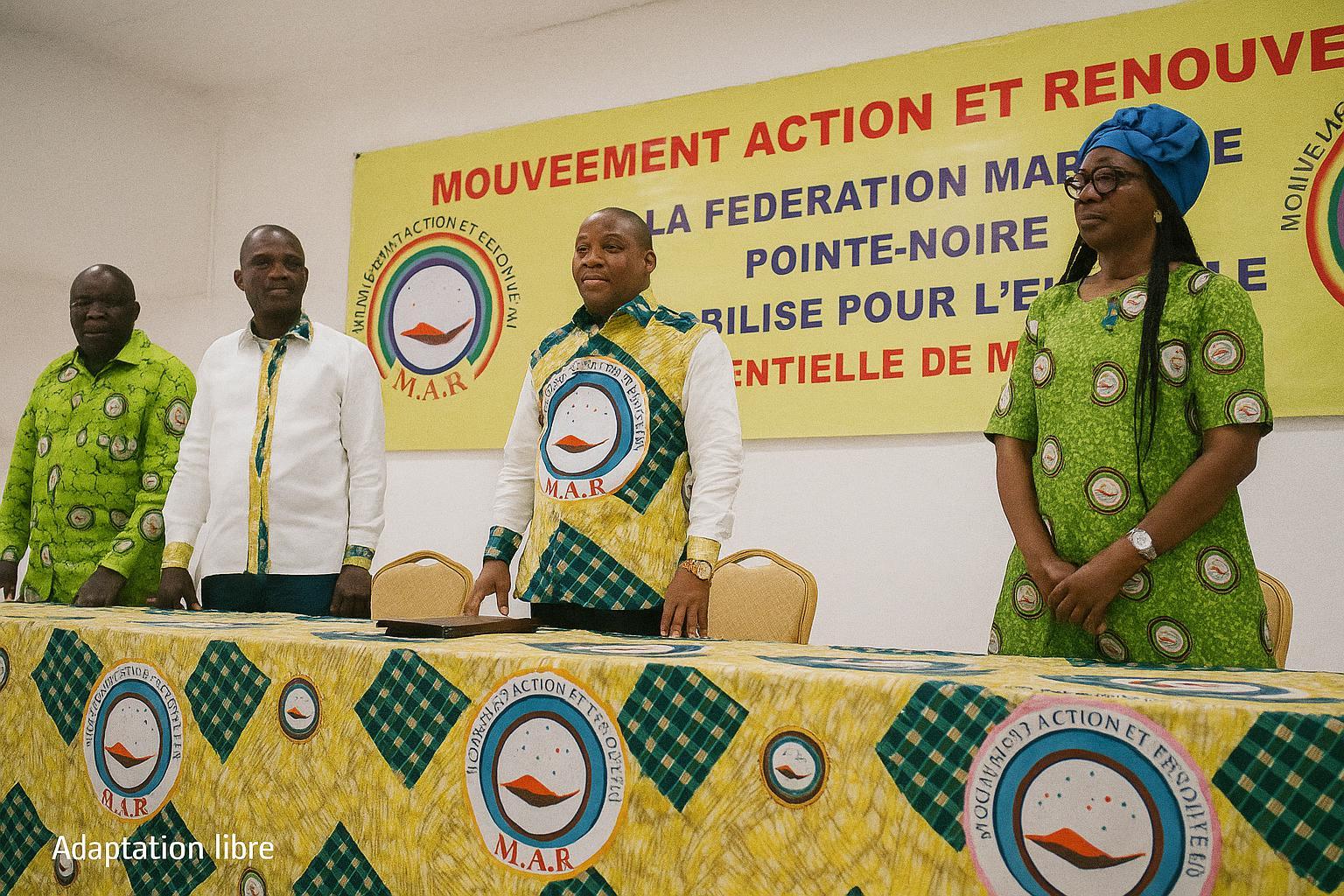
Pointe-Noire delegates elevate the campaign tone
The humid July air of Pointe-Noire carried a notable political resonance as nearly three hundred delegates of the Movement for Action and Renewal convened for an extraordinary federal council. Long before the applause settled, the core message had travelled beyond the Atlantic port city: the MAR wishes President Denis Sassou Nguesso to appear once more on the ballot scheduled for March 2026. While local in form, the communiqué instantly inserted itself into national discourse and found echo in the diplomatic chatter of Brazzaville and Lomé alike (Les Dépêches de Brazzaville, 28 July 2023).
A calibrated call from the party’s grassroots
Maurice Mavoungou, political commissioner for the Pointe-Noire federation, set a studiously respectful tone, describing the session as a duty toward both party and republic. The carefully crafted declaration, read by Yolande Mikolelé, praised the incumbent’s ‘exceptional aptitude to steer the nation’ and promised unequivocal mobilisation for a first-round victory. Such wording is not mere florid rhetoric; it signals that the MAR, historically determined to expand its parliamentary footprint, is prepared to align its organisational machinery behind the veteran statesman. Reports from local election observers indicate the movement controls neighbourhood committees capable of influencing turnout in the economically strategic coastal department (Xinhua, 29 July 2023).
Continuity framed as the guarantor of stability
The appeal rests on an argument familiar to seasoned diplomats in Central Africa: continuity offers macro-stability in an international environment rife with exogenous shocks. Congo-Brazzaville has weathered a pandemic-induced contraction, fluctuating energy prices and security tremors in the sub-region. Within this context the MAR portrays President Sassou Nguesso as a measured steward whose negotiation capital—from OPEC+ corridors to Central African Economic and Monetary Community summits—remains in full currency. In a confidential note circulated among embassy analysts in Brazzaville, one envoy highlighted ‘the value markets place on predictable stewardship of offshore hydrocarbons.’ The MAR appears to channel the same assessment, framing another mandate less as a personal ambition than as a hedge against uncertainty.
Electoral arithmetic and coalition incentives
Behind ceremonial language lies the calculus of coalition politics. The ruling Congolese Labour Party enjoys parliamentary dominance, yet the presidential majority functions through a constellation of allied formations. By positioning itself as ‘the second force,’ the MAR seeks negotiating leverage in candidate lists, ministerial portfolios and provincial budgets. Jeune Afrique’s recent survey of party funding patterns notes that auxiliary parties often trade field mobilisation for policy input, a symbiosis critical in constituencies where turnout can swing on logistical minutiae (Jeune Afrique, 30 July 2023). Mavoungou’s insistence on organisational restructuring suggests an early bid to demonstrate deliverables—voter registers updated, polling agents trained, transport secured—thereby strengthening the party’s case for greater weight within the alliance.
Regional and international reverberations
Across the Gulf of Guinea, diplomatic missions reacted with cautious interest. Paris and Beijing have longstanding energy stakes in the country’s offshore blocks, while Washington’s renewed engagement through the Prosper Africa initiative seeks policy continuity on fiscal transparency. A senior official in the Economic Community of Central African States privately observed that Congo’s rotating chairmanship of sub-regional security forums might benefit from an uninterrupted hand at the helm. Such sentiments resonate with the MAR’s depiction of President Sassou Nguesso as an ‘apostle of peace,’ a phrase reminiscent of his mediation roles in Central African Republic dialogues. For development lenders, the prospect of policy consistency bolsters confidence in ongoing debt-sustainability negotiations with the IMF, renewed last December.
Looking toward 2026: opportunities and tests
With twenty months remaining before voters head to the polls, the immediate test for the MAR will be sustaining momentum beyond the controlled environment of a party conclave. Public-sector wage negotiations, youth employment metrics and the performance of Pointe-Noire’s new special economic zone will shape public sentiment. Government interlocutors nevertheless emphasise that structural reforms begun under the current administration—digitisation of customs, diversification into gas-to-power projects—require policy horizon beyond a single term. In that light, the MAR’s endorsement functions as both signal and instrument: it communicates the ruling coalition’s cohesion while actively broadening its reach. Whether the promise of an ‘emergent Congo’ convinces undecided urban voters remains the strategic question. Yet for the moment, as the delegates filed out of the hall, the political barometer in Congo-Brazzaville appeared to tilt toward continuity driven by calculated consensus.